Course Progress
To record this course toward your Master’s degree, pass the required-reading test. Your certificate follows.
Prepare the Foundation
Why preach, why prepare, and how to choose a text — the seven gateways into a Biblical sermon.
1.1 Why Lay and Bivocational Preaching Matters
Forty percent of people surveyed list fear of public speaking as their greatest dread. We are more afraid of speaking in public than we are of dying. So when God calls a layperson, a Sunday-school teacher, or a bivocational pastor to preach, the response is often Moses' response: "Who am I that I should go?" The fear is real, the sense of inadequacy is honest, and the obstacle of inadequate training is genuine. And yet the call comes anyway, because the church across every generation has needed more preachers than the seminary system can produce. WiseSpeak exists to equip those whom God has called but the system has not reached.
There are four reasons the layperson should accept the call to preach. The first is Biblical. Amos was not a professional. He told the king of Israel plainly, "I was no prophet, neither was I a prophet's son" (Amos 7:14). He kept livestock and tended sycamore trees. God called him out of that ordinary life to speak prophetic words to a nation. Moses had been raised in Pharaoh's court but spent forty years as a shepherd before God appeared in the burning bush. When Moses protested that he was not eloquent, the Lord answered, "Who hath made man's mouth?" (Exodus 4:11). Jesus came into the world as a proclaimer; someone has said that God had only one Son and made Him a preacher. Paul earned his living by making tents and yet planted churches across the Roman world. Philip is the only person in Scripture explicitly called an evangelist (Acts 21:8), and he was a deacon by office; even his daughters preached. The early Christian movement was overwhelmingly a lay movement. Most of its preachers earned their living at a trade and proclaimed the gospel as the second labor of their lives.
The second reason is historical. The Methodist revival in England rested heavily on lay preachers whose names are now forgotten. The Baptists, Congregationalists, and Brethren used them too. North America in its frontier years had few ordained ministers; one of the farmers who plowed his field six days a week would stand up and preach on Sunday. Dwight L. Moody chose to remain a layman though he served full-time in ministry. The work of God advanced because lay people stood up to speak when no professional was available.
The third reason is the priesthood of all believers. In the Old Testament the priesthood was a closed office held by descendants of Aaron. In the New Testament, Peter declares of the whole church: "Ye also, as living stones, are built up a spiritual house, to be a holy priesthood" (1 Peter 2:5). This means that we do not merely have a priesthood — we are a priesthood. The believer's task is to exercise his gifts for the glory of God, and if the gift of speech is among them, the Lord will use that gift in building His church.
The fourth reason is simply that lay preachers can be effective. There are not enough ordained clergy to meet every preaching need today, and there never have been. The Gideons have preached for generations and have done a fine job. Pastors regularly leave their pulpits in the hands of capable lay speakers when they must be away. The work continues because God uses what is offered to Him.
1.2 Why Prepare to Preach
There are groups in the church that advocate preaching without preparation. They believe the preacher need only stand up and rely on the Holy Spirit for inspiration. The lay people who later comment on this kind of preaching almost always describe the same experience: the sermons are long, disorganized, and repeat the same ideas over and over. Five reasons stand against unprepared preaching.
First, God demands it. Paul charged young Timothy: "Give diligence to present thyself approved unto God, a workman that needeth not to be ashamed, handling aright the word of truth" (2 Timothy 2:15). It is an awesome thing to speak for God. We are not prophets in the strict sense; we do not receive direct revelation. We are not apostles; we have not seen the risen Christ with physical eyes. We are stewards of the Bible, and our authority is derivative — it depends entirely upon how faithfully we have studied the text. G. Campbell Morgan closeted himself with his Bible every morning and would let nothing but a genuine emergency interrupt him.
Second, the task itself demands it. Every Sunday millions gather to hear a word from God. In Jeremiah's day, false prophets told King Zedekiah whatever he wanted to hear, while the true prophet sat in prison. When the national crisis came, the king sent for Jeremiah in secret and asked, "Is there any word from the Lord?" That is the question every congregation, in every generation, brings to church on Sunday morning. The preacher has no right to give them anything else.
Third, preparation removes the fear of uncertainty. Much of the dread of speaking comes from the inner whisper, "I have nothing to say." Preparation answers that whisper. The preacher who has studied does not need to wonder whether the next sentence will arrive; he has placed his sentences in order ahead of time. The fear does not disappear entirely, but it becomes manageable.
Fourth, preparation provides direction. Extemporaneous preaching tends to wander. The preacher may set off in one direction in his introduction and end up somewhere quite different. He chases a rabbit and never recovers the scent of his original quarry. An outline gives the sermon a destination and keeps the preacher walking toward it.
Fifth, preparation allows the Holy Spirit to work over an extended period. If the Spirit can give us a word to speak in the moment we stand to preach, He can do even more if we have given Him a week to shape our thoughts. Preparation does not compete with the Spirit's power; it gives the Spirit room to work in us before we work in the pulpit.
1.3 The Sermon as a House
It helps to think of a sermon as a house under construction. The text is the foundation — because it is the Word of God, it provides the stability that holds the whole sermon up. The introduction is the entryway: it leads people into the sermon, and like the entryway of a house, it should be relatively small, because no one is supposed to spend much of his life there. The divisions of the sermon are the support beams; their function is to hold the structure up, not to be admired in themselves. The illustrations are the windows that let light in. The conclusion is the exit. Each part is built with care because no part can be left to chance.
The foundational materials of every unified sermon are six: the text, the idea, the probing question, the keyword, the subject, and the objective. In this unit you learn to use the text. In the units that follow, you will learn to use the others. By the end of Unit 2 you will have all six in hand, and from Unit 3 onward you will use them to construct outlines.
1.4 The Text: Laying the Foundation
The literal meaning of the word text is "to weave." The text is the fabric on which the sermon is fashioned. Since the time of Origen in the third century, Christian preaching has been derived from a text — but having a text does not by itself guarantee that the preacher has submitted his mind to the Bible. H. H. Farmer warned against the danger that a preacher will use "the scripture words merely as a perch on which his own ideas, like a lot of twittering birds, may alight and preen themselves." The theme of the text and the theme of the sermon must be the same.
Some years ago I heard a pastor preach from Psalm 142:4 — David, depressed and despondent, writing from a cave: "no man cared for my soul." The pastor preached on "those who care about lost souls," and went through Father, Son, Spirit, heaven, and hell as those who care. The sermon was Biblical and useful — but it had nothing to do with the text. The pastor needed a different text, because his theme and the theme of Psalm 142 simply did not match. Compare that with an outline I once heard from Isaiah 6:1–8 on "visions in an encounter with God": (1) a vision of God, (2) a vision of inadequacy, (3) a vision of service. There the theme of the text and the theme of the sermon were one and the same.
1.5 Seven Methods of Text Selection
There are seven distinct methods by which a preacher may select a text. Each is legitimate; the choice depends on the occasion, the congregation, and the gift of the preacher.
1. Preach on a whole book. It is possible to preach a single sermon on an entire book of the Bible, especially shorter ones — Genesis, Ruth, Jonah, Job, Esther. When you do, select a summary verse to read as the scripture lesson. Eric Hayden in Preaching Through the Bible gives a one-word summary, a theme, and a central verse for every book. For Ephesians he uses the word church, the verse Ephesians 5:30 ("we are members of his body"), and the theme "the essential character of the church." From this he develops three points: the church as intimate relationship, vital union, and loving possession.
2. Preach on a chapter. Many chapters in the Bible are excellent material for a single sermon: Genesis 3, Psalm 1, Psalm 22, Psalm 23, Psalm 119, Isaiah 53, John 3, John 10, 1 Corinthians 13, Hebrews 11. A sermon from Hebrews 11 might examine "examples of faith." A summary verse may serve as the scripture lesson, instead of reading the whole chapter aloud.
3. Preach on a theme. Much doctrinal preaching is thematic rather than expository — the preacher uses verses gathered from across the Bible to develop a single doctrine. New Testament preaching itself was largely thematic: the kerygma, the Cross, judgment, the love of God. Themes might include grace, the Lordship of Christ, baptism, stewardship, the authority of Scripture, the security of the believer, the fellowship of the church, or the attributes of God (omniscience, omnipotence, omnipresence).
4. Preach on a word. A single word can carry an entire sermon. Words like sin, forgiveness, repentance, judgment, reconciliation, or love each contain enough theological weight to support a full message. The Greek word doulos ("bondservant") is what James calls himself in James 1:1; William Barclay's analysis of doulos develops four implications: absolute obedience, absolute humility, absolute loyalty, and absolute pride. When you do a word study, you do not need to use the Greek or Hebrew form in the pulpit. The congregation has little interest in the original word itself; they care about what the word means and how it lands in their lives.
5. Preach on a miracle or a parable. Someone defined the parable as "an earthly story with a heavenly meaning." The New Testament records as many as seventy parables of Jesus; about a third of His teaching is in parable form. Miracles can be handled like enacted parables — there are spiritual truths within the incident itself. The Sower, the Hidden Treasure, the Pearl of Great Price, the Unmerciful Servant, the Good Samaritan, the Rich Fool, the Prodigal Son — each is a sermon waiting to be preached. So is the healing of the blind man in John 9, or Jesus' calming of the storm in Matthew 8.
6. Preach on a character. People are genuinely interested in the lives of other people. The Bible offers characters in vast variety. Some, like Demas or Enoch, have only a few lines written about them; others, like Abraham or Moses, have many chapters. There are characters who inspire (Barnabas) and characters who warn (Absalom, Judas). There are saints and scoundrels, great loves and great hates. Drawing pastoral lessons from the lives of Biblical personalities is one of the easiest forms of preaching, and one of the most engaging for the congregation.
7. Preach consecutively after doing an analysis. A preaching analysis is the work of moving through a book or section of the Bible in advance, discovering the outlines that the Scripture itself naturally contains. From this analysis you can plan a series of consecutive sermons through the book. The advantage is that you preach the whole counsel of God rather than only your favorite passages, and much of the preparation is done in advance. The disadvantage is that consecutive preaching requires discipline; the preacher must follow the text rather than his own moods. Consecutive analysis will be examined more fully in a later unit.
For each Scripture passage below, identify which of the seven text-selection methods would best fit. Use one of: book, chapter, theme, word, parable/miracle, character, consecutive.
Develop an Idea
Idea, probing question, keyword, subject, objective — the five tools that turn a text into a sermon.
2.1 The Idea
After you have a text, the next foundational material is the idea. The idea is the general topic of the sermon, and it must come from the Scripture itself. Donald Miller laid down a rule that has shaped a generation of preachers: the theme of the text and the theme of the sermon must be the same. If they are not, the text is no longer a text — it is a pretext, a starting point for the preacher's own thoughts. The idea answers the question, "What is the general topic of this text?"
Examples of an idea include: faith, the kingdom of God, hope, law, grieving the Holy Spirit, works, love, fasting, baptism, singleness, growing, family. Each of these is a real Biblical idea — but each is also far too general to preach in one sermon. Try preaching on faith. You could speak about the qualities of faith, the demands of faith, examples of faith, men of faith, or reasons faith is important — and each of these would itself be a full sermon. The idea is the raw quarry stone. It must be cut down before it can be set in a wall.
The tool that cuts the idea down is the probing question. But before you reach for that tool, you have to have the stone. Open your text and ask the simple question: "What is this passage about?" Whatever single noun or phrase comes back is your idea. Resist the temptation to make it clever. The idea should be plain. Cleverness comes later.
2.2 The Probing Question
The probing question is the tool that narrows the idea to a manageable size. The news industry uses these same questions to produce a story. Rudyard Kipling wrote a poem in The Elephant's Child that is the easiest way to remember them:
They taught me all I knew,
Their names are What and Why and When
And How and Where and Who.
For preaching purposes, Kipling's six become eight by adding which and how much. So the eight interrogatives are: who, which, what, why, when, where, how, and how much. The probing question is formed by putting the idea together with one of these interrogatives in a complete sentence question.
Take the idea of hope. Each interrogative produces a different probing question, and each probing question will produce a different sermon:
Who generally points to people. "Who has hope?"
Which points to types or kinds. "Which kinds of hope are valid?"
What points to steps, ways, or qualities. "What are the values of hope?"
Why points to reasons. "Why is hope necessary?"
When points to times. "When do we need hope?"
Where points to places. "Where do we find hope?"
How points to procedures or ways. "How is hope obtained, or lost?"
How much points to quantity. "How much hope do we need?"
Notice that the same idea — hope — has just produced eight different sermons. Each is legitimate. Each is Biblical. Each will require a different sermon outline. The probing question has done the cutting work that the idea alone could not do.
2.3 The Keyword
The keyword arises naturally from the probing question. It is usually a plural noun, and it is the single most important word in your sermon's structure — because the keyword is what unites the outline. Every point of the sermon will be a particular instance of the keyword.
Three rules govern the keyword. First, it is always plural. Almost without exception, your keyword will end in -s. Check yours: if it does not end in -s and is not an irregular plural like "people" or "men," it is probably wrong. Second, only one keyword per sermon. Just as you must use only one interrogative, you must use only one keyword. Third, avoid generic words like "things." "Three things about prayer" is not a keyword; it is laziness. The keyword should be as specific as possible to the actual content of your divisions.
Watch how the keyword arises from each probing question on the idea of faith:
Who are some people of great faith? Keyword = people.
Which are the elements of faith? Keyword = elements.
What are the ingredients of faith? Keyword = ingredients.
What are the effects of faith? Keyword = effects. (Possible outline: seeing the invisible, doing the impossible, believing the incredible.)
Why have faith? Keyword = reasons. (Possible outline: abundant life, eternal life.)
When should we have faith? Keyword = times. (When discouraged, when distracted, when disappointed.)
Where may faith be found? Keyword = places. (Before the throne, in the closet, near the cross.)
How do we show faith? Keyword = ways. (By word, by walk, by witness.)
How much faith do we need? Keyword = amounts. (Enough to cover sorrow, enough to fill our lives, enough to overflow into joy.)
A list of keywords useful in preaching: actions, advantages, affirmations, aims, alternatives, answers, applications, areas, attitudes, attributes, barriers, beliefs, benefits, blessings, changes, comparisons, conditions, contrasts, dangers, demands, duties, elements, examples, expressions, facts, failures, fears, fundamentals, gifts, groups, ideas, ingredients, insights, instances, instruments, joys, justifications, kinds, lessons, losses, methods, needs, occasions, opinions, opportunities, principles, problems, proofs, promises, provisions, questions, qualities, reactions, reasons, results, rewards, rules, secrets, sins, stages, steps, successes, testimonies, tests, topics, trials, truths, types, targets, uses, values, views, warnings, ways, words.
2.4 The Subject
Having a clear subject is what prevents aimless wandering in preaching. I remember walking through the woods with my father as a boy. I would have been hopelessly lost — every tree looked the same — but my father pulled out his compass at intervals. The compass gave him a fixed point of reference; we did not wander. The subject of a sermon is its compass.
The subject is the keyword plus a modifier. A modifier is anything that describes or limits the keyword. Three forms of modifier are common. The first is the adjective: "seven deadly sins" — the words "seven" and "deadly" both modify the keyword "sins." The second is the prepositional phrase: "ways of gaining faith" — the keyword is "ways," and "of gaining faith" is a prepositional phrase that modifies it. The third is the subordinate clause: "qualities that God possesses" — "qualities" is the keyword, and "that God possesses" is a clause that modifies it.
The subject answers the question, "What is the sermon about?" If you ask the probing question, "What are some ways of gaining faith?", the keyword is "ways" and the subject is "ways of gaining faith." Each division of the outline will be one specific way of gaining faith. The congregation, when they take notes, will be able to write the subject at the top of their page and write each numbered point underneath. They will know what the sermon is about, and so will you.
2.5 The Objective
The objective is the goal of the sermon. It answers the question, "What do I want people to do?" The objective should be phrased as an action, not as a belief or attitude — because beliefs and attitudes will follow when actions are right, but actions will not always follow when beliefs and attitudes are merely informed.
A useful formula is to begin the objective with the words "people will…" If your action is salvation, the objective might be: "People will respond during the invitation to receive Christ as Savior." If your subject deals with anger, the objective might be: "People will begin to control their anger during difficult situations." If your subject deals with prayer, the objective might be: "People will set aside a specific time each day for prayer this week." Each of these is concrete, each is measurable, and each gives the conclusion of your sermon a clear destination.
When you have completed the five tools of Unit 2 — idea, probing question, keyword, subject, and objective — you have completed the foundation. From Unit 3 forward you will use these foundational materials to construct outlines.
This is the central exercise of the course. Work through one full keyword sequence — idea, probing question, keyword, subject, objective. Your answers are checked automatically where possible. The "Show Model Answer" button reveals a sample so you can compare.
Step 1 — Choose an Idea
Pick any general Biblical idea (one or two words). Examples: faith, prayer, grace, baptism, family, love, hope, forgiveness.
Step 2 — Form a Probing Question
Combine your idea with one of the eight interrogatives (who, which, what, why, when, where, how, how much) into a complete sentence question.
• Who are some people of great faith?
• Which kinds of faith does the Bible commend?
• What are the effects of faith?
• Why is faith necessary?
• When should we exercise faith?
• Where is faith found?
• How is faith strengthened?
• How much faith do we need?
Step 3 — Identify the Keyword
Extract the keyword from your probing question. It must be plural (almost always ending in -s) and as specific as possible. Avoid generic words like "things."
Step 4 — Form the Subject
Build the subject by adding a modifier to the keyword. Modifier types: adjective ("seven deadly sins"), prepositional phrase ("ways of gaining faith"), or subordinate clause ("qualities that God possesses").
Step 5 — Write the Objective
State the goal of the sermon as an action, not a belief or attitude. Begin with "People will…" Concrete and measurable.
• People will respond during the invitation to receive Christ as Savior.
• People will set aside fifteen minutes each day this week for Scripture and prayer.
• People will speak words of forgiveness to one person who has wronged them.
• People will begin to control their anger during difficult situations.
Construct Your Outline
El bosquejo WiseSpeak de un vistazo — del tema a las divisiones paralelas.
Five marks of a good outline, and the deductive method that produces it.
3.1 How Many Divisions?
Most homiletic writers agree that two to five divisions is the right range for a sermon. Less than two is not enough to develop a theme adequately. More than five becomes too much for the congregation to follow and remember. Three is a classical default, and not without reason. Craig Skinner quotes the limerick that justifies it:
Who lived with three wives at a time;
When they asked, "Why the third?"
He replied, "One's absurd;
And bigamy, sir, is a crime!"
The structure of a sermon deserves more attention than most preachers give it. Some homiletic writers advise: "Don't make the outline obtrusive." I have never been able to imagine an outline that was too noticeable. An old bony cow may not be pretty, but it is still preferable to a cow lying dead in the field with no bones at all. Some of the most effective preachers in history made their outlines visible — they not only stated each point but repeated the whole outline at the start of every new section. The congregation came away knowing exactly what they had heard.
3.2 Five Marks of a Good Outline
A well-built outline shows five characteristics. They function together; weakness in any one of them will weaken the whole sermon.
1. Unity. The whole sermon is about one thing — not three things, not five things, but one. Unity is the most important of the five marks because without it nothing else will hold. The keyword is your main tool for unity; every division must be a particular instance of the keyword. Consider this poor outline: (I) All Christians need to pray; (II) The Psalms lead us to praise God's holy name; (III) Some other remarks about prayer. Three points, all about prayer in some way, but disjointed — there is no real subject. The outline could be repaired by selecting a clear subject like "necessities in prayer," and arranging the points beneath it: (I) the need to request, (II) the need to praise, (III) the need to confess.
2. Order. Order is the relationship of the parts to each other and to the whole. Each division should be distinct from the others, and none should be equal to the subject. Take 2 Corinthians 13:14: "The grace of the Lord Jesus Christ, and the love of God, and the communion of the Holy Spirit, be with you all." A subject like "the blessings we receive from God" will produce a flawed outline because the second division ("the love of God") repeats the word God already in the subject. A better subject is "the blessings we receive from the Trinity," which yields a polished outline: (I) the grace of the Son, (II) the love of the Father, (III) the fellowship of the Spirit.
3. Movement. The outline goes somewhere. There is a clear starting point and an identifiable destination. Edgar Jackson observed: "Contrary to generally accepted practice, it is psychologically sound to make your strongest point first." Lost attention is hard to regain. At the same time, it is wise to put the most evangelistic point last, because the sermon will move into the invitation from there, and an evangelistic peak makes the transition natural. A useful pattern is: (I) a strong point to gain attention, (II) a sustaining point that keeps attention, (III) the most evangelistic point, leading into the invitation.
4. Proportion. The divisions are roughly equal in length and weight. The temptation is to lavish ninety percent of the sermon on the first point and rush through the others — the tail wagging the dog. If a point is important enough to make, it deserves to be developed. If it cannot be developed, perhaps it should not be a separate point at all.
5. Parallelism. The divisions match each other in grammatical structure. If the first division is a phrase, all the others should be phrases — not sentences or single words. Verbs should be active rather than passive where possible. Take a flawed outline from Matthew 14:14–21 on "Ways Jesus demonstrates His compassion": (I) Jesus healed their sick, (II) They were shown love by Him, (III) They were fed by Him. Two of the three are passive. Recast in active and parallel form: (I) He healed them, (II) He loved them, (III) He fed them. The three lines now sound like three lines, and the congregation will remember them.
Do not force alliteration onto a text it will not bear. Many a fine outline has been ruined by a preacher who insisted that every point begin with the same letter and ended up bending the meaning of the text to do it. Parallelism in grammar is helpful; alliteration is sometimes helpful but never required.
3.3 The Deductive Method
There are two principal ways of building a sermon outline: deduction and induction. This unit covers deduction; Unit 4 will cover induction. Deduction is reasoning from the general to the specific. You begin with a general statement — for example, "God is great" — and then point out specific ways that statement is true: (I) great in His knowledge, (II) great in His power, (III) great in His presence. The general is broken down into the specific.
In preaching, deduction works like this: after discovering the idea contained in your text and forming a subject, you state the subject as a general truth and then list specific instances of it. Each point is a subdivision of the larger subject. Topical preaching is almost always deductive, but expository preaching often uses deduction as well — the preacher takes a verse, identifies its main affirmation, and then walks through the specific ways it is true.
I once preached a message called "Christ Across Canada" using Luke 19:39–40, where Jesus told the crowds that if His followers were silent, the very stones would cry out. My idea was that nature itself declares the name of Christ. My subject was "reminders of the name of Christ throughout Canada." Using deduction, the four points became:
(I) He is the Living Water at Niagara (John 4:10).
(II) He is the Bread of Life through the plains (John 6:35).
(III) He is the Solid Rock on the mountains (1 Corinthians 10:4).
(IV) He is the True Vine in the Okanagan Valley (John 15:5).
Notice that every point has a Scripture reference. This is the rule for deductive preaching: every point must be supported by a verse. If you cannot find a verse to support a point, you should not preach the point. The preacher's authority is the Word of God, and the moment he begins making points the Bible does not make, he has stepped outside that authority.
3.4 The Topical Sermon
A topical sermon takes its idea from a text but draws its supporting material from across the Bible. Many doctrinal sermons are topical because doctrine is rarely confined to a single passage. Many of the sermons Jesus preached were topical in form. The topical sermon can be just as Biblical as the expository — provided that every point is anchored in a verse.
A Good Friday sermon I have preached more than once is "The Seven Words of the Cross." Its idea is the Cross; its keyword is "words"; its subject is "the seven words of the Cross." The outline runs:
(I) A word of pardon (Luke 23:34) — "Father, forgive them, for they know not what they do."
(II) A word of promise (Luke 23:39–43) — "Today shalt thou be with me in Paradise."
(III) A word of provision (John 19:26–27) — "Behold thy son… behold thy mother."
(IV) A word of pain (John 19:28–29) — "I thirst."
(V) A word of dereliction (Matthew 27:46) — "My God, my God, why hast thou forsaken me?"
(VI) A word of triumph (John 19:30) — "It is finished."
(VII) A word of commitment (Luke 23:46) — "Father, into thy hands I commend my spirit."
Seven points violates the normal rule of three to five, and indeed when I preach this sermon I do not use subpoints. As a general principle, when a sermon has more than three points, drop the subpoints. The congregation cannot hold both a long outline and a layered one in their heads at the same time.
Build a deductive outline of three points. The check will verify your point count, scan for parallel grammatical structure, and look for active rather than passive verbs.
Subject & Three Divisions
Choose any subject (or use one from your Unit 2 practice). Write three parallel points. Aim for active voice and matching grammatical form across all three lines.
I. He healed them
II. He loved them
III. He fed them
Notice: all three points start with the same subject ("He"), use the same verb tense (past), and use active voice. That is parallelism.
Build Outlines Inductively
The Jeopardy approach to preaching — the answer is given in the text, and your job is to discover the question. Induction, the textual sermon, and the expository sermon.
4.1 Why Two Days on Induction
In my experience, students have had more difficulty grasping the inductive method of sermon outlining than any other part of this course. For that reason I am giving you two days to work on induction and two days to work on the textual method. Read the material on the first day and complete one outline. On day two, reread the material and complete any additional outlines called for in the activity. Repeat the same procedure for days three and four. Take it slowly. The technique looks simple once you have it, but it is built upside-down from what most beginning preachers expect, and that takes some getting used to.
4.2 D. Induction
Another way of forming an outline is through induction. Induction is a type of reasoning which begins with the specific and moves to the general — the opposite approach to deduction. It is possible to observe the mountains, the stars, and the seas, and then conclude that there must be an awesome God who created them. One looks at specific examples and forms a general conclusion. In preaching, you begin with the points found in a text and work backward to form a subject. This is used for producing both textual and expository sermons. The process is something like the Jeopardy television program: the answer is given within the text, and you must discover the question. Begin with the parallel statements you can see in the passage, list them, and only then ask, "What single subject ties these together? What question are these statements answering?" An example may be taken from John 1:1 and 14.
1:1 — "In the beginning was the Word, and the Word was with God, and the Word was God."
1:14 — "And the Word became flesh and dwelt among us, and we beheld His glory, the glory as of the only begotten of the Father, full of grace and truth."
Notice that the central idea relates to the Word. Several parallel statements may be arranged into a simple outline:
1. The Word was in the beginning (v. 1)
2. The Word was with God (v. 1)
3. The Word was God (v. 1)
4. The Word became flesh (v. 14)
After writing these down, work backwards to discover the idea, the probing question, the keyword and the subject. These statements are so familiar I will not try to make them more parallel — this is an exception to the parallelism rule. Notice that division four uses "became" instead of "was," and that two and three use "God." Normally it is best not to repeat a word in two divisions but not all of them.
Idea = Word
Keyword = Facts (or truths, teachings, statements)
Subject = Facts (keyword) about the Word (modifier)
P.Q. = What are some facts about the Word?
The outline itself looks very similar to a topical outline. The only difference is that each point comes from the text and not from supporting texts. Because the divisions have come directly from the text, it is not necessary to use supporting Scriptures as with the topical outline.
Now try it yourself. Read Psalm 103:1–5. The Psalmist is praising God for His goodness; you can find at least five separate reasons in those verses. List the ones you can identify, then take them and discover the idea, the probing question, the keyword, and the subject. Then do the same with 1 Peter 2:9 — Peter strings together several parallel descriptions of God's people; find four of them and work backward to a subject. Below is a sample of how those outlines might come out; yours may be quite different and equally valid.
Idea = Blessing
Keyword = Reasons
Subject = Reasons to count our blessings
P.Q. = What are the reasons to count our blessings?
Classification = Textual
Outline:
I. Because God forgives us (v. 3a)
II. Because God heals us (v. 3b)
III. Because God saves us (v. 4a)
IV. Because God crowns us (v. 4b)
V. Because God satisfies us (v. 5)
Sample 2 — 1 Peter 2:9
Idea = Elect
Keyword = Descriptions
Subject = Descriptions of God's Elect
P.Q. = What are the descriptions of God's elect?
Classification = Textual
Outline:
I. A Chosen Community
II. A Royal Priesthood
III. A Holy Nation
IV. A Peculiar People
4.3 E. Textual Sermon
When the main divisions of a sermon come from the text, as in the examples above, the sermon is called a textual sermon. The points come from the text, but the explanation of a textual sermon comes from the preacher. This is the simplest form of induction in preaching, and often the points are found in a single verse or two. Usually with a textual sermon, there is not enough information within the text to explain the point completely. In this case the preacher will explain the point from his general Biblical understanding. The text supplies the skeleton; the preacher supplies the flesh.
Verse 4: "Coming to Him as to a living stone, rejected indeed by men, but chosen by God and precious,"
Verse 5: "you also, as living stones, are being built up a spiritual house, a holy priesthood, to offer up spiritual sacrifices acceptable to God through Jesus Christ."
Verse 6: "Therefore it is also contained in the Scripture, 'Behold, I lay in Zion a chief cornerstone, elect, precious, and he who believes on Him will by no means be put to shame.'"
Text = 1 Peter 2:4–6
Keyword = Qualities
Subject = Qualities of Living Stones
P.Q. = What are some qualities of living stones?
Classification = Textual
Outline:
1. Living stones are divinely chosen (v. 4)
2. Living stones are divinely composed (v. 4)
3. Living stones are divinely capped (v. 6)
Notice the alliteration: chosen / composed / capped. That isn't required, but when it comes naturally it helps the hearer remember.
Now take some of the selected texts below and form inductive outlines of your own. Begin by discovering the point(s) and writing them out. From those, try to discover the question being answered by the Biblical writer. Then derive keywords, subjects, and the probing question. The outlines may have between two and four points each. I have provided two more examples to get your eye in.
"For everything in the world — the lust of the flesh, the lust of the eyes, and the pride of life — comes not from the Father but from the world."
Idea = The World
P.Q. = What are some enticements of the world?
Keyword = Enticements
Subject = Enticements of the world
Outline:
1. The lust of the flesh
2. The lust of the eyes
3. The pride of life
Example B — John 16:8
"When he comes, he will convict the world of guilt in regard to sin and righteousness and judgment."
Idea = Holy Spirit
P.Q. = What are some convictions brought about by the Holy Spirit?
Keyword = Convictions
Subject = Convictions of the Holy Spirit
Outline:
1. He convicts of sin
2. He convicts of righteousness
3. He convicts of judgment
Practice texts to try yourself: Psalms 1:1; Acts 2:42; James 1:19; 1 Peter 2:17; 1 Peter 3:12.
4.4 F. Expository Sermon
In the expository sermon, both the divisions and the explanations for them come from the text. Whereas only the divisions come from the text with a textual sermon, both the divisions and the subdivisions usually come from the text with an expository sermon. An expository sermon often makes use of more verses than a textual sermon. The greatest difference, however, is the treatment. An expository sermon seeks to explain the meaning of the passage studied more fully than the textual sermon. Structurally the expository sermon is most related to the text. The preacher is the messenger; the text is the message.
P.Q. = What are the activities of the Shepherd?
Keyword = Activities
Subject = The Shepherd's Activities
I. The Shepherd's Provision
A. For our requirements — I shall not want
B. For our rest — Makes me to lie down
C. For our refreshment — Beside still waters
D. For our restoration — Restores my soul
II. The Shepherd's Protection
A. With his plan — Leadeth me in paths
B. With his presence — With me through the valley
C. With his power — Rod and staff
III. The Shepherd's Preparation
A. Of a harvest — In enemies' presence
B. Of a healing — Anointing with oil
C. Of a happiness — Goodness and mercy
D. Of a home — Dwell in the house
Notice that not only the main divisions but also the subdivisions are drawn from the text itself. The threefold P pattern (Provision / Protection / Preparation) emerges from the passage and is reinforced at the subdivision level. This is what makes it expository rather than merely textual.
Activity: try forming an expository outline from Psalm 1:1–6. The Psalm contrasts two ways of life. Look at it carefully and let the text itself give you the divisions. Below is one possible expository outline drawn from the Psalm — yours may be quite different but equally valid.
P.Q. = What are the two primary ways of life?
Keyword = Ways
Subject = Two Ways of Life
I. The Righteous Way
A. Blessed for Following God's Wisdom
i. Does not walk
ii. Does not stand
iii. Does not sit
B. Blessed for Knowing God's Word
C. Blessed for Doing God's Work
i. Planted
ii. Growing
iii. Fruitbearing
II. The Wicked Way
A. He will not endure the sifting
B. He will not stand the judgment
C. He will not be in the congregation
D. He will not survive the condemnation
4.5 Putting Induction, Textual, and Expository Together
Induction is the reasoning style: start with specifics in the text, conclude to a general subject. The textual sermon is the simplest application: divisions come from the text, but the preacher supplies the explanation from broader Biblical knowledge. The expository sermon is the fullest application: divisions and subdivisions both come from the text, and the explanation closely tracks the passage. All three sit on the same foundation — the conviction that the text drives the sermon, not the other way around. Topical preaching reasons from a subject down to texts; inductive preaching reasons from texts up to a subject. Both are legitimate, but inductive preaching gives the Bible the first word and the last word in the message.
Amplify the Outline
EAI — explanation, application, illustration — plus four alternative methods for developing each division.
5.1 The EAI Method
One of the simplest ways of developing the sermon after completing the outline is to use explanation, application, and illustration for each division. For purposes of this course we will call this the EAI Method. The order of these three elements may vary — you may start with illustration, proceed with application, and conclude with explanation. The same procedure is used for every point until the sermon is finished. Each of the three parts would normally receive the same attention, although they may not be exactly the same length. Repeat the procedure for topical, textual, or expository messages.
5.2 Explanation
Explanation means "to bring out the meaning, to make plain, to make clear." This may take several different forms. (1) Explaining the meaning of the text — the interpreter asks, "What exactly was the Biblical writer saying to his hearers?" Here one seeks to draw out and explain the meaning of the text. (2) Narration — one gives the bare account of an event. You might tell the story of a Biblical character such as Daniel or Abraham. (3) Description — you describe how something appears to the five senses. You are painting a picture with words.
5.3 Application — Master of All
Application is the master of all whereas the illustration is the servant of all. Charles H. Spurgeon said that application is where the sermon actually begins. It seeks to relate Biblical truth to people's lives. Otherwise it is just an historical Bible study. While there may be some value in such a study, it will not have much of an impact upon people's lives. Harry Emerson Fosdick said that people are not interested in what God said to the Jebusites. They are interested in what God is saying to them today through the story of the Jebusites.
Research suggests that unless the application is made by the speaker, it will not be made by the hearers. Application should be very personal — use "we" in speaking and answer "What should we do?" It should be in the present tense and should answer "What should we do right now?" It should be dynamic and changing — the truths of Scripture do not change, but applications of these truths do change with the times. It should suggest ways and means — "How are we to put this into practice today?"
(1) Then — what the text said to its original hearers.
(2) Universal — the timeless principle that transcends culture.
(3) Now — the specific application for today.
Example:
#1 Then. Jesus calmed the storm on the Sea of Galilee, and the storm in the lives of the disciples (Matthew 8:24-27).
#2 Universal. Jesus has the power to calm outer and inner storms that rage in people's lives.
#3 Now. Jesus calms outer and inner storms today such as loneliness, sickness, fear, and anxiety.
5.4 Illustration — Servant of All
No book is completely adequate for producing illustrations. The word "illustrate" means to throw light upon. A human interest story makes the sermon come alive. Try for at least one good illustration per division — every point you make should be illustrated. I usually also use one in the introduction and one in the conclusion. Many students and pastors report that the finding of good illustrations is the most difficult task they face.
Six sources of illustrations: (1) The Bible itself — biographies, parables, figures, or historical events. When you do this, the congregation may not know you are illustrating; you have the advantage of teaching the Bible at the same time. (2) Observation — keep a notebook of observations from nature, science, psychology, and people. Be discreet about using examples of church members or family. (3) Newspapers, newscasts, and news magazines — current events make Scripture feel immediate. (4) General reading and viewing — history, literature, films, novels. (5) Pastoral work — visits often produce illustrations; sometimes ask permission to share a story. (6) Personal experience — a form of testimony where you tell about something that happened to you.
5.5 Additional Subdivision Methodologies
Apart from EAI there are several other methods for forming subpoints. With any of these the subpoints should appear in the preacher's notes but should very rarely be stated while delivering the sermon. Because preaching is an oral art form, too many subpoints are confusing rather than enlightening.
1. The keyword method. A keyword is used in forming the subdivisions the same way a keyword links the main divisions. Each division could actually be a second sermon. Job 1:1 and Job 21:7 yield two great questions: "Why do the good suffer?" (subdivisions named with keyword positive results: Job learned of his pride, of patience, of God's providence) and "Why do the wicked prosper?" (subdivisions named with keyword reasons: things are not always as they appear; God's patience and mercy; one day God will make all things right).
2. The series of statements method. No attempt is made to discover a keyword for the subdivisions. The statements are rapid-fire concepts designed to provoke thought and stimulate word pictures. Mark 5:25-34, "He Touched Me" — Subject = Areas Jesus made the woman whole. Under "Christ made her physically whole" you might list: She had a foolish faith / She had an ignorant faith / She had a genuine faith. The healing was free; it was immediate.
3. The combination method. Combine several methods, using one for one division and another for the next. The explanation method might be used for one point and the series of statements or keyword method for others.
4. EAI revisited. Return to EAI when the unit's content calls for substantial development on a single point — explanation drawn from the text, application drawn from the universal-to-now bridge, illustration drawn from any of the six sources above.
Beautify and Refine
Beauty, simplicity, the title, transitions, introduction, conclusion, and the preaching analysis tool.
6.1 A Touch of Beauty
Outlines seem to be stronger, and are remembered more easily, when each point is five or fewer words in length. Another important ingredient of beauty is parallelism. With parallelism you try to extend the exact wording of each division for as long as possible. In most instances parallelism helps the hearers to remember the message, and it produces a nicer outline. This may or may not involve alliteration, the repetition of a sound.
A message is usually stronger if it is in the active voice instead of the passive voice. Voice is a grammatical term used to tell whether the subject of the sentence is acting or receiving the action expressed by the verb. "John the Baptist proclaimed the arrival of Christ" (active) is stronger than "The arrival of Christ was preached by John the Baptist" (passive). Sometimes you may begin with a rough outline in which two of the points are active and one is passive; it may be possible to change the voice of the passive point without changing the meaning. Sometimes the divisions may be reworded so that a nicer outline is developed while retaining the essential integrity of the text.
Rough draft:
1. It covered their shame
2. They are given privilege
3. Their position is restored
Revised: (alliterate with "p"; active voice throughout; present tense; verbs alliterate with "g")
1. It Grants Pardon.
2. It Gives Privilege.
3. It Gains Position.
6.2 The Beauty of Simplicity
For us to use words like justification, spiritual, faith, repentance, righteous, calling, fellowship, conversion, holiness, ordain, sanctification, glorification, propitiation, or redemption is often to miss the mark. Most people in the pew will not understand what we are talking about. Even simpler words like church, letter, faith, or grace will often not communicate. If we are trying to attract people with little or no church background, we must be understandable. It is important therefore to explain in simple terms what we want to say. Jesus managed to communicate important theological concepts with the use of parables.
6.3 The Finishing Touches — Title, Transition, Introduction
A sermon is composed of three primary parts: the introduction, the body, and the conclusion. We have been working primarily on the body up to this point. Now we will insert the finishing touches.
Title. The title is the name you give to the sermon — what it is called. The primary purpose for having a title is for advertising the sermon. You are trying to catch the listener's attention. Some pastors post the sermon title on the church sign; others place the title in the bulletin. The title may sometimes be the same as the subject, but this is not always true. Many effective titles relate to human needs: "How to Raise Your Kids," "How to Have a Happy Home," "How to Cope with Stress," "How to Manage Your Money."
Transition. The transition is a moving from one section of the sermon to another. You need a transition from the introduction into the body, between the divisions, and in moving from the divisions to the conclusion. The major transition is going from the introduction to the body. This transition should include the subject and may be stated, "Let us examine (transition) some answers as to who Christ is (statement of the subject)."
Introduction. An introduction leads into the sermon and should comprise five to twenty percent of a sermon. The introduction seeks to gain attention, to let the people know why the sermon is important, to give the purpose of the sermon, and to establish rapport with the audience. I nearly always prepare the introduction after completing everything else. I like to know what I am introducing before putting it down. Two primary types: textual introduction (discusses geography, history, archaeology, setting and customs surrounding the text) and subject introduction (introduces the topic itself in a unique and interesting way — often by free association from a personal memory or current event).
6.4 The Conclusion
The conclusion leads out of the sermon. It should include the objective — a practical way to implement what you have said. The conclusion is not a place to introduce new material. You may restate your major ideas or draw conclusions from the points. I usually go directly from the final division into the invitation without a sharp break. Four methods:
1. The Illustration or Story Conclusion. A powerful, moving illustration right before the final appeal softens hearts and allows the Holy Spirit to speak without restraint. Roy Fish recounts Robert Ingersoll, the noted infidel, repeatedly daring his audiences to stand if any still claimed Christ — until two teenage girls rose in a midwestern theater and walked the aisle singing "Stand Up, Stand Up for Jesus," joined by almost the entire audience.
2. The Summary Conclusion. A restatement and recapitulation of the main ideas. New ideas should not be introduced. One exception: an appeal drawn directly from the text — Jesus' "Go and do likewise" at the end of the Good Samaritan (Luke 10:37, NKJV).
3. The Inference Conclusion. After stating the main ideas, draw out inferences from them. From a subject "reasons for believing in the Resurrection" — empty tomb, disciples' boldness, verified appearances — infer: "Therefore we may conclude that we serve a Lord who is alive today."
4. The Prayer Conclusion. Some pastors make an appeal and then conclude with a prayer before the invitation. Effective when done well, but runs the risk of breaking the continuity of the appeal.
6.5 The Preaching Analysis
Now that you understand the mechanics of constructing a sermon, here is one final tool: the preaching analysis. This tool will help you examine the Bible book by book and find sermonic subjects. If you do a preaching analysis of the books of the Bible, you will have enough possible sermon topics and outlines to last your complete ministry — though such an analysis of the whole Bible could very well take most of your years of ministry.
A preaching analysis involves going through the text and using induction to find the probing question and an outline. It is much different from a chapter or passage outline; it begins with the discovery of common concepts within the text. The concepts may cover from one to several verses. After identifying these concepts, you use an inductive approach to discover the probing question. Often the probing question will contain the subject of the passage. Sometimes there will be a probing question within a larger probing question. Beside the probing question and concepts, you may want to write the verses. After completing the analysis, you may go back and begin to form outlines. Not all the analysis outlines are suitable for preaching outlines, but they can help in formulating them. Many pastors find an analysis especially helpful when preaching consecutive sermons through a book.
Preaching from the Inside Out
Thorough study and a full manuscript, then internalization, a simple keyword note, and natural delivery. The method is not "prepare less." It is to prepare until the sermon belongs to the preacher.
7.1 The Purpose of This Unit
This unit examines an actual preaching practice: thorough study and manuscript development, followed by internalization, a simple keyword-based retrieval note, and extemporaneous delivery. It bridges the work of building a sermon, which the earlier units taught, and the work of delivering one, which the next unit takes up.
- Study
- Develop
- Internalize
- Reduce to cues
- Preach naturally
The keyword does not contain the sermon. It unlocks the sermon.
7.2 Case Study: Galatians 4:4 — God's Perfect Plan
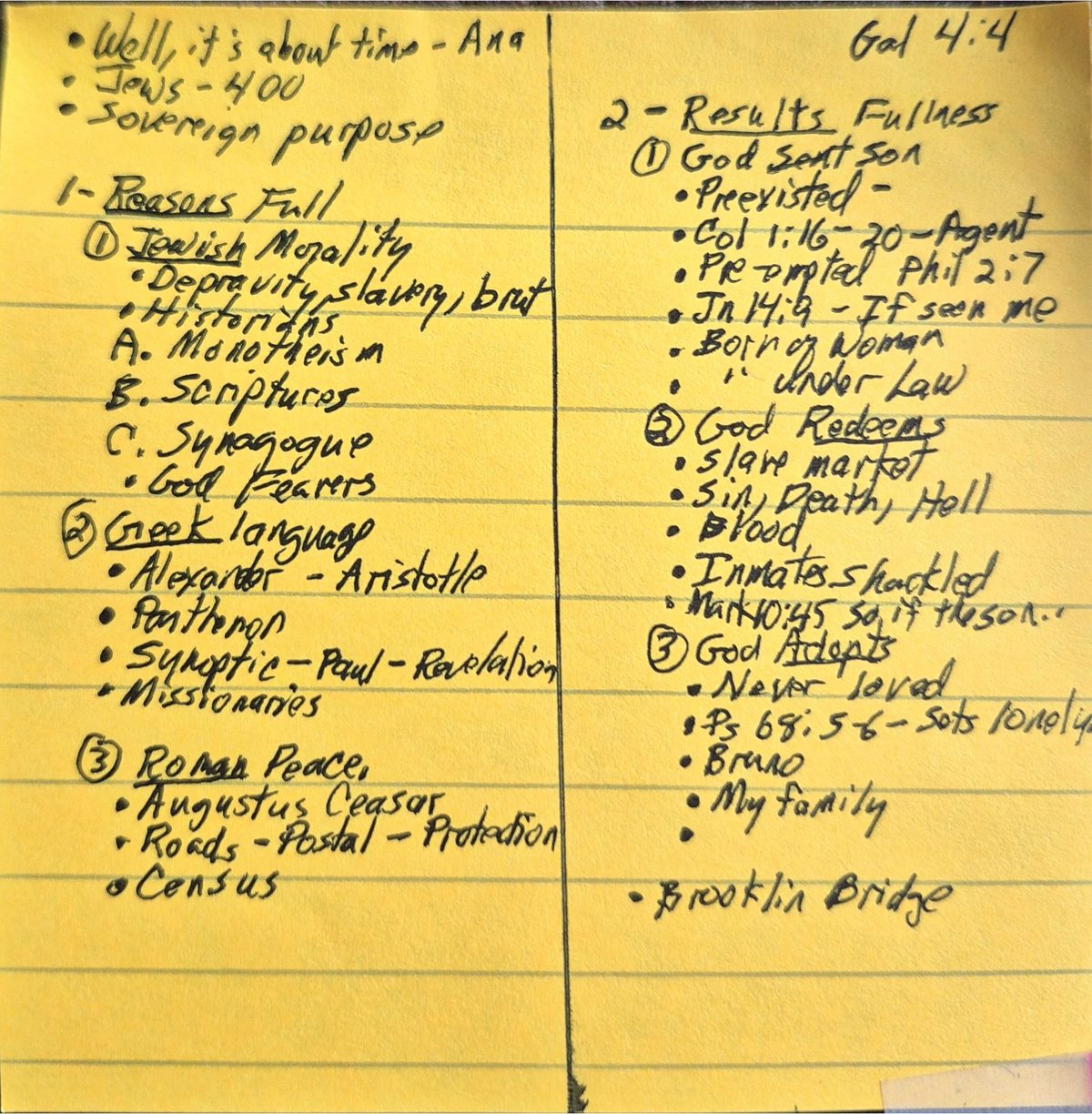
The surviving materials preserve different stages of one sermon's development. The handwritten Galatians 4:4 note below is an earlier retrieval form. The surviving Word manuscript, reproduced later in this unit, developed the same material into a First Advent / Second Advent structure. They are related materials, not an exact note-and-manuscript pair from the same revision, so do not read the note as a copy of that final manuscript.
The manuscript develops Jewish morality, Alexander and Greek culture and language, the Septuagint, Roman peace, roads, safety, and postal communication at length. The small note reduces those large blocks of prepared thought to a handful of cues.
7.3 The Simplicity of the Keyword Model
A keyword is not a miniature sermon. It is a personal retrieval signal. "Alexander / Aristotle" can reopen a developed historical discussion. A story label such as "Brooklyn Bridge" can retrieve an entire narrative. The note functions as an index into prepared material already stored in the mind.
7.4 Stories as Memory Anchors
Stories are unusually efficient retrieval units because they contain sequence, people, setting, tension, and outcome. A short cue can "decompress" into substantial material. The same quality helps the congregation: a remembered story can retrieve the truth attached to it.
Older homiletical cautions rightly warn against allowing an illustration to eclipse biblical truth. Yet Jesus often taught through parables in which the story did more than decorate a proposition: the story carried or disclosed the truth. The test is whether the story serves the text and advances understanding and application.
7.5 Internalization, Not Memorization
The goal is not sentence memorization. The preacher internalizes the sermon's location and direction: where each major idea belongs and how the ideas connect. Strong structure creates freedom. If wording changes, an illustration moves, or a thought is expanded or shortened, the preacher still knows where the sermon is going.
The manuscript is where the preacher develops the sermon. The pulpit note is where the preacher retrieves it.
The Forgotten-Bible Test
On one occasion I arrived without my Bible. I borrowed a Bible from the church library, wrote my outline on a borrowed Post-it note, and preached. Members said it was the same as usual. The lesson is not that a preacher needs neither Bible nor preparation. The opposite is true: the sermon had been prepared and internalized so thoroughly that recreating the retrieval map was sufficient to guide delivery.
7.6 Full Manuscript — Preserved Case Material
The following is reproduced from the surviving Galatians 4:4 Word file rather than rewritten for this unit. The notes in the margin identify features of the manuscript that matter for the preaching method. The file ends with the preacher's own condensed outline of the same sermon, shown after the manuscript.
Text: Galatians 4:4 But when the fullness of time had come, God sent forth his Son, born of woman, born under the law.
Title: God's Perfect Plan
Introduction. The movie Arrival, released a few years ago, depicts several mysterious alien spacecraft suddenly appearing around the globe. Dr. Louise Banks, a brilliant linguist, is tasked with understanding a mysterious alien language. As she delves into this language, she discovers a strange truth about time. It is not just a straight linear line.
Our text talks about God's time, the perfect time ...the arrival of our Lord Jesus during an advent. The word "advent" means "a coming" or "arrival." During this season, we learn of God's perfect plan with the coming of our Savior into the world. So Galatians 4:4 states, "But when the fullness of time had come, God sent forth his Son, born of woman, born under the law."
I want to look today at not one, but the dual Advents of Jesus.
I. The First Advent. Jesus’ arrival in Bethlehem. "Well, it's about time!" is an expression we use when someone is late and we are frustrated. Surely people wondered why God did not send the Messiah when expected. 400 years had elapsed since there had even been a prophet in Israel. God seemed distant and silent. But in looking back we can see how God had carefully prepared for this arrival.
A. Prophecies of the birth. There were over 300 prophecies in the Old Testament about the Messiah. Today we're going to look at two related to Jesus' birth.
Isaiah 7:14: The Virgin Birth. "A virgin shall have a son, and shall call his name Emmanuel, which means God with us."
During the time of Isaiah, the Kingdom of Judah, the southern Kingdom of Israel, was under threat from the powerful Assyrian Empire. Because Ahaz's enemies were forming an alliance, Ahaz decided to get his own partner -- Egypt. Isaiah went up to the king and told him to trust in the Lord and not in a scheming alliance with Egypt. But Ahaz is unfaithful and doubts that God is really going to come through for him. So Isaiah said, "Ask the Lord for a sign." Ahaz hypocritically says, "I don't want to insult God by asking for a sign.' Isaiah said, "Well God will give you a sign anyway. A virgin shall have a son, and shall call his name Emmanuel, which means God with us."
Isaiah prophesied that a young woman would conceive and bear a son, naming him Immanuel, which means "God with us." The immediate context of the prophecy was a sign of God's protection for Judah, so somehow, I believe God fulfilled the prophecy in that day. But an even more astounding New Testament prophecy was to come, ultimately pointing to the miraculous birth of the Messiah, Jesus the Christ.
So this prophecy of the Virgin birth was given. Then 700 years slowly pass by. The great hour arrives, the clock of eternity runs out; it is time for the Savior to be born. Now we see God picking out a human mother to bring his son into the world. In Galilee he found a young woman named Mary who was engaged to Joseph to be the child's mother.
Micah 5:2: The Birthplace of the Messiah. “But you, Bethlehem Ephrathah, though you are small among the clans of Judah, out of you will come for me one who will be ruler over Israel." Micah prophesied during a time of political turmoil and division in Israel. His prophecies often focused on the hope of restoration and the coming of a righteous ruler.
Micah specifically identified Bethlehem as the birthplace of the coming Messiah. This small town, associated with King David's lineage, was an unlikely place for the birth of a great ruler. However, the prophecy points to the humble beginnings of Jesus, the long-awaited Messiah. The religious leaders under Herod rightly identified Bethlehem as the place of the child's birth. To remove the threat of a king, Herod killed all the infants in the area under 2 years of age. So first there are prophecies about the birth, preparing the nation for the coming of the Messiah. He would be born of a virgin and in Bethlehem.
B. High Jewish Morality
Religiously, the ancient world was sunk in a moral abyss so deep that even pagans cried out against it. Spiritual hunger was everywhere evident as witnessed by the prevalent appeal within every social stratum for spiritual insight from religions introduced from the east. The religions in apparent ascendancy within the empire were exactly those ancient religions which had once been confronted by the prophets of God when the Hebrew peoples first entered the Promised Land.
When many pagans saw the difference of Judaism....a high standard of morality they were attracted to it. They believed in one God and even worshipped in the Jewish synagogues. Cornelius was one of these. To actually become a Jew required circumcision of the men. For many that was a step too far. But they were called God-fearers because they feared God and wanted an association with the God of Israel.
C. Prominent Greek Language and Culture.
Alexander the Great, who lived in the 4th century B.C., began the conquest of the civilized world, and took with him his teacher Aristotle. And Alexander the Great made the whole civilized world Hellenist, Greek. Greek institutions, Greek philosophy, Greek architecture, Greek culture and Greek language; from one side of the empire to the other, the whole civilized world became Greek. They spoke Greek.
When Alexander died at the age of thirty-three, he was the same age as our Lord. When Alexander the Great died, his empire was divided by his four generals into four quadrants, and they carried through that Greek Hellenization of the civilized world.
In Egypt, in 280 BC, the Bible of the Hebrews was translated into Greek, into the Septuagint, and that was the same Bible that the first apostles and Christ used.
When the Christian preachers and the evangelists went forth, declaring the wondrous works of God in Christ Jesus, they spoke in the universal language. From one side to the other they preached in Greek, and the whole world could understand. When Paul wrote his letter to the great capital city at Rome, called the Book of Romans, he wrote it in Greek. And when the apostle John wrote his letters to the seven churches of Asia, he wrote them in Greek. From one extremity of the empire to the other, it was Greek.
And those first Christian preachers, soulwinners, proclaimers of the wonderful grace of God, when they stood anywhere in the civilized world, they could be understood and they could hear Greek. Little did Alexander the Great or his successors dream that in building a Greek empire they were preparing the way, the plerōma, for the grace of God in the coming of Christ Jesus. "In the fullness of the time, God sent forth His Son, born of a woman"[Galatians 4:4].
D. Roman Peace.
Most people in the Mediterranean world were grateful to Rome. You could go from one side of the Empire to the other. The Romans rid the whole world of pirates on the sea and robbers on the land so that merchants and people could travel from one side to the other without fear of molestation. They did not need to fear robbers or invading armies. There was peace in the lands. The Romans also laced the entire civilized world with Roman roads. They are traveled on even today, those paved roads. And they inaugurated the finest postal service that the earth had ever known so that letters could be written and carried in dispatch all over the known world. And they brought to the world the Pax Romana, the universal peace.
The Christian missionaries and the apostles of our Lord and the preachers of the gospel of Jesus went forth over Roman highways, down Roman roads, in peace and in safety, declaring the saving grace of the Son of God, the plerōma, the fullness of the time. Paul's letters could be circulated using Roman postal service. Little did any Caesar ever realize, that what he was doing in building the Empire, he was making ready, and making way for the coming of the preaching of Jesus our Lord; a miracle of God’s grace.
2. The Second Advent....the Second Coming.
Paul writes in 1 Thessalonians 4:13-18 Brothers and sisters, we do not want you to be uninformed about those who sleep in death, so that you do not grieve like the rest of mankind, who have no hope. 14 For we believe that Jesus died and rose again, and so we believe that God will bring with Jesus those who have fallen asleep in him. 15 According to the Lord’s word, we tell you that we who are still alive, who are left until the coming of the Lord, will certainly not precede those who have fallen asleep. 16 For the Lord himself will come down from heaven, with a loud command, with the voice of the archangel and with the trumpet call of God, and the dead in Christ will rise first. 17 After that, we who are still alive and are left will be caught up together with them in the clouds to meet the Lord in the air. And so we will be with the Lord forever. 18 Therefore encourage one another with these words.
Jesus is coming back again one day. This event will be parallel to the First Advent Just as the first advent occurred at God’s precise time, the second will also happen when the time is ripe.
There is a Greek word that has become especially familiar to many Christians. It is the word "parousia" and means an arrival or a coming. It occurs 24 times in the New Testament. When Christians refer to the Parousia, they are talking about a Second Coming of Jesus to earth. Some preachers talk about it constantly, others ignore it.
A. When will it be? Mark 13:32 But about that day or hour no one knows, not even the angels in heaven, nor the Son, but only the Father.
Jesus said that no one knows the hour or day--not the angels and not even Jesus himself. After the resurrection the disciples were again curious and he told them pointedly, "It is not for you to know times or epochs which the Father has fixed by his own authority."
In order to understand the Second Coming of Jesus it is useful to look at the Old Testament background. There the prophets wrote and spoke of the Day of the Lord. They divided time into the present evil age which was wholly bad and then there was the future age which would be the golden age of God. Between the two ages was the Day of the Lord. They said three things about the Day of the Lord--it would come quickly; it would shake the universe; and it would bring judgment.
When the Christians thought of Jesus' coming again to the earth, they naturally identified it with the Day of the Lord. Paul simply called it "the Day." Much of what is written is in picture language and so it is hard to understand. Still there are certain clues given that provide some information. But there is not enough to give a clear picture.
Despite this warning, men are still curious about the future. Just as some people have their palms read, some go to mediums, some read tarot cards, and some look up their horoscopes, there are Christians that try to use the Bible to predict the future, like a sacred crystal ball.
Charles T. Russell, the founder of the Jehovah Witnesses, attracted a great deal of attention in the late 19th century by preaching about the Second Coming. He first predicted that it would come in 1914. When nothing happened, he claimed that he had come anyway--Jesus' rule had begun. His followers also predicted the end of the world for 1974. When this didn't pan out they went back to the drawing board and arrived at a new date, Oct 2, 1984. To say the least, Jehovah Witnesses have failed the test of prophets. The Old Testament said to see if what a prophet said came true. If it did not then the man was a false prophet. Unfortunately not only heretical groups like the Jehovah Witnesses made predictions of the Second Coming.
I can remember as a teenager having Billy Graham say he expected the end of the world within five years. It is small comfort to know that Billy Graham is in the same company as thousands of others that have likewise been wrong. Nobody, up till this point, has ever been right. Clearly it was not God's purpose that we know that hour. It remains unknown.
There was one day in American history that was so dark and dreadful that everyone thought that the end of the world was coming. The Senate was meeting at the time and many wanted to abandon all business and wait. But one who was wiser said, "Light the candles and let the business proceed, for how could our Lord better come upon us then doing our appointed work.". So Jesus will come again, but a time that we least expect it.
B. How quickly will it happen? 1 Thessalonians 5:2 For you are fully aware that the Day of the Lord will come like a thief in the night.
A second thing we can know about the Second Coming is that it will come quickly.
That means that Christians of every age must be prepared. Perhaps this is why God left us ignorant. Now all men of every generation must be ready.
The preacher's condensed outline, from the end of the same file
Text: Galatians 4:4 But when the fullness of time had come, God sent forth his Son, born of woman, born under the law.
Title: God's Perfect Plan
I. First Advent.
A. Prophecies of the birth.
Isaiah 7:14: The Virgin Birth. "A virgin shall have a son, and shall call his name Emmanuel, which means God with us."
Micah 5:2: The Birthplace of the Messiah. “But you, Bethlehem Ephrathah, though you are small among the clans of Judah, out of you will come for me one who will be ruler over Israel."
B. High Jewish Morality
C. Prominent Greek Language and Culture.
D. Roman Peace.
II. The Second Advent....the Second Coming.
Paul writes in 1 Thessalonians 4:13-18 Brothers and sisters, we do not want you to be uninformed about those who sleep in death, so that you do not grieve like the rest of mankind, who have no hope. 14 For we believe that Jesus died and rose again, and so we believe that God will bring with Jesus those who have fallen asleep in him. 15 According to the Lord’s word, we tell you that we who are still alive, who are left until the coming of the Lord, will certainly not precede those who have fallen asleep. 16 For the Lord himself will come down from heaven, with a loud command, with the voice of the archangel and with the trumpet call of God, and the dead in Christ will rise first. 17 After that, we who are still alive and are left will be caught up together with them in the clouds to meet the Lord in the air. And so we will be with the Lord forever. 18 Therefore encourage one another with these words.
A. When will it be? Mark 13:32 But about that day or hour no one knows, not even the angels in heaven, nor the Son, but only the Father.
B. How quickly will it happen? 1 Thessalonians 5:2 For you are fully aware that the Day of the Lord will come like a thief in the night.
C. What will happen for the wicked? John 5:28–29 Do not marvel at this, for an hour is coming when all who are in the tombs will hear his voice and come out, those who have done good to the resurrection of life, and those who have done evil to the resurrection of judgment.
7.7 Practical Exercise
Take about three minutes of your own fully prepared sermon material. Reduce it to no more than five or six personally meaningful cues. Put the manuscript away and preach from those cues. Afterwards, identify which cues immediately reopened the prepared material and which did not. Revise the note so that you recognize it at a glance, rather than so that another preacher could read it.
Available to every student as review; these ten items do not count toward passing the unit. Type an answer and select Check. Each response tells you whether it is correct and shows the preferred answer. Several equivalent answers are accepted in English and in Spanish.
Preparation and Delivery
Weekly preparation rhythm, methods of delivery, voice, body, eye contact — turning the manuscript into a living sermon.
8.1 Collecting Ideas and Materials
Specific preparation is the preparation that you do in your weekly routine. Many preachers find weekly sermon preparation exhausting. Reader's Digest once interviewed a preacher who quit because "the Sabbath came too often." Perhaps the Sabbath will not be such a dreaded day if you build sermon preparation into your routine. There are several steps:
1. Get the idea. Most pastors have difficulty here, and many seem to get the idea from the calendar and the clock. The idea may come from the text, a situation, a need, or a thought that pops into the mind. If you cannot find a text that has the idea you wish to use, it may not be Biblical and should not be preached. Some pastors plan their preaching for a year or so in advance by setting aside a few days for a retreat or study. Keep a sermon pad in your pocket — an idea may come while visiting or while attending a conference. Do not risk losing a good idea.
2. Study the text. Read it and reflect on it. Read the Bible both devotionally and exegetically. Some suggest reading a passage several times before starting to work with it. If you work through books of the Bible by systematic analysis, outlines will emerge naturally from your weekly study pattern.
3. Put down everything. Let your mind be creative. No matter how far-fetched an idea may seem, put it down. Sometimes a large drafting sheet helps for initial brainstorming.
4. Start collecting material. Have the idea at least one week in advance — preferably three months to a year. Some pastors keep 104 folders for upcoming sermon topics; as illustrations and information cross their desks, they drop them in the right folder. When the week arrives, the folder already contains much of the work.
5. Gather other materials. Several Bible translations and paraphrases, linguistic tools (Vine's, Wuest, Barclay for word studies), concordances (Strong's, Young's), commentaries (one or two critical sets such as Word and Interpreter's; devotional authors such as Barclay, McGee, Gutzke, Wiersbe — buy by author, not by set), Bible dictionaries (Interpreter's, Zondervan's Pictorial Encyclopedia), and a thematic index for topical references.
8.2 The Nine-Step Weekly Rhythm
Once material is gathered, four further steps take you from raw notes to pulpit:
6. Arrange the material. Put down a tentative outline. Note references and page numbers for ideas and illustrations you may use within the outline. Later you can type or write the other material into the sermon.
7. Brood over the message. Write down the important ideas. Make any changes in the outline or plan that you need to make. This is a place for imagination and style.
8. Write out the sermon with an oral style. Think of the words as they will sound. Write the body first, then the invitation, and only last the introduction — because the sermon often develops in a different direction than originally anticipated.
9. Prepare to preach. Most immediate preparation can be done on Sunday morning. Read through the sermon slowly; preach it through in your mind before breakfast. (a) Prayer. Spirit-filled sermons are not effortless to produce — they are bathed in fervent prayer. Preaching drives the preacher to his knees with inadequacy more than anything else. (b) Studying and restudying. A sermon is always fresher if it has been working in your soul all week. (c) Go over the sermon on your feet at least twice. Once before the mirror; once in the pastor's study during the first part of Sunday School.
8.3 Methods of Delivery
John Basigno says that two things are important in preaching: delivery and content. He gives the example of the big league baseball player who earns a huge salary by pitching an inexpensive baseball — the minor leaguer pitches the same ball for a fraction of the salary. The difference is not the baseball but the delivery. A sermon is not a sermon until it has been heard. There are five methods of delivery, and no one method fits everyone — each preacher should discover the way that is most effective for his own gifts.
1. Memorizing. The sermon is written in full and then committed to memory. Very stressful — if one word is forgotten, the preacher may get lost.
2. Reading. The sermon is written beforehand, the notes are carried to the pulpit, and the sermon is read. Jonathan Edwards, Thomas Chalmers, and Peter Marshall all used this method. Not the most popular method, especially in a free-church tradition — many laymen say, "If he is going to read it, he might as well give me the copy and let me read it."
3. Extemporaneous. Preaching without notes or with very limited notes. John Basigno, Norman Vincent Peale, Clarence McCartney, Charles Koller, and V. L. Stanfield all advocate this method. Stanfield calls it "free delivery" — careful preparation, but no notes. Many preachers find it liberating after years of being tied to a manuscript.
4. Limited Notes. Either a brief outline or a highlighted manuscript is carried to the pulpit. Best only for those who can use notes without being tied to them.
5. Impromptu. Speaking at the spur of the moment with limited preparation. Spurgeon sometimes employed something akin to this and succeeded admirably, but it can lead to blunders. Some independent-fundamentalist Baptist preachers once believed it unspiritual to prepare a sermon at all; they tended to be long-winded and repetitious. Do not try to speak impromptu unless you have developed a pronounced talent for this method.
8.4 Five Half-Truths About Delivery
Robert Kirkpatrick warned of five common but incomplete pieces of advice:
1. "Be natural." The call for naturalness is a reaction against the old preacher's horn — a monotone yelling. The problem is that some people are naturally dull. Preaching is an art and naturally bad habits need correcting. Preaching is to be conversational in manner, but not in emphasis or volume.
2. "Learn to use your body and voice correctly." Too much emphasis on technique can be stifling. The time to focus on techniques is before delivery — during the sermon, allow it to flow unhindered.
3. "Be filled with your subject." You may be so filled with the subject that you forget the object — the audience. Watch for cues: coughing, fidgeting, upright heads, and yawning signal inattention; enthusiastic singing, slightly tilted heads, frequent blinking, smiling and nodding signal engagement.
4. "Desire to help others." The desire to help is no guarantee of effectiveness. Earnest desire cannot overcome defects of style and delivery. Some very sincere preachers are incompetent communicators.
5. "God will provide." God does provide, but rarely when the preacher has not made effort beforehand. As Kirkpatrick said: "It is no more sensible for a preacher to expect a miraculous gift of speech than for a missionary to go to the heathen expecting to receive the gift of tongues."
8.5 Verbal Aspects of Delivery
Voice projection and volume. Aim the voice slightly upward about ten feet above the congregation. One preacher spoke to a nail on the back wall. Volume should usually begin low — the introduction does not call for a lot of volume. The old black preachers' advice: "Start slow. Stay low. Get higher. Catch fire." At times be loud; at other times speak softly and use a pause of four to five seconds after a profound statement.
Pitch, tone, and inflection. Find your optimum pitch level (about three to five notes above the lowest note you can hit). Three kinds of inflection: downward for a completed thought, upward for question or excitement, circumflex (up and down) for strong doubt or emphasis. Reading fairy tales to children improves inflection — we are naturally expressive with children but inhibited with adults. Beware of raising pitch as volume increases; consciously reach down for a lower note when getting louder.
Rate. Two dangers — speaking too rapidly (nervousness) and speaking too slowly (a greater danger). Faster talkers (around 180 words per minute) are more persuasive than slow or average ones (120-150). A rate twenty to twenty-five percent above average is ideal. The pause can be very effective — Jack Benny would pause before his punch line much longer than other comedians. Use pauses for punctuation, effect, and emphasis. Pause for a moment before beginning to speak; this focuses the audience's attention on you.
Conversational voice and enthusiasm. A good speech is the projection of a good conversation. The monotone yell is the greatest danger to conversational speech. The one characteristic all the great preachers share is enthusiasm — sometimes called zeal, unction, fire, energy. It is not the same as volume, nor as oratory. Most students rate their energy too high; on videotape what felt like a six or seven shows as a two or three. "Preaching from the soul" and "dominating the space" both describe enthusiasm — the preacher's presence occupies all the space he and the audience share.
8.6 The Body in Delivery
Albert Mehrabian's research suggests communication is seven percent verbal, thirty-eight percent vocal, and fifty-five percent facial. If words and actions disagree, we tend to believe the actions. Six elements:
1. Authority and confidence. People look for a father figure in a leader. Fear is the great enemy of confidence — fidgeting, rattling change in your pocket, clearing the throat, foot shuffling, stammering, "ah" and "you know" all display lack of poise. Control nervous habits with deep breaths and finger-shaking before the service. Speak with the authority of Scripture — avoid "to my limited knowledge…" or "I don't have all the facts, but…" Billy Graham's "the Bible says…" is very effective.
2. General appearance. The minister's appearance should not call attention to itself. A business suit usually fits, though some preachers targeting younger audiences dress casually. Enter the pulpit with dignity and poise. Take a firm stand a short distance from the pulpit. Do not lean on it or grip its edges — the pulpit is for the Bible and your notes, not to hold you up.
3. Movement. A small pulpit and a lapel mike free movement. Slightly forward is psychologically preferred to a backward defensive hesitation. Some pastors preach the entire sermon in front of the pulpit. Avoid quick jerky movements from nervousness.
4. The face. Smile while preaching; the face needs to appear as though we are delivering the most important message of the hour. Eyebrows raised and lowered; eyes twinkling. Avoid a dead-pan poker face unless delivering a funeral eulogy.
5. Eye contact. Look at the audience constantly. Look at individuals, not at a mass. Maintain contact with some person all the time. Audiences strongly prefer good eye contact.
6. The hands. The hands enhance or detract. Pulling at the ear, twiddling thumbs, stroking a tie or playing with keys disconcerts the audience. When not in use let the hands drop by the side — they will be there when needed. Cultivate gestures: hands, face, and eyes should work together. Above all — sincerity — delivery begins with the personality. Genuine sincerity comes across.
Four Great Centuries of Preaching
Some students of church history have observed that there are four great centuries of preaching — the first, the fourth, the sixteenth, and the nineteenth. Each century answered a different crisis; each gave us preachers whose voices still teach us how to preach.
9.1 Why Study the Preachers
Studying great preachers is studying great preaching in action. A textbook gives you the parts of a sermon; a great preacher shows you how the parts move when a soul is in the balance. You have learned, in the first seven units of this course, every skill the discipline of homiletics has to offer: text selection, the probing question, divisions and movement, induction, application and illustration, beauty and simplicity, delivery. Now we put those tools down for a unit and watch the masters work.
There is an old observation among church historians that, while preaching has continued without break for two thousand years, four centuries stand out as great pulpit eras. The first century gave us the apostolic preaching of Jesus and the apostles. The fourth century gave us the Christian rhetoric of Chrysostom and Augustine. The sixteenth century gave us the Reformers. The nineteenth century gave us a flowering of evangelistic and pastoral pulpits that still shapes us. Other centuries had great preachers too — Savonarola in the fifteenth, Wesley and Whitefield in the eighteenth, Graham in the twentieth — but these four are the high water marks. We will visit each in turn.
9.2 The First Century: Turning the World Upside Down
When the believers reached Thessalonica, their enemies complained to the city officials with a phrase that has rung through every great revival since: "These who have turned the world upside down have come here too" (Acts 17:6). It was meant as an accusation; the church has worn it as a badge. How did a handful of Galilean fishermen and one converted Pharisee turn over the Roman world in a single generation? They preached.
Jesus is the Master Preacher and the model by which all others are measured. He preached with an authority the crowds had never heard. The Sermon on the Mount opens with the Beatitudes and proceeds through six "you have heard it said... but I say to you" antitheses (Matthew 5–7) — He claims the right to interpret Moses with His own voice. His parables turn the sermon into story; the Prodigal Son, the Good Samaritan, the Sower, and the Pearl of Great Price are still the most quoted illustrations in the world. And He balanced the public crowd with the private disciple — the same lips that fed five thousand on a Galilean hillside took thirteen men aside in an upper room and washed their feet.
Peter is the apostolic example of preaching under the Spirit's anointing. On the day of Pentecost, having denied his Lord less than two months before, he stood up with the eleven and preached one sermon — and three thousand were saved (Acts 2). It was not eloquence; it was Scripture. He quoted Joel, he quoted David's Psalms, and he proclaimed Jesus crucified and risen. A few weeks later at Solomon's Portico, with a lame man healed at his side, he preached again and another five thousand believed (Acts 3–4). Peter's preaching is what Spirit-filled, Scripture-saturated proclamation looks like when no skill on earth can explain the result.
Paul is the missionary preacher, the apologist, and the church's foremost writer of preached theology. On Mars Hill in Athens he stood among the philosophers and built a bridge from their "altar to the Unknown God" straight to the resurrection of Christ (Acts 17). His thirteen epistles are sermons in letter form — they were read aloud to the gathered churches and still preach with the freshness of the day they were written. Paul shows us that the preacher must engage the culture without surrendering the gospel, and that written preaching is preaching too: the page is a pulpit when the words have been forged in love and fire.
And then there is Stephen, the deacon, who preached the sermon that cost him his life (Acts 7). Charged before the Sanhedrin, he answered with a sweeping survey of redemptive history — Abraham, Joseph, Moses, David, Solomon — and closed by pointing to Jesus as the Righteous One they had murdered. The stones started flying before the closing prayer. Stephen reminds us that not every faithful sermon ends in revival. Some end in stones. And in the front row of those who heard him died was a young Pharisee named Saul of Tarsus, who would one day stand on Mars Hill himself.
9.3 The Fourth Century: The Patristic Pulpit
After Constantine's edict in A.D. 313, the church stepped out of the catacombs and into the basilicas. For the first time in two and a half centuries, preachers preached in daylight and lived to preach again next week. Three centuries of underground catechesis had produced a generation of theologically prepared believers; now they needed pulpits worthy of them. The fourth century delivered.
John Chrysostom (c. 347–407) is the patron saint of expositors. Born in Antioch, trained as an orator under the pagan rhetorician Libanius, he was converted in his early twenties and gave away his fortune to live as a monk. When the church called him back to the city, he became a presbyter at Antioch and preached so powerfully that the city named him Chrysostomos — "Golden Mouth." He preached straight through whole books of Scripture in series after series, verse by verse, with a clarity that congregations could follow and a courage that emperors could not bear. In 397 he was made bishop of Constantinople, the capital itself, and immediately turned the pulpit against the worldliness of the imperial court. The Empress Eudoxia banished him for it. He died in exile in 407, still walking to the next assigned village. Hundreds of his sermons survive — they remain among the most exegetically careful and pastorally tender preaching ever written down.
Augustine of Hippo (354–430) is the patron of theological preaching. A North African rhetorician who had pursued every passion of his age and found each one empty, he was converted in a garden in Milan in 386 reading Romans 13. He became bishop of the small port city of Hippo and stayed there forty years, preaching, writing, and shaping the theology of the Western church. His Confessions is the first spiritual autobiography in literature; his City of God is a theology of history written while Rome was sacked outside his city walls. He is believed to have preached around eight thousand sermons in his lifetime; some five hundred survive. And in Book IV of his On Christian Doctrine he gave the church its first preaching manual — a brilliant fusion of classical rhetoric and Christian content that argues the preacher must aim to teach, to delight, and to move, in that order. Every later preaching textbook, including this one, descends from that book.
9.4 The Sixteenth Century: The Reformers
Between the patristic pulpit and the Reformation pulpit lies a thousand years in which preaching never disappeared but largely lost its center. The medieval mass had become a watched event, not a heard one; the homily, when it occurred, was often a Latin reading nobody understood. The Reformers' great recovery was to put the preached Word back at the heart of Christian worship.
Martin Luther (1483–1546) is the volcano. An Augustinian monk and professor at Wittenberg, he nailed his Ninety-Five Theses to the church door on October 31, 1517, and the Reformation began. He preached almost daily; an estimated two thousand of his sermons survive. But his greatest contribution to preaching was indirect: he translated the Bible into German so that the people in the pew could finally hear, in their own tongue, the text the preacher was preaching. He held that the preached Word — not the sacrament, not the liturgy, however valuable — is the foremost act of Christian worship, because it is the means by which faith comes (Romans 10:17). Where Luther's translation went, the preaching pulpit rose with it.
John Calvin (1509–1564) is the architect. Driven from France for his evangelical views, he settled reluctantly in Geneva and spent the rest of his life there teaching the city to think and preach biblically. He preached lectio continua — straight through entire books of the Bible — twice on Sundays and several weekdays. Roughly two thousand of his sermons were taken down by stenographers. His Institutes of the Christian Religion, written in his twenties and revised for the rest of his life, is the most influential systematic theology of the Reformation. Calvin shows the preacher that doctrinal depth and pulpit fire are not opposites — that the most rigorous theologian can also be the most pointed evangelist.
Ulrich Zwingli (1484–1531) is the pioneer. Two years after Luther's theses, on January 1, 1519, Zwingli stood up at the Grossmünster in Zurich and announced that, instead of preaching the lectionary readings appointed for the church year, he would preach straight through the Gospel of Matthew, verse by verse, chapter by chapter, week by week. That was the day the Reformation pulpit was born as a recognizable thing. Calvin would perfect the method; Zwingli invented it. He died on the battlefield at Kappel in 1531, still in his forties, but the method he pioneered would outlive him by half a millennium and counting.
John Knox (c. 1514–1572) is the prophet. The Scottish Reformer, trained in part by Calvin in Geneva, returned to a Scotland still bound to Rome and proceeded to dismantle the established church by preaching alone. His confrontations with Mary, Queen of Scots, are the stuff of legend — she said she feared his prayers more than an army of ten thousand men. His private prayer was famous: "Give me Scotland or I die." When the Reformation prevailed in Scotland in 1560, it was largely because John Knox would not stop preaching. His example to us is courage in the pulpit when the throne is in the pew.
9.5 The Nineteenth Century: The Great Pulpit Age
The nineteenth century was a flowering. The Industrial Revolution had crowded the cities; the printing press could now ship sermons across continents within days; literacy had risen; and the awakening movements of the previous century had left whole nations open to gospel preaching. The result was a pulpit age unmatched before or since. Three figures will represent it.
Charles Haddon Spurgeon (1834–1892) is the Prince of Preachers. Converted as a teenager during a snowstorm in a Primitive Methodist chapel, he was preaching by sixteen and pastoring his first church at seventeen. Called to New Park Street Chapel in London at nineteen, he soon outgrew it; the Metropolitan Tabernacle was built to seat six thousand and was full every Sunday for almost forty years. He preached without notes — only an outline on a small card — and he preached without a microphone in a building that seated six thousand people. His sermons were taken down by stenographers, printed each Wednesday morning, and shipped throughout the English-speaking world. He suffered chronic depression and chronic gout; he carried on preaching through both. He also founded a pastors' college, an orphanage, and over sixty other ministries. The published volumes of his sermons run to sixty-three thick books — the largest body of sermon literature ever produced by one preacher.
Dwight L. Moody (1837–1899) is the lay evangelist. A Massachusetts farm boy who became a Chicago shoe salesman, he was converted at seventeen by a Sunday school teacher and never finished formal schooling. He never sought ordination and refused it when it was offered. He founded a Sunday school in the Chicago slums that grew into a church, then into an evangelistic empire that included two schools (Mount Hermon and Northfield) and the Bible institute in Chicago that now bears his name. He preached in the great hippodromes of London and the open fields of Iowa with equal effectiveness; he is said to have crossed the Atlantic more than a hundred times. The line most often quoted from him — "The world has yet to see what God will do with and for and through and in the man who is fully and wholly consecrated to him" — was reportedly spoken to him by Henry Varley; Moody is said to have responded, "By the grace of God, I'll be that man." Moody shows us that the seminary diploma is not the prerequisite for great preaching; the consecrated heart is.
John Jasper (1812–1901) is the prophet of the African-American pulpit. Born a slave in Fluvanna County, Virginia, he was converted while working in a tobacco factory in Richmond and began preaching the same week. He could neither read nor write; he taught himself to read the Bible during stolen evening hours by spelling out one word at a time. After Emancipation he founded the Sixth Mt. Zion Baptist Church of Richmond in 1867; he pastored it the rest of his life. His most famous sermon, "De Sun Do Move" — a defense of the literal motion of the sun in answer to a parishioner unsettled by the new astronomy — he preached more than two hundred and fifty times across thirty-five years; people came from across the South to hear it, white as well as black. His life was written by William E. Hatcher, a white Baptist pastor in the same city, in a remarkable 1908 biography (John Jasper: The Unmatched Negro Philosopher and Preacher); a later treatment, Rhapsody in Black, brought his story to a wider audience. He stands as proof that the power of the pulpit has never been bound by literacy, race, or formal training, but by the Spirit of God resting on a soul yielded to Him.
9.6 Honorable Mentions
Other centuries had their giants too. Girolamo Savonarola (1452–1498) preached against the corruptions of Renaissance Florence with such fire that the city was at one point ruled from his pulpit; he was hanged and burned in 1498 — a forerunner of the Reformation by twenty years. John Wesley (1703–1791) and George Whitefield (1714–1770), in the eighteenth century, took the gospel out of the parish church and into the open fields of England and the American colonies; Whitefield's open-air crowds sometimes numbered twenty to thirty thousand without amplification. Charles Finney (1792–1875), a New York lawyer turned evangelist, was the transitional figure between the awakenings and the modern revivalism; his "new measures" provoked both revival and controversy. And in our own twentieth century, Billy Graham (1918–2018) carried the simple gospel of John 3:16 to more people, in person, than any preacher in history — an estimated two hundred fifteen million on six continents. They are not in the four great centuries because their centuries belong, on balance, elsewhere; but each is a gift to the universal church.
9.7 What All Four Eras Share
Look across the four centuries and a common DNA appears. First, every great preaching era was a Word era. Peter preached the Psalms and the Prophets; Chrysostom preached straight through Romans and Matthew; the Reformers' watchword was sola Scriptura; Spurgeon's outlines were verses, not topics. Where the text is honored, the pulpit is renewed; where the text is replaced with something cleverer, the pulpit dies. Second, every great preaching era was a courage era. Stephen was stoned, Chrysostom exiled, Luther outlawed, Knox imprisoned, Jasper born into slavery — and each kept preaching. The pulpit costs something. Third, every great preaching era preached Christ. Paul on Mars Hill, Augustine in Hippo, Luther in Wittenberg, Spurgeon in London, Jasper in Richmond — the name on their lips was the same name. The preacher's job has never changed: to lift Jesus up before a world that, when it sees Him, comes (John 12:32). Fourth, every great preaching era was a Spirit era. Pentecost without the Spirit would have been Peter giving a speech. Chrysostom without the Spirit would have been a clever rhetorician. Luther without the Spirit would have been an academic. The seven skills you have learned in this course are the bow; the Spirit of God is the arrow. Never pretend that one without the other will hit the mark.
You are about to finish this course. When you do, the same Spirit who anointed every preacher on this list is the Spirit who has been given to you (Acts 1:8). The four great centuries are not closed. There is no reason a fifth great century could not begin in your generation, in your pulpit, in your town. The men in this unit had no advantage over you that matters — they had paper and ink, you have keyboards and platforms; they had crowds, you have congregations; they had the same Holy Spirit. Go and preach.
Unit 9 — Assessment
All students: 20 multiple-choice. Associate, Th.M. and M.Div.: also 10 fill-in-the-blank (9 of 10 to pass); for Certificate they are review only. The 10 essay scenarios are required for Th.M. and M.Div., and optional for Certificate and Associate (they do not affect those results).
The Four Purposes of Preaching
You have learned a method. The same sermon, built the same way, may be preached toward very different ends. What changes from one sermon to the next is not the craft in your hands but the purpose in your heart. Across the centuries the Christian pulpit has served four great purposes — to teach, to convert, to heal, and to confront.
10.1 Purpose and Structure
A method is a tool, and a tool can be turned to more than one task. The Apostle Paul gathered the purposes of preaching when he charged Timothy to "preach the word" and to do it "in season, out of season," to "reprove, rebuke, exhort, with all longsuffering and teaching" (2 Timothy 4:2). In that one verse the sermon both comforts and confronts; it teaches and it pleads. The faithful preacher learns to recognize which purpose a given congregation, text, and hour requires, and to bend his method toward it.
These four purposes are a matter of the sermon's aim, not its shape. How a sermon is built — topical, textual, expository, or narrative — is a separate question of structure, and structure has little to do with how biblical a sermon is. Every sermon must be biblical; not every sermon is expository. Here our concern is purpose: why we preach a given message, and what we mean it to accomplish. We will take each of the four in turn.
10.2 Doctrinal Preaching — To Teach
The doctrinal sermon takes a basic Christian belief — the cross, the new birth, justification by faith, the Person of Christ, the resurrection, the last things — and preaches it with a view to gaining understanding and acceptance. Its purpose is not merely to inform the mind but to win the heart's consent and then to govern the life. A great doctrine is laid open, explained in plain words, defended where the hearer's questions or the errors of the age require it, and pressed home until the listener not only grasps the truth but lives by it.
In its structure, doctrinal preaching is usually topical preaching. A great doctrine is rarely confined to a single passage; it is gathered from throughout the Bible — the new birth from John, Romans, and Peter; the atonement from Isaiah, the Gospels, and Hebrews. So the doctrinal sermon collects its truth from many texts and arranges it around one theme, which is exactly what a topical sermon does. This makes it no less biblical than an expository message. Topical, textual, and expository describe how a sermon is arranged, not how faithful it is to Scripture; every sermon must be biblical, but not every sermon need be expository.
The doctrinal preacher must remember that he is preaching, not lecturing. The constant danger of this kind of sermon is that it hardens into a classroom lesson, as dry as Ezekiel's bones, full of explanation and empty of life. The cure is to keep three things together: make the doctrine clear (take one truth, not ten, and let the whole sermon serve it); make it warm (a doctrine is a window onto the character of God, and should leave the hearer worshiping); and make it applied (every doctrine carries a "therefore" — if Christ is risen, then do not fear the grave). Paul charged Titus to "speak the things which befit the sound doctrine" (Titus 2:1). It is the backbone of a healthy pulpit, and every other purpose depends on it.
10.3 Evangelistic Preaching — To Convert
The evangelistic sermon proclaims the gospel of Jesus Christ and calls the hearer to a decision. Where the doctrinal sermon labors chiefly for understanding, the evangelistic sermon labors for response. It sets the dark truth of sin against the bright truth of grace, lifts up Christ crucified and risen as the only Savior, and presses the listener to receive him — not someday, but today.
Urgency is the mark of this preaching. Paul wrote, "now is the acceptable time; behold, now is the day of salvation" (2 Corinthians 6:2). The evangelistic preacher believes that every time the gospel is heard a decision is being made, and that there is no neutral ground. He warms the heart, he reasons with the will, and he does not leave the sermon without a clear and earnest invitation; the whole message rises toward that appeal as toward its summit. Felix trembled under Paul's reasoning of righteousness, temperance, and judgment, yet put off his decision to a more convenient season that never came (Acts 24:25). The evangelist preaches so that his hearers will not make that fatal delay. Every other kind of sermon may borrow this urgency; a doctrinal or pastoral message that ends with a clear call to Christ is the stronger for it.
10.4 Therapeutic (Pastoral) Preaching — To Heal
This sermon is called by several names — pastoral preaching, therapeutic preaching, or life-situation preaching — but they all describe the same thing: a sermon that meets people where they hurt and brings the comfort and counsel of God's Word to bear upon a real human need. Where doctrinal preaching begins with a truth and evangelistic preaching with the gospel call, pastoral preaching often begins with a problem — grief, fear, guilt, loneliness, a marriage under strain, a wound that will not close — and then brings Scripture to that need as balm and as guide.
The warrant for this preaching is the shepherd's heart of God himself, who "healeth the broken in heart, and bindeth up their wounds" (Psalm 147:3), and of the Lord Jesus, who said, "Come unto me, all ye that labor and are heavy laden, and I will give you rest" (Matthew 11:28). Paul wrote to a grieving church not with platitudes but with the hope of the resurrection, "that ye sorrow not, even as the rest, who have no hope" (1 Thessalonians 4:13). To approach it well, begin with the real situation your people face, name it honestly, and then let the Scripture speak to it — not the other way around. But here is its peril, and it is a serious one: pastoral preaching must never decay into mere self-help or borrowed pop-psychology — comfort without Christ, advice without authority. The world has counsel enough; the people of God need a word from God. Let the sermon meet the need, but let it heal with Scripture and not merely soothe with sentiment.
10.5 Ethical (Prophetic) Preaching — To Confront
The ethical sermon — often called prophetic preaching — calls the people of God to righteous living and lays the claims of God's holiness upon their conduct, both personal and public. Where pastoral preaching binds up wounds, ethical preaching probes them; where the one comforts, the other confronts. It names sin plainly, summons the hearer to repentance, and marks out the road of obedience. This is the preaching of the prophets: what does the LORD require of you, asked Micah, but "to do justly, and to love kindness, and to walk humbly with thy God" (Micah 6:8)? It is the preaching of John the Baptist, who told the crowds to "bring forth fruit worthy of repentance" (Matthew 3:8). Above all it is pictured in Nathan, who went to a king guilty of adultery and murder and, by a story that disarmed him, brought him at last to the words "Thou art the man" (2 Samuel 12:7).
Yet ethical preaching has its own danger. It can curdle into mere moralism — a list of duties cut off from the gospel — or into bare social commentary that scolds without saving. The remedy is to root every command in grace. We do not preach righteousness as the way to earn God's favor, but as the glad response of those who have already received it. Law tells us what to do; only the gospel gives us the heart to do it. The ethical sermon presses obedience, but always upon a people first reminded of the mercy that makes obedience possible.
10.6 One Method, Many Aims
Doctrinal, evangelistic, therapeutic, ethical — to teach, to convert, to heal, to confront. A single sermon will often serve more than one of them at once: a doctrinal message may close with an evangelistic appeal; a pastoral word may carry an ethical edge. The wise preacher knows which purpose his text and his people require, and he bends his craft toward it. The WiseSpeak method you have learned equips you for all four. The skill is the same; what you bring to it is the purpose. Learn to ask, before each sermon, not only "What does this text say?" but "What is this sermon for?"
Unit 10 — Assessment
All students: 20 multiple-choice. Associate, Th.M. and M.Div.: also 10 fill-in-the-blank (9 of 10 to pass); for Certificate they are review only. The 10 essay scenarios are required for Th.M. and M.Div., and optional for Certificate and Associate (they do not affect those results).

