Jisajili mara moja, kwa kozi zote
Maendeleo yako yanahifadhiwa kwenye kivinjari hiki unaposoma, na seminari inayatunza chini ya msimbo wako wa mwanafunzi, ili uweze kuendelea kwenye kifaa chochote. Weka msimbo huo kwa siri, kama nenosiri. Barua pepe si lazima. Iongeze ili tukurudishie msimbo wako wa mwanafunzi, tukutumie vikumbusho na tukupe cheti. Unaweza kujiandikisha na kuendelea kusoma bila barua pepe. Tunachohifadhi.
Programu ya Cheti inajibu maswali ya kuchagua jibu. Shahada ya Mshiriki inaongeza maswali ya kujaza pengo; M.Div. na Th.M. zinaongeza hayo na maswali ya majibu mafupi. Asilimia 90 ya kila sehemu inahitajika ili kufaulu.
UtanguliziOrientation
Katika sehemu hii tunavuka kutoka kwa manabii kwenda kwenye mifano ya Yesu, na tunaanzia mahali ambapo Yesu Mwenyewe anaonekana kuanzia. Wanafunzi walipomwuliza juu ya mfano wa mpanzi, Yeye alijibu, "Hamjui mfano huu? Basi mifano yote mtaitambuaje?" (Marko 4:13). Huu ndio mfano unaotufundisha jinsi ya kusikia kila mfano mwingine. Unahusu kusikia kwenyewe.With this unit we cross from the prophets to the parables of Jesus, and we begin where Jesus Himself seems to have begun. When the disciples asked Him about the parable of the sower, He answered, "Do you not understand this parable? How then will you understand all the parables?" (Mark 4:13). This is the parable that teaches us how to hear every other parable. It is about hearing itself.
Marko 4 inaeleza mazingira. Mkutano mkubwa mno ulikusanyika kando ya Bahari ya Galilaya hata Yesu akapanda chomboni, akaketi ndani yake, na mkutano wote ukasimama ufuoni (Marko 4:1). Mashamba aliyoyaeleza huenda yalionekana katika vilima vilivyokuwa nyuma yao. "Sikilizeni!" alianza. "Tazama, mpanzi alitoka kwenda kupanda" (4:3). Katika sehemu hii tunajifunza mfano wa mpanzi na maelezo ya Yesu juu yake, kisha mifano miwili mifupi inayoufuata katika Marko 4: taa na kipimo, na mbegu inayokua yenyewe. Kwa pamoja inafundisha jinsi neno la Mungu linavyopokelewa, jinsi linavyopaswa kusikiwa, na jinsi linavyokua.Mark 4 sets the scene. So great a crowd gathered by the Sea of Galilee that Jesus got into a boat and sat in it, and the whole multitude stood on the shore (Mark 4:1). The fields He described were probably visible on the hillsides behind them. "Listen!" He began. "Behold, a sower went out to sow" (4:3). In this unit we study the parable of the sower and Jesus' explanation of it, and then two short parables that follow it in Mark 4: the lamp and the measure, and the seed that grows by itself. Together they teach how the word of God is received, how it must be heard, and how it grows.
I. Udongo: Jinsi Watu Wanavyolipokea Neno (Marko 4:1–20)I. The Soils: How People Receive the Word (Mark 4:1–20)
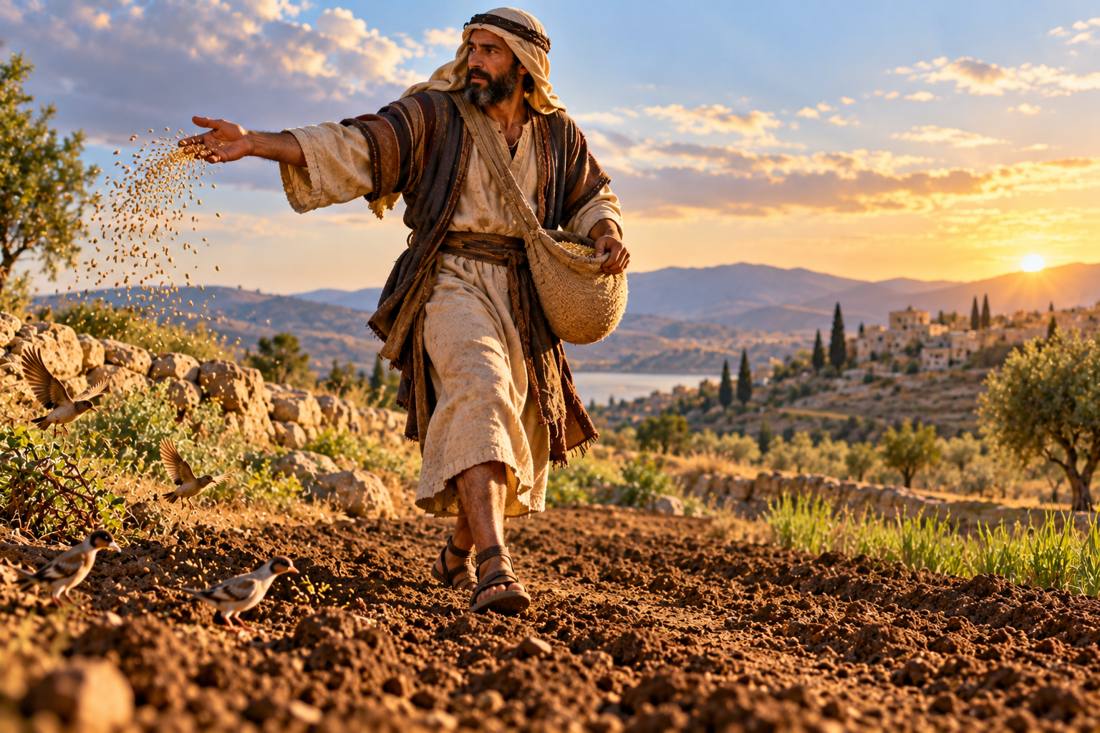
"Mfano umeelezwa kuwa hadithi ya kidunia yenye maana ya kimbinguni." Nilianza mahubiri ya Jumapili ya Ubatizo kwa maneno hayo mwaka 1981, nayo yanaufaa mfano huu kikamilifu. Yesu anachora picha ya mkulima katika Palestina. Anaingiza mkono katika mfuko ulio kiunoni mwake, anachota konzi ya mbegu, na kuzitawanya katika shamba lake lote. Baadhi ya wasomi wanaamini kwamba wakulima wa siku za Yesu mara nyingi walipanda kwanza na kisha kulima ili kuzifunika mbegu, jambo ambalo lingeeleza kwa nini mbegu zilianguka katika aina nyingi za ardhi. Yesu Mwenyewe anaieleza hadithi hii: "Mpanzi huyo hulipanda neno" (Marko 4:14). Katika mfano huu mkazo hauko juu ya mpanzi, wala juu ya mbegu. Uko juu ya udongo. Watu wanaposikia habari za Yesu, mambo manne yanaweza kutokea."A parable has been described as an earthly story with a heavenly meaning." I began a Baptism Sunday sermon with those words in 1981, and they fit this parable perfectly. Jesus paints a picture of a farmer in Palestine. He reaches into the bag at his waist, grabs a handful of seed, and broadcasts it across his field. Some scholars believe farmers in Jesus' day often sowed first and plowed the seed in afterward, which would explain why seed fell in so many kinds of ground. Jesus Himself explains the story: "The sower sows the word" (Mark 4:14). In this parable the emphasis is not on the sower, nor on the seed. It is on the soils. When people hear about Jesus, four things can happen.
1. Watu wengine wanakataa kusikia. Katika Palestina mashamba yaligawanywa katika vipande virefu na vyembamba. Hapakuwa na ua, kwa hiyo vijia vyembamba vilipita kati yake, na watu walivitembelea mpaka vikawa vigumu kama saruji. Mbegu zilizoanguka hapo hazikuweza kupenya ardhini, na ndege wakazila. Watu wengine wanafunga akili zao dhidi ya Injili. Wengine hawajali: si maadui, ila hawajali hata kidogo, kama vile watu wengine wanavyojisikia juu ya mchezo usiowavutia. Lakini maisha ni mafupi sana, na umilele ni mrefu sana. Wengine wamefanywa wagumu; wanajua kwamba kumpokea Kristo kunamaanisha kushiriki maisha yao pamoja Naye, nao hawataki kushusha daraja la ngome yao. Yesu anasema kwamba Shetani huja mara akaliondoa neno (4:15).1. Some people refuse to hear. In Palestine the fields were divided into long, narrow strips. There were no fences, so narrow footpaths ran between them, and people walked them until they were as hard as cement. Seed that fell there could not penetrate the surface, and the birds took it. Some people close their minds to the gospel. Some are indifferent: they are not hostile, they simply could not care less, the way some people feel about a sport that does not interest them. But life is very short, and eternity is very long. Others are hardened; they know that receiving Christ means sharing their lives with Him, and they will not let down the drawbridge. Jesus says that Satan comes immediately and takes away the word (4:15).
2. Watu wengine wanaitikia juu juu tu. Ardhi yenye miamba haikuwa udongo wenye mawe ndani yake. Ilikuwa tabaka jembamba la udongo juu ya mwamba wa chokaa. Mbegu ziliota upesi, lakini mizizi haikuweza kushuka chini, na jua lilipowaka kwa nguvu, mche mchanga ukanyauka. Hawa ndio wale ambao "mara walipokwisha kulisikia lile neno hulipokea kwa furaha; ila hawana mizizi ndani yao, bali hudumu muda mchache tu" (4:16–17). Sote tumesikia habari za watu wanaoongoka wakati wa hatari tu, kama askari aliye shimoni vitani. Niliwahi kumjua kijana mmoja aliyekuwa mlevi na mcheza kamari sugu. Mke wake alikuwa karibu kumwacha, naye akapata uzoefu wa kidini. Mara iliyofuata nilipomwona, alikuwa bado analewa, bado anacheza kamari, na anaishi na mwanamke mwingine. Taabu ya kwanza aliyokutana nayo iliharibu uzoefu wake. Labda alijaribu kuweka shauku mahali pa imani. Furaha ina nafasi yake katika maisha ya Kikristo, lakini furaha ni mbadala dhaifu wa imani. Paulo alipokutana na Kristo aliyefufuka njiani kuelekea Dameski, hakurukaruka kwa furaha; alikaa siku tatu akiwa kipofu, akiomba na kufunga, akitafakari yaliyompata (Matendo 9:9).2. Some people have a shallow response. The rocky ground was not soil with stones in it. It was a thin skin of soil over a shelf of limestone. The seed sprang up quickly, but the roots could not go down, and when the sun beat down, the young plant withered. These are the ones who "immediately receive it with gladness; and they have no root in themselves, and so endure only for a time" (4:16–17). We have all heard of foxhole conversions. I once knew a young man who was an alcoholic and a compulsive gambler. His wife was about to leave him, and he had a religious experience. The next time I saw him he was still drinking, still gambling, and living with another woman. The first trouble he met destroyed his experience. Perhaps he tried to substitute enthusiasm for faith. There is a place for joy in the Christian life, but joy is a poor substitute for faith. When Paul met the risen Christ on the road to Damascus, he did not jump for joy; he spent three days in blindness, prayer, and fasting, considering what had happened to him (Acts 9:9).
Nilipokuwa nikifundisha seminari, mmoja wa wanafunzi wangu aliniambia juu ya usiku ule alipokuwa Mkristo. Wengine kadhaa walifanya maamuzi wakati huo huo, na baadhi yao walifurahi sana hata wakawa wanaruka juu na chini. Kwake yeye, alisema, ilikuwa zaidi kama, "Haya, sawa, nitakuwa Mkristo." Wengi wa wale waliofurahi sana baadaye walianguka. Lakini kijana yule mtulivu aliendelea kukua, na mwishowe akaingia seminari. Ukubwa wa mwitikio wa kwanza hautabiri kina cha mzizi.When I was teaching seminary, one of my students told me about the night he became a Christian. Several others made decisions at the same time, and some were so excited they were jumping up and down. For him, he said, it was more like, "Yeah, okay, I'll become a Christian." Many of those excited ones later fell away. But that quiet young man kept growing, and he ended up in seminary. The size of the first response does not predict the depth of the root.
3. Watu wengine wana mioyo iliyogawanyika. Ardhi yenye miiba huenda ilikuwa ya mkulima mvivu ambaye, badala ya kung'oa magugu, aliyakata na kuyachoma moto. Shamba lilionekana safi, lakini mizizi ilikuwa bado iko. Mvua zilipokuja, miiba ilikua kwa kasi kuliko ngano na kuisonga. Hawa ndio wale ambao ndani yao "shughuli za dunia hii, na udanganyifu wa mali, na tamaa za mambo mengine zikiingia, hulisonga lile neno" (4:19). Mtu mmoja anasema, "Nitampokea Kristo, lakini siwezi kuacha kunywa pombe." Mwingine anasema, "Ninapenda anayosema Yesu, lakini sitaacha mwenendo wangu mchafu." Yule kijana tajiri, mtawala, alitaka uzima wa milele, lakini aliipenda mali yake zaidi, akaondoka kwa huzuni (Marko 10:17–22). Mungu anasogezwa nyuma polepole, na mapendo mengine yanamsukuma nje.3. Some people have divided hearts. The thorny ground may have belonged to a lazy farmer who, instead of pulling up the weeds, cut them down and burned them. The field looked clean, but the roots were still there. When the rains came, the thorns grew faster than the wheat and choked it. These are the ones in whom "the cares of this world, the deceitfulness of riches, and the desires for other things entering in choke the word" (4:19). One person says, "I will accept Christ, but I cannot stop drinking." Another says, "I like what Jesus says, but I will not give up my immoral conduct." The rich young ruler wanted eternal life, but he loved his money more, and he went away sad (Mark 10:17–22). God slowly moves to the back burner, and other loves crowd Him out.
4. Watu wengine wanalipokea neno na kuzaa matunda. Udongo mzuri uko wazi, una kina, na haujagawanyika. Unaipokea mbegu, unailisha, na kuzaa "mmoja thelathini, na mmoja sitini, na mmoja mia" (4:20). Wasomi wanajadiliana juu ya mavuno ya kawaida yalikuwa kiasi gani katika eneo lile, lakini wanakubaliana kwamba mavuno kama haya yangewashangaza wasikilizaji wa Yesu. Wakristo wanaompa Kristo kila kitu mara nyingi huzaa matunda yanayozidi sana idadi yao. Siku moja ya Krismasi, mwongofu mpya kijana katika Afrika Magharibi alimletea mmisionari wake sarafu ya fedha, wakati washiriki wengi wa kanisa lile maskini walileta mboga au maua. Mmisionari aliogopa kwamba huenda aliipata kwa njia isiyo ya haki. Yeye alieleza kwamba alikuwa amejiuza kwa mwenye shamba wa jirani kuwa mtumishi wa maisha yake yote, ili aweze kuweka thamani ya maisha yake yote miguuni pa Bwana wake. Kristo hataki tu fedha zetu, mahudhurio yetu, au vipaji vyetu. Anatutaka sisi wote.4. Some people receive the word and bear fruit. Good soil is open, deep, and undivided. It receives the seed, nourishes it, and produces "some thirtyfold, some sixty, and some a hundred" (4:20). Scholars debate what an ordinary harvest was in that region, but they agree that yields like these would have astonished Jesus' hearers. Christians who give Christ everything often produce far out of proportion to their numbers. A young convert in West Africa once brought her missionary a silver coin on Christmas Day, when most of the poor congregation brought vegetables or flowers. The missionary feared she had gotten it dishonestly. She explained that she had sold herself to a neighboring planter as a lifelong servant, so that she could lay the price of her whole life at the feet of her Lord. Christ does not only want our money, our attendance, or our talents. He wants all of us.
II. Upande wa Mpanzi katika HadithiII. The Sower's Side of the Story
Mkazo wa mfano huu uko juu ya udongo, lakini pia una faraja kubwa kwa kila mtu anayepanda neno. Mkulima katika hadithi hakuchunguza kila futi ya mraba ya ardhi kabla ya kutupa mbegu zake. Alipanda kwa ukarimu, akijua kwamba baadhi zingepotea, kwa sababu alijua kwamba baadhi zingeanguka kwenye udongo mzuri. Sisi hatuutawali udongo. Tumeitwa kupanda.The emphasis of the parable is on the soils, but it also carries great encouragement for everyone who sows the word. The farmer in the story did not examine each square foot of ground before he threw his seed. He sowed generously, knowing that some would be lost, because he knew some would fall on good ground. We do not control the soil. We are called to sow.
Leigh Richmond, mchungaji Mwingereza, siku moja aliwapa trakti abiria wenzake wa gari la farasi walipokuwa wakipanda mlima mkali kwa miguu ili kuwapunguzia farasi mzigo. Mtu mmoja kwa hasira aliisokota trakti yake na kuitupa chini. "Haya, hiyo umeipoteza," mtu mmoja akasema. "Labda sivyo," Richmond alijibu. "Mungu ataishughulikia." Upepo uliipeleka trakti ile katika shamba walimokuwa wakifanya kazi wavunaji wa majani. Waliinyoosha na kuisoma pamoja, na yule mtu mwenye hasira alipotazama nyuma na kuona kundi zima la watu wakisoma kile alichokitupa, alichomwa moyo. Baadaye aliongoka, naye mwenyewe akawa msambazaji wa trakti. "Heri ninyi mpandao kando ya maji yote" (Isaya 32:20).Leigh Richmond, an English pastor, once handed tracts to his fellow coach passengers as they walked up a steep hill to spare the horses. One man angrily twisted his tract and threw it on the ground. "Well, you lost that one," someone said. "Maybe not," Richmond answered. "God will take care of it." The wind carried the tract into a field where some haymakers were working. They smoothed it out and read it together, and when the angry man looked back and saw a whole band of men reading what he had thrown away, he was convicted. He was later converted and became a distributor of tracts himself. "Blessed are you who sow beside all waters" (Isaiah 32:20).
Mungu anaweza kumtumia mpanzi aliye mnyonge kuliko wote. John R. Rice, ambaye baadaye alihubiri kwa zaidi ya miaka hamsini na kuandika vitabu vingi, alisimulia jioni moja alipokuwa akifundisha chuo kikuu na akaenda kusaidia katika Pacific Garden Mission huko Chicago. Mhubiri usiku ule alikuwa Holland Oates, fundi mwashi mwenye elimu ya darasa la tano ambaye zamani alikuwa akilewa na kulaani pamoja na wafanyakazi wake mpaka Mungu alipomwokoa. Oates alisimulia jinsi, siku moja baada ya kujigonga kidole cha mguu kwa jiwe, alivyofunga mlango wa ofisi yake na kuomba, "Bwana, kuna kitu kingine unachotaka? Ukinitaka, unaweza kunichukua. Ukitaka niuze biashara hii, nitakwenda kuhubiri." Alipofungua mlango, mtu mmoja aliingia na kumwuliza kama angeuza ghala lake la mawe. Aliliuza ndani ya nusu saa kwa nusu ya thamani yake. Oates alinunua lori dogo, akaweka ndani yake kengele za muziki na kinanda kidogo, akamnunulia mwanawe tarumbeta, akaenda kwenye pembe za barabara za Chicago. Umati ulipokusanyika, aliwaeleza kwa kadiri alivyoweza jinsi ya kuokolewa na kuwagawia vioo vidogo. Upande mmoja uliandikwa, "Unataka kumwona mwenye dhambi? Tazama upande mwingine." Oates alipokuwa akinukuu maneno ya Isaya, "Mimi hapa, nitume mimi," moyo wa yule mwalimu wa chuo uliguswa. Yeye pia alisema, "Bwana, nitume mimi," na usiku ule akamwongoza mlevi mmoja kwa Kristo. Alisema, "Bwana, kufundisha chuo hakujawahi kuwa hivi!" Fundi mwashi alipanda mbegu, na Mungu akatoa matunda yaliyoendelea kwa nusu karne.God can use the humblest sower. John R. Rice, who later preached for more than fifty years and wrote many books, told of an evening when he was teaching college and went to help at the Pacific Garden Mission in Chicago. The preacher that night was Holland Oates, a stonemason with a fifth-grade education who had once drunk and cursed with his workers until God saved him. Oates told how, one day after smashing his toe with a stone, he shut his office door and prayed, "Lord, is there anything else You want? If You want me, You can have me. If You want me to sell this business, I'll go to preaching." When he unlocked the door, a man walked in and asked if he would sell his stoneyard. He sold it in half an hour for half its worth. Oates bought a small truck, put a set of chimes and a little organ in it, got a cornet for his son, and went out to the street corners of Chicago. When a crowd gathered, he told them as best he could how to be saved and handed out little mirrors. One side said, "Want to see a sinner? See the other side." As Oates quoted Isaiah's "Here am I; send me," the college teacher's heart was stirred. He too said, "Lord, send me," and that night he led a drunken man to Christ. He said, "Lord, college teaching never was like this!" The stonemason sowed the seed, and God gave fruit that went on for half a century.
III. Taa na Kipimo (Marko 4:21–25)III. The Lamp and the Measure (Mark 4:21–25)
Mara baada ya kuueleza mfano wa mpanzi, Yesu aliongeza misemo miwili mifupi. "Mwaleta taa ili kuiweka chini ya pishi, au chini ya kitanda? Si kwamba mwaileta ili kuiweka juu ya kiango? Kwa maana hakuna neno lililositirika, ambalo halitafunuliwa" (4:21–22). Katika Sehemu ya 1 tuliona kwamba mifano hufunua na pia huficha. Hapa Yesu anaweka wazi kwamba kuficha huko ni kwa muda tu. Nuru ya ufalme haikutolewa ili ifichwe. Yale aliyowanong'oneza wanafunzi siku moja yangetangazwa kwa ulimwengu wote, na wale wanaolipokea neno wanapaswa kuliacha liangaze.Right after explaining the sower, Jesus added two short sayings. "Is a lamp brought to be put under a basket or under a bed? Is it not to be set on a lampstand? For there is nothing hidden which will not be revealed" (4:21–22). In Unit 1 we saw that parables both reveal and conceal. Here Jesus makes clear that the concealing is temporary. The light of the kingdom was not given to be hidden. What He whispered to the disciples would one day be proclaimed to the whole world, and those who receive the word are to let it shine.
Kisha akasema, "Angalieni mnayoyasikia. Kipimo kile mpimacho ndicho mtakachopimiwa; nanyi mnaosikia mtaongezewa. Kwa kuwa yeyote mwenye kitu atapewa zaidi; na yeye asiye na kitu, hata kile alicho nacho atanyang'anywa" (4:24–25). Huu ni mfano wa udongo uliowekwa katika methali. Kusikia hakuwi kamwe jambo lisilo na upande. Yule anayelipokea neno kwa moyo wazi huona kwamba ufahamu wake unakua; yule anayelifungia nje huona kwamba hata kile kidogo alichokuwa nacho kinamponyoka. Njia ngumu inazidi kuwa ngumu, na udongo mzuri unazidi kuwa na rutuba. Kila hubiri tunalolisikia hutulainisha au hutufanya wagumu.Then He said, "Take heed what you hear. With the same measure you use, it will be measured to you; and to you who hear, more will be given. For whoever has, to him more will be given; but whoever does not have, even what he has will be taken away from him" (4:24–25). This is the parable of the soils put into a proverb. Hearing is never neutral. The one who receives the word with an open heart finds that understanding grows; the one who shuts it out finds that even what little he had slips away. The hard path grows harder, and the good soil grows richer. Every sermon we hear either softens us or hardens us.
IV. Mbegu Inayokua Yenyewe (Marko 4:26–29)IV. The Seed That Grows by Itself (Mark 4:26–29)
Ni Marko peke yake anayeandika mfano huu mdogo. "Ndivyo ulivyo ufalme wa Mungu, kana kwamba mtu atupa mbegu katika ardhi; akalala, akaondoka, usiku na mchana, mbegu ikamea, ikakua, asivyojua yeye. Nchi huzaa yenyewe; mmea, kisha suke, kisha ngano pevu katika suke. Lakini matunda yakiiva, mara aupeleka mundu, kwa kuwa mavuno yamefika" (4:26–29).Only Mark records this little parable. "The kingdom of God is as if a man should scatter seed on the ground, and should sleep by night and rise by day, and the seed should sprout and grow, he himself does not know how. For the earth yields crops by itself: first the blade, then the head, after that the full grain in the head. But when the grain ripens, immediately he puts in the sickle, because the harvest has come" (4:26–29).
Mkulima anafanya sehemu yake: anatawanya mbegu. Kisha anakwenda kulala. Hawezi kuifanya mbegu ikue kwa kuihangaikia, wala haelewi jinsi inavyokua. Maneno ya Kigiriki yaliyotafsiriwa "yenyewe" ndiyo yaliyotupa neno la Kiingereza automatic (kwa Kiswahili "otomatiki"). Ukuaji unatoka katika uhai ambao Mungu ameuweka ndani ya mbegu na udongo. Paulo alisema jambo hilo hilo juu ya huduma: "Mimi nilipanda, Apolo akatia maji; bali Mungu akakuza. Basi, apandaye si kitu, wala atiaye maji, bali Mungu akuzaye" (1 Wakorintho 3:6–7).The farmer does his part: he scatters the seed. Then he goes to bed. He cannot make the seed grow by worrying over it, and he does not understand how it grows. The Greek words translated "by itself" give us our word automatic. The growth comes from the life God has put in the seed and the soil. Paul said the same thing about ministry: "I planted, Apollos watered, but God gave the increase. So then neither he who plants is anything, nor he who waters, but God who gives the increase" (1 Corinthians 3:6–7).
Hili ni neno la raha kwa wachungaji wenye wasiwasi. Hatuwezi kumleta mtu yeyote katika ufalme kwa mabishano, wala hatuwezi kulazimisha ukuaji wa kiroho kwa ratiba yetu. Ukuaji pia unakuja kwa hatua, "mmea, kisha suke, kisha ngano pevu." Mwamini mpya bado si mwamini aliyekomaa, wala hatupaswi kutarajia suke kamili la ngano kutoka kwa mmea ulioota wiki iliyopita. Lakini mfano huu pia unatazama mwisho: ngano ikiiva, mundu unakuja. Ukuaji wa ufalme ulio kimya na uliofichika unaelekea kwenye mavuno. Kazi ya mpanzi ni kupanda kwa uaminifu, kulala kwa amani, na kumwamini Mungu kwa ukuaji.This is a word of rest for anxious pastors. We cannot argue anyone into the kingdom, and we cannot force spiritual growth on our timetable. Growth also comes in stages, "first the blade, then the head, after that the full grain." A new believer is not yet a mature one, and we should not expect a full head of grain from a blade that sprouted last week. But the parable also looks to the end: when the grain is ripe, the sickle comes. The quiet, hidden growth of the kingdom is moving toward a harvest. The sower's job is to sow faithfully, sleep peacefully, and trust God with the growth.
V. Kuhubiri Mfano wa MpanziV. Preaching the Sower
Mfano wa udongo unahubirika vizuri kwa vipengele vinne: watu wengine wanakataa kusikia, wengine wana mwitikio wa juu juu, wengine wana mioyo iliyogawanyika, na wengine wanazaa matunda. Kila kipengele kinahitaji picha iliyo wazi ya udongo na picha iliyo wazi ya mtu. Hitimisha kwa kuwauliza wasikilizaji ni udongo upi unaowaeleza leo, na uwaalike walipokee neno katika ardhi nzuri, yenye kina, isiyogawanyika. Hubiri la pili linaweza kuzungumza na wapanzi walio katika kusanyiko: pandeni kwa ukarimu, kama yule mkulima; pandeni kwa uaminifu, kama Holland Oates; na pumzikeni katika uweza wa Mungu wa kutoa ukuaji, kama yule mtu aliyelala wakati mbegu ilipokua. Kumbuka onyo la Yesu Mwenyewe, "Angalieni mnayoyasikia," na ukumbuke kwamba linamhusu mhubiri kwanza.The parable of the soils preaches well with four points: some people refuse to hear, some have a shallow response, some have divided hearts, and some bear fruit. Each point needs a clear picture of the soil and a clear picture of the person. Close by asking listeners which soil describes them today, and invite them to receive the word into good, deep, undivided ground. A second sermon can speak to the sowers in the congregation: sow generously, like the farmer; sow faithfully, like Holland Oates; and rest in God's power to give the growth, like the man who slept while the seed grew. Remember Jesus' own warning, "Take heed what you hear," and remember that it applies to the preacher first.
HitimishoClosing
Yesu alimaliza mfano wa mpanzi kwa mwito: "Mwenye masikio ya kusikilia, na asikie" (Marko 4:9). Mbegu ni njema, na Mpanzi ni mwaminifu. Swali ni udongo. Je, tutaliacha neno libaki juu juu, liote kisha linyauke, au lisongwe na mapendo mengine? Au tutalipokea katika ardhi nzuri, yenye kina, isiyogawanyika, na kumpa Kristo kila kitu? Hataki sehemu tu ya nafsi zetu. Anatutaka sisi wote.Jesus ended the parable of the sower with a call: "He who has ears to hear, let him hear!" (Mark 4:9). The seed is good, and the Sower is faithful. The question is the soil. Will we let the word stay on the surface, spring up and wither, or be choked by other loves? Or will we receive it into good, deep, undivided ground, and give Christ everything? He does not want only part of us. He wants all of us.
— Dkt. Wayne Cook
Seminari ya Teolojia ya Chapala— Dr. Wayne Cook
Chapala Theological Seminary
Mtihani wa Sehemu ya 7Unit 7 Exam
Njia ya Cheti: maswali 20 ya kuchagua jibu. Shahada ya Mshiriki: maswali ya kuchagua jibu na maswali 10 ya kujaza nafasi. Shahada ya Uzamili ya Huduma ya Kiungu (M.Div.) na Shahada ya Uzamili ya Teolojia (Th.M.): maswali ya kuchagua jibu, ya kujaza nafasi na maswali 10 ya majibu mafupi. Asilimia 90 ya kila sehemu inahitajika ili kufaulu. Usipofaulu, mtihani unasubiri muda mfupi kabla hujaweza kujaribu tena.Certificate track: the 20 multiple-choice questions. Associate: multiple choice and the 10 fill-in-the-blank questions. M.Div. and Th.M.: multiple choice, fill-ins and the 10 short-answer questions. 90% of each part is required to pass. If you do not pass, the exam waits a short time before you can try again.
M.Div. na Th.M.: masomo yote matano yaliyopangwa ni sehemu ya kozi. Mtihani wake tofauti ni wa lazima baada ya kuanzishwa; tazama ukurasa wake kwa kanuni ya sasa. Heshima inabaki kuwa ya hiari na haichukui nafasi ya mtihani.
Fungua Masomo ya Kozi →