Register once, for every course
Your progress is saved in this browser as you study, and kept with the seminary under your student code, so you can continue on any device. Keep the code private, like a password. Email is optional. Add one so we can return your student code, send reminders, and deliver a certificate. You can enroll and keep studying without it. What we keep.
The Certificate track answers the multiple choice. The Associate adds the fill-in-the-blank questions; M.Div. and Th.M. add those and the short-answer questions. 90% of each part is required to pass.
Orientation
With this unit we cross from the prophets to the parables of Jesus, and we begin where Jesus Himself seems to have begun. When the disciples asked Him about the parable of the sower, He answered, "Do you not understand this parable? How then will you understand all the parables?" (Mark 4:13). This is the parable that teaches us how to hear every other parable. It is about hearing itself.
Mark 4 sets the scene. So great a crowd gathered by the Sea of Galilee that Jesus got into a boat and sat in it, and the whole multitude stood on the shore (Mark 4:1). The fields He described were probably visible on the hillsides behind them. "Listen!" He began. "Behold, a sower went out to sow" (4:3). In this unit we study the parable of the sower and Jesus' explanation of it, and then two short parables that follow it in Mark 4: the lamp and the measure, and the seed that grows by itself. Together they teach how the word of God is received, how it must be heard, and how it grows.
I. The Soils: How People Receive the Word (Mark 4:1–20)
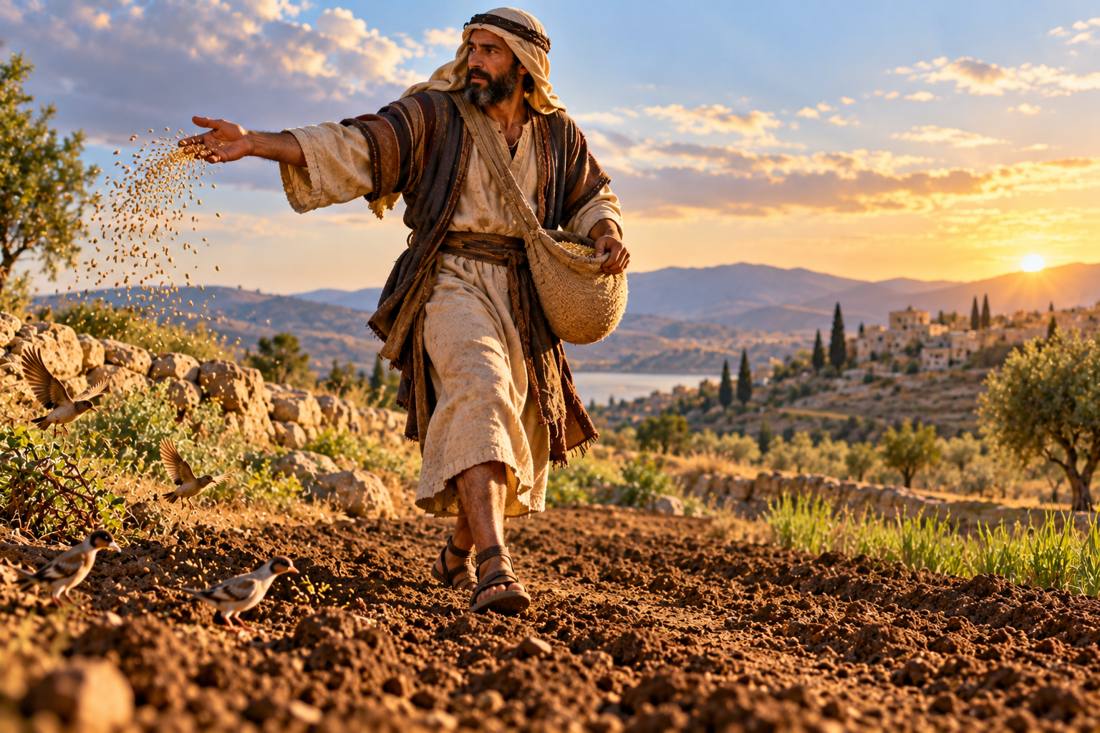
"A parable has been described as an earthly story with a heavenly meaning." I began a Baptism Sunday sermon with those words in 1981, and they fit this parable perfectly. Jesus paints a picture of a farmer in Palestine. He reaches into the bag at his waist, grabs a handful of seed, and broadcasts it across his field. Some scholars believe farmers in Jesus' day often sowed first and plowed the seed in afterward, which would explain why seed fell in so many kinds of ground. Jesus Himself explains the story: "The sower sows the word" (Mark 4:14). In this parable the emphasis is not on the sower, nor on the seed. It is on the soils. When people hear about Jesus, four things can happen.
1. Some people refuse to hear. In Palestine the fields were divided into long, narrow strips. There were no fences, so narrow footpaths ran between them, and people walked them until they were as hard as cement. Seed that fell there could not penetrate the surface, and the birds took it. Some people close their minds to the gospel. Some are indifferent: they are not hostile, they simply could not care less, the way some people feel about a sport that does not interest them. But life is very short, and eternity is very long. Others are hardened; they know that receiving Christ means sharing their lives with Him, and they will not let down the drawbridge. Jesus says that Satan comes immediately and takes away the word (4:15).
2. Some people have a shallow response. The rocky ground was not soil with stones in it. It was a thin skin of soil over a shelf of limestone. The seed sprang up quickly, but the roots could not go down, and when the sun beat down, the young plant withered. These are the ones who "immediately receive it with gladness; and they have no root in themselves, and so endure only for a time" (4:16–17). We have all heard of foxhole conversions. I once knew a young man who was an alcoholic and a compulsive gambler. His wife was about to leave him, and he had a religious experience. The next time I saw him he was still drinking, still gambling, and living with another woman. The first trouble he met destroyed his experience. Perhaps he tried to substitute enthusiasm for faith. There is a place for joy in the Christian life, but joy is a poor substitute for faith. When Paul met the risen Christ on the road to Damascus, he did not jump for joy; he spent three days in blindness, prayer, and fasting, considering what had happened to him (Acts 9:9).
When I was teaching seminary, one of my students told me about the night he became a Christian. Several others made decisions at the same time, and some were so excited they were jumping up and down. For him, he said, it was more like, "Yeah, okay, I'll become a Christian." Many of those excited ones later fell away. But that quiet young man kept growing, and he ended up in seminary. The size of the first response does not predict the depth of the root.
3. Some people have divided hearts. The thorny ground may have belonged to a lazy farmer who, instead of pulling up the weeds, cut them down and burned them. The field looked clean, but the roots were still there. When the rains came, the thorns grew faster than the wheat and choked it. These are the ones in whom "the cares of this world, the deceitfulness of riches, and the desires for other things entering in choke the word" (4:19). One person says, "I will accept Christ, but I cannot stop drinking." Another says, "I like what Jesus says, but I will not give up my immoral conduct." The rich young ruler wanted eternal life, but he loved his money more, and he went away sad (Mark 10:17–22). God slowly moves to the back burner, and other loves crowd Him out.
4. Some people receive the word and bear fruit. Good soil is open, deep, and undivided. It receives the seed, nourishes it, and produces "some thirtyfold, some sixty, and some a hundred" (4:20). Scholars debate what an ordinary harvest was in that region, but they agree that yields like these would have astonished Jesus' hearers. Christians who give Christ everything often produce far out of proportion to their numbers. A young convert in West Africa once brought her missionary a silver coin on Christmas Day, when most of the poor congregation brought vegetables or flowers. The missionary feared she had gotten it dishonestly. She explained that she had sold herself to a neighboring planter as a lifelong servant, so that she could lay the price of her whole life at the feet of her Lord. Christ does not only want our money, our attendance, or our talents. He wants all of us.
II. The Sower's Side of the Story
The emphasis of the parable is on the soils, but it also carries great encouragement for everyone who sows the word. The farmer in the story did not examine each square foot of ground before he threw his seed. He sowed generously, knowing that some would be lost, because he knew some would fall on good ground. We do not control the soil. We are called to sow.
Leigh Richmond, an English pastor, once handed tracts to his fellow coach passengers as they walked up a steep hill to spare the horses. One man angrily twisted his tract and threw it on the ground. "Well, you lost that one," someone said. "Maybe not," Richmond answered. "God will take care of it." The wind carried the tract into a field where some haymakers were working. They smoothed it out and read it together, and when the angry man looked back and saw a whole band of men reading what he had thrown away, he was convicted. He was later converted and became a distributor of tracts himself. "Blessed are you who sow beside all waters" (Isaiah 32:20).
God can use the humblest sower. John R. Rice, who later preached for more than fifty years and wrote many books, told of an evening when he was teaching college and went to help at the Pacific Garden Mission in Chicago. The preacher that night was Holland Oates, a stonemason with a fifth-grade education who had once drunk and cursed with his workers until God saved him. Oates told how, one day after smashing his toe with a stone, he shut his office door and prayed, "Lord, is there anything else You want? If You want me, You can have me. If You want me to sell this business, I'll go to preaching." When he unlocked the door, a man walked in and asked if he would sell his stoneyard. He sold it in half an hour for half its worth. Oates bought a small truck, put a set of chimes and a little organ in it, got a cornet for his son, and went out to the street corners of Chicago. When a crowd gathered, he told them as best he could how to be saved and handed out little mirrors. One side said, "Want to see a sinner? See the other side." As Oates quoted Isaiah's "Here am I; send me," the college teacher's heart was stirred. He too said, "Lord, send me," and that night he led a drunken man to Christ. He said, "Lord, college teaching never was like this!" The stonemason sowed the seed, and God gave fruit that went on for half a century.
III. The Lamp and the Measure (Mark 4:21–25)
Right after explaining the sower, Jesus added two short sayings. "Is a lamp brought to be put under a basket or under a bed? Is it not to be set on a lampstand? For there is nothing hidden which will not be revealed" (4:21–22). In Unit 1 we saw that parables both reveal and conceal. Here Jesus makes clear that the concealing is temporary. The light of the kingdom was not given to be hidden. What He whispered to the disciples would one day be proclaimed to the whole world, and those who receive the word are to let it shine.
Then He said, "Take heed what you hear. With the same measure you use, it will be measured to you; and to you who hear, more will be given. For whoever has, to him more will be given; but whoever does not have, even what he has will be taken away from him" (4:24–25). This is the parable of the soils put into a proverb. Hearing is never neutral. The one who receives the word with an open heart finds that understanding grows; the one who shuts it out finds that even what little he had slips away. The hard path grows harder, and the good soil grows richer. Every sermon we hear either softens us or hardens us.
IV. The Seed That Grows by Itself (Mark 4:26–29)
Only Mark records this little parable. "The kingdom of God is as if a man should scatter seed on the ground, and should sleep by night and rise by day, and the seed should sprout and grow, he himself does not know how. For the earth yields crops by itself: first the blade, then the head, after that the full grain in the head. But when the grain ripens, immediately he puts in the sickle, because the harvest has come" (4:26–29).
The farmer does his part: he scatters the seed. Then he goes to bed. He cannot make the seed grow by worrying over it, and he does not understand how it grows. The Greek words translated "by itself" give us our word automatic. The growth comes from the life God has put in the seed and the soil. Paul said the same thing about ministry: "I planted, Apollos watered, but God gave the increase. So then neither he who plants is anything, nor he who waters, but God who gives the increase" (1 Corinthians 3:6–7).
This is a word of rest for anxious pastors. We cannot argue anyone into the kingdom, and we cannot force spiritual growth on our timetable. Growth also comes in stages, "first the blade, then the head, after that the full grain." A new believer is not yet a mature one, and we should not expect a full head of grain from a blade that sprouted last week. But the parable also looks to the end: when the grain is ripe, the sickle comes. The quiet, hidden growth of the kingdom is moving toward a harvest. The sower's job is to sow faithfully, sleep peacefully, and trust God with the growth.
V. Preaching the Sower
The parable of the soils preaches well with four points: some people refuse to hear, some have a shallow response, some have divided hearts, and some bear fruit. Each point needs a clear picture of the soil and a clear picture of the person. Close by asking listeners which soil describes them today, and invite them to receive the word into good, deep, undivided ground. A second sermon can speak to the sowers in the congregation: sow generously, like the farmer; sow faithfully, like Holland Oates; and rest in God's power to give the growth, like the man who slept while the seed grew. Remember Jesus' own warning, "Take heed what you hear," and remember that it applies to the preacher first.
Closing
Jesus ended the parable of the sower with a call: "He who has ears to hear, let him hear!" (Mark 4:9). The seed is good, and the Sower is faithful. The question is the soil. Will we let the word stay on the surface, spring up and wither, or be choked by other loves? Or will we receive it into good, deep, undivided ground, and give Christ everything? He does not want only part of us. He wants all of us.
— Dr. Wayne Cook
Chapala Theological Seminary
Unit 7 Exam
Certificate track: the 20 multiple-choice questions. Associate: multiple choice and the 10 fill-in-the-blank questions. M.Div. and Th.M.: multiple choice, fill-ins and the 10 short-answer questions. 90% of each part is required to pass. If you do not pass, the exam waits a short time before you can try again.
M.Div. and Th.M.: all five assigned readings are part of the course. Their separate exam is required after activation; see its page for the current rule. Honors remains optional and does not replace the exam.
Open Course Readings →