Register once, for every courseRegístrese una vez, para todos los cursos
Your progress is saved in this browser as you study, and kept with the seminary under your student code, so you can continue on any device. Keep the code private, like a password. A confirmed email is needed only to receive a certificate. What we keep.Su progreso se guarda en este navegador mientras estudia, y en el seminario bajo su código de estudiante, para que pueda continuar en cualquier dispositivo. Mantenga el código en privado, como una contraseña. Solo se necesita un correo confirmado para recibir un certificado. Lo que guardamos.
The Certificate track answers the multiple choice. The Associate adds the fill-in-the-blank questions; M.Div. and Th.M. add those and the short-answer questions. 90% of each part is required to pass.El trayecto de Certificado responde la opción múltiple. El Asociado añade las preguntas de completar el espacio en blanco; M.Div. y Th.M. añaden esas y las preguntas de desarrollo. Se requiere 90% en cada parte para aprobar.
Orientation
With this unit we cross from the prophets to the parables of Jesus, and we begin where Jesus Himself seems to have begun. When the disciples asked Him about the parable of the sower, He answered, "Do you not understand this parable? How then will you understand all the parables?" (Mark 4:13). This is the parable that teaches us how to hear every other parable. It is about hearing itself.
Mark 4 sets the scene. So great a crowd gathered by the Sea of Galilee that Jesus got into a boat and sat in it, and the whole multitude stood on the shore (Mark 4:1). The fields He described were probably visible on the hillsides behind them. "Listen!" He began. "Behold, a sower went out to sow" (4:3). In this unit we study the parable of the sower and Jesus' explanation of it, and then two short parables that follow it in Mark 4: the lamp and the measure, and the seed that grows by itself. Together they teach how the word of God is received, how it must be heard, and how it grows.
I. The Soils: How People Receive the Word (Mark 4:1–20)
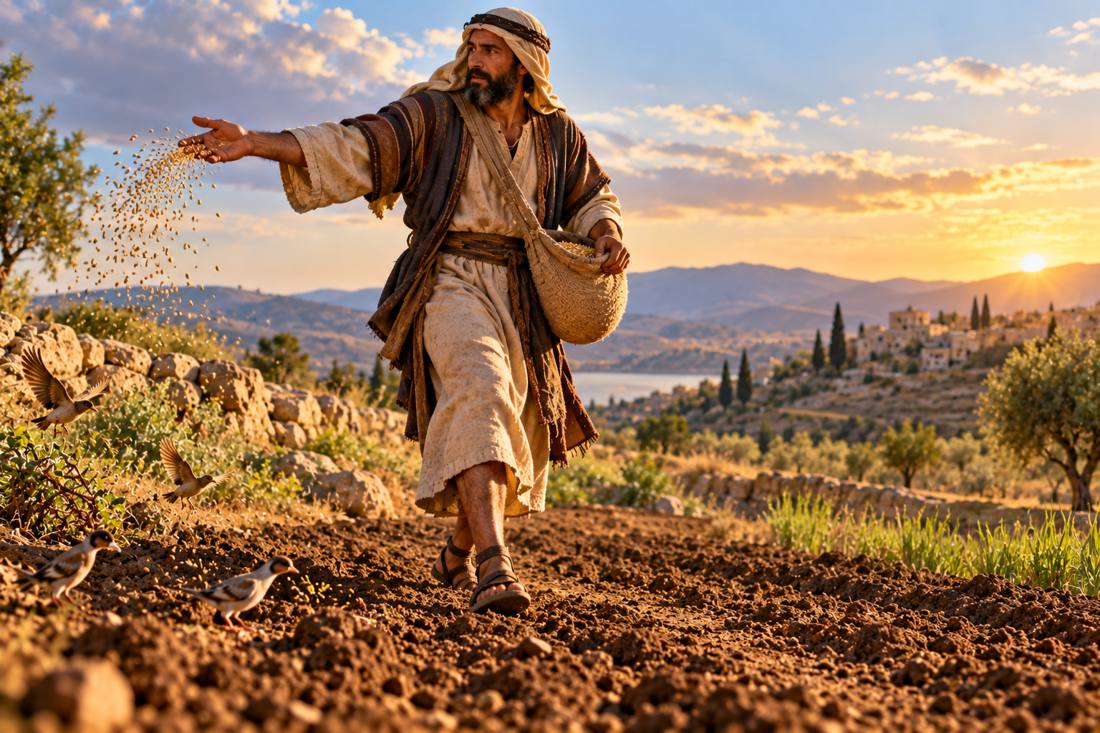
"A parable has been described as an earthly story with a heavenly meaning." I began a Baptism Sunday sermon with those words in 1981, and they fit this parable perfectly. Jesus paints a picture of a farmer in Palestine. He reaches into the bag at his waist, grabs a handful of seed, and broadcasts it across his field. Some scholars believe farmers in Jesus' day often sowed first and plowed the seed in afterward, which would explain why seed fell in so many kinds of ground. Jesus Himself explains the story: "The sower sows the word" (Mark 4:14). In this parable the emphasis is not on the sower, nor on the seed. It is on the soils. When people hear about Jesus, four things can happen.
1. Some people refuse to hear. In Palestine the fields were divided into long, narrow strips. There were no fences, so narrow footpaths ran between them, and people walked them until they were as hard as cement. Seed that fell there could not penetrate the surface, and the birds took it. Some people close their minds to the gospel. Some are indifferent: they are not hostile, they simply could not care less, the way some people feel about a sport that does not interest them. But life is very short, and eternity is very long. Others are hardened; they know that receiving Christ means sharing their lives with Him, and they will not let down the drawbridge. Jesus says that Satan comes immediately and takes away the word (4:15).
2. Some people have a shallow response. The rocky ground was not soil with stones in it. It was a thin skin of soil over a shelf of limestone. The seed sprang up quickly, but the roots could not go down, and when the sun beat down, the young plant withered. These are the ones who "immediately receive it with gladness; and they have no root in themselves, and so endure only for a time" (4:16–17). We have all heard of foxhole conversions. I once knew a young man who was an alcoholic and a compulsive gambler. His wife was about to leave him, and he had a religious experience. The next time I saw him he was still drinking, still gambling, and living with another woman. The first trouble he met destroyed his experience. Perhaps he tried to substitute enthusiasm for faith. There is a place for joy in the Christian life, but joy is a poor substitute for faith. When Paul met the risen Christ on the road to Damascus, he did not jump for joy; he spent three days in blindness, prayer, and fasting, considering what had happened to him (Acts 9:9).
When I was teaching seminary, one of my students told me about the night he became a Christian. Several others made decisions at the same time, and some were so excited they were jumping up and down. For him, he said, it was more like, "Yeah, okay, I'll become a Christian." Many of those excited ones later fell away. But that quiet young man kept growing, and he ended up in seminary. The size of the first response does not predict the depth of the root.
3. Some people have divided hearts. The thorny ground may have belonged to a lazy farmer who, instead of pulling up the weeds, cut them down and burned them. The field looked clean, but the roots were still there. When the rains came, the thorns grew faster than the wheat and choked it. These are the ones in whom "the cares of this world, the deceitfulness of riches, and the desires for other things entering in choke the word" (4:19). One person says, "I will accept Christ, but I cannot stop drinking." Another says, "I like what Jesus says, but I will not give up my immoral conduct." The rich young ruler wanted eternal life, but he loved his money more, and he went away sad (Mark 10:17–22). God slowly moves to the back burner, and other loves crowd Him out.
4. Some people receive the word and bear fruit. Good soil is open, deep, and undivided. It receives the seed, nourishes it, and produces "some thirtyfold, some sixty, and some a hundred" (4:20). Scholars debate what an ordinary harvest was in that region, but they agree that yields like these would have astonished Jesus' hearers. Christians who give Christ everything often produce far out of proportion to their numbers. A young convert in West Africa once brought her missionary a silver coin on Christmas Day, when most of the poor congregation brought vegetables or flowers. The missionary feared she had gotten it dishonestly. She explained that she had sold herself to a neighboring planter as a lifelong servant, so that she could lay the price of her whole life at the feet of her Lord. Christ does not only want our money, our attendance, or our talents. He wants all of us.
II. The Sower's Side of the Story
The emphasis of the parable is on the soils, but it also carries great encouragement for everyone who sows the word. The farmer in the story did not examine each square foot of ground before he threw his seed. He sowed generously, knowing that some would be lost, because he knew some would fall on good ground. We do not control the soil. We are called to sow.
Leigh Richmond, an English pastor, once handed tracts to his fellow coach passengers as they walked up a steep hill to spare the horses. One man angrily twisted his tract and threw it on the ground. "Well, you lost that one," someone said. "Maybe not," Richmond answered. "God will take care of it." The wind carried the tract into a field where some haymakers were working. They smoothed it out and read it together, and when the angry man looked back and saw a whole band of men reading what he had thrown away, he was convicted. He was later converted and became a distributor of tracts himself. "Blessed are you who sow beside all waters" (Isaiah 32:20).
God can use the humblest sower. John R. Rice, who later preached for more than fifty years and wrote many books, told of an evening when he was teaching college and went to help at the Pacific Garden Mission in Chicago. The preacher that night was Holland Oates, a stonemason with a fifth-grade education who had once drunk and cursed with his workers until God saved him. Oates told how, one day after smashing his toe with a stone, he shut his office door and prayed, "Lord, is there anything else You want? If You want me, You can have me. If You want me to sell this business, I'll go to preaching." When he unlocked the door, a man walked in and asked if he would sell his stoneyard. He sold it in half an hour for half its worth. Oates bought a small truck, put a set of chimes and a little organ in it, got a cornet for his son, and went out to the street corners of Chicago. When a crowd gathered, he told them as best he could how to be saved and handed out little mirrors. One side said, "Want to see a sinner? See the other side." As Oates quoted Isaiah's "Here am I; send me," the college teacher's heart was stirred. He too said, "Lord, send me," and that night he led a drunken man to Christ. He said, "Lord, college teaching never was like this!" The stonemason sowed the seed, and God gave fruit that went on for half a century.
III. The Lamp and the Measure (Mark 4:21–25)
Right after explaining the sower, Jesus added two short sayings. "Is a lamp brought to be put under a basket or under a bed? Is it not to be set on a lampstand? For there is nothing hidden which will not be revealed" (4:21–22). In Unit 1 we saw that parables both reveal and conceal. Here Jesus makes clear that the concealing is temporary. The light of the kingdom was not given to be hidden. What He whispered to the disciples would one day be proclaimed to the whole world, and those who receive the word are to let it shine.
Then He said, "Take heed what you hear. With the same measure you use, it will be measured to you; and to you who hear, more will be given. For whoever has, to him more will be given; but whoever does not have, even what he has will be taken away from him" (4:24–25). This is the parable of the soils put into a proverb. Hearing is never neutral. The one who receives the word with an open heart finds that understanding grows; the one who shuts it out finds that even what little he had slips away. The hard path grows harder, and the good soil grows richer. Every sermon we hear either softens us or hardens us.
IV. The Seed That Grows by Itself (Mark 4:26–29)
Only Mark records this little parable. "The kingdom of God is as if a man should scatter seed on the ground, and should sleep by night and rise by day, and the seed should sprout and grow, he himself does not know how. For the earth yields crops by itself: first the blade, then the head, after that the full grain in the head. But when the grain ripens, immediately he puts in the sickle, because the harvest has come" (4:26–29).
The farmer does his part: he scatters the seed. Then he goes to bed. He cannot make the seed grow by worrying over it, and he does not understand how it grows. The Greek words translated "by itself" give us our word automatic. The growth comes from the life God has put in the seed and the soil. Paul said the same thing about ministry: "I planted, Apollos watered, but God gave the increase. So then neither he who plants is anything, nor he who waters, but God who gives the increase" (1 Corinthians 3:6–7).
This is a word of rest for anxious pastors. We cannot argue anyone into the kingdom, and we cannot force spiritual growth on our timetable. Growth also comes in stages, "first the blade, then the head, after that the full grain." A new believer is not yet a mature one, and we should not expect a full head of grain from a blade that sprouted last week. But the parable also looks to the end: when the grain is ripe, the sickle comes. The quiet, hidden growth of the kingdom is moving toward a harvest. The sower's job is to sow faithfully, sleep peacefully, and trust God with the growth.
V. Preaching the Sower
The parable of the soils preaches well with four points: some people refuse to hear, some have a shallow response, some have divided hearts, and some bear fruit. Each point needs a clear picture of the soil and a clear picture of the person. Close by asking listeners which soil describes them today, and invite them to receive the word into good, deep, undivided ground. A second sermon can speak to the sowers in the congregation: sow generously, like the farmer; sow faithfully, like Holland Oates; and rest in God's power to give the growth, like the man who slept while the seed grew. Remember Jesus' own warning, "Take heed what you hear," and remember that it applies to the preacher first.
Closing
Jesus ended the parable of the sower with a call: "He who has ears to hear, let him hear!" (Mark 4:9). The seed is good, and the Sower is faithful. The question is the soil. Will we let the word stay on the surface, spring up and wither, or be choked by other loves? Or will we receive it into good, deep, undivided ground, and give Christ everything? He does not want only part of us. He wants all of us.
— Dr. Wayne Cook
Chapala Theological Seminary
Orientación
Con esta unidad pasamos de los profetas a las parábolas de Jesús, y comenzamos donde Jesús mismo parece haber comenzado. Cuando los discípulos le preguntaron por la parábola del sembrador, respondió: "¿No sabéis esta parábola? ¿Cómo, pues, entenderéis todas las parábolas?" (Marcos 4:13). Esta es la parábola que nos enseña a oír todas las demás. Trata del oír mismo.
Marcos 4 prepara la escena. Se reunió alrededor de Él tanta gente junto al mar de Galilea que Jesús entró en una barca y se sentó en ella, y toda la multitud estaba en tierra junto al mar (Marcos 4:1). Probablemente los campos que describía se veían en las laderas detrás de ellos. "Oíd", comenzó. "He aquí, el sembrador salió a sembrar" (4:3). En esta unidad estudiamos la parábola del sembrador y la explicación de Jesús, y luego dos parábolas breves que la siguen en Marcos 4: la lámpara y la medida, y la semilla que crece por sí sola. Juntas enseñan cómo se recibe la palabra de Dios, cómo debe oírse y cómo crece.
I. Los terrenos: cómo reciben las personas la palabra (Marcos 4:1–20)
"Se ha dicho que una parábola es una historia terrenal con un significado celestial." Comencé un sermón de domingo de bautismos con esas palabras en 1981, y encajan perfectamente con esta parábola. Jesús pinta el cuadro de un agricultor en Palestina. Mete la mano en la bolsa que lleva en la cintura, toma un puñado de semilla y la esparce a voleo por su campo. Algunos eruditos creen que en los días de Jesús los agricultores a menudo sembraban primero y araban después para enterrar la semilla, lo cual explicaría por qué la semilla caía en tantas clases de terreno. Jesús mismo explica la historia: "El sembrador es el que siembra la palabra" (Marcos 4:14). En esta parábola el énfasis no está en el sembrador ni en la semilla. Está en los terrenos. Cuando las personas oyen de Jesús, pueden suceder cuatro cosas.
1. Algunos se niegan a oír. En Palestina los campos estaban divididos en franjas largas y angostas. No había cercas, así que entre ellos corrían senderos angostos, y la gente los caminaba hasta que quedaban duros como cemento. La semilla que caía allí no podía penetrar la superficie, y las aves se la comían. Algunas personas cierran la mente al evangelio. Algunas son indiferentes: no son hostiles, sencillamente no les importa, como algunos sienten acerca de un deporte que no les interesa. Pero la vida es muy corta, y la eternidad es muy larga. Otras están endurecidas; saben que recibir a Cristo significa compartir su vida con Él, y no quieren bajar el puente levadizo. Jesús dice que Satanás viene en seguida y quita la palabra (4:15).
2. Algunos tienen una respuesta superficial. Los pedregales no eran tierra con piedras. Eran una capa delgada de tierra sobre una losa de piedra caliza. La semilla brotaba pronto, pero las raíces no podían bajar, y cuando el sol calentaba, la plantita se secaba. Estos son los que "al momento la reciben con gozo; pero no tienen raíz en sí, sino que son de corta duración" (4:16–17). Todos hemos oído de las conversiones de trinchera. Una vez conocí a un joven que era alcohólico y jugador compulsivo. Su esposa estaba a punto de dejarlo, y él tuvo una experiencia religiosa. La siguiente vez que lo vi seguía bebiendo, seguía apostando y vivía con otra mujer. El primer problema que encontró destruyó su experiencia. Quizás trató de sustituir la fe con entusiasmo. Hay lugar para el gozo en la vida cristiana, pero el gozo es un pobre sustituto de la fe. Cuando Pablo se encontró con Cristo resucitado en el camino a Damasco, no saltó de gozo; pasó tres días ciego, orando y ayunando, considerando lo que le había sucedido (Hechos 9:9).
Cuando yo enseñaba en el seminario, uno de mis estudiantes me contó de la noche en que se hizo cristiano. Varios otros tomaron decisiones al mismo tiempo, y algunos estaban tan emocionados que saltaban de gozo. Para él, dijo, fue más bien algo como: "Bueno, está bien, me haré cristiano." Muchos de aquellos emocionados después se apartaron. Pero aquel joven callado siguió creciendo y terminó en el seminario. El tamaño de la primera respuesta no predice la profundidad de la raíz.
3. Algunos tienen el corazón dividido. El terreno de espinos quizás pertenecía a un agricultor perezoso que, en lugar de arrancar la maleza, la cortó y la quemó. El campo se veía limpio, pero las raíces seguían allí. Cuando llegaron las lluvias, los espinos crecieron más rápido que el trigo y lo ahogaron. Estos son aquellos en quienes "los afanes de este siglo, y el engaño de las riquezas, y las codicias de otras cosas, entran y ahogan la palabra" (4:19). Una persona dice: "Aceptaré a Cristo, pero no puedo dejar de beber." Otra dice: "Me gusta lo que dice Jesús, pero no voy a dejar mi conducta inmoral." El joven rico quería la vida eterna, pero amaba más su dinero, y se fue triste (Marcos 10:17–22). Poco a poco Dios queda en segundo plano, y otros amores lo desplazan.
4. Algunos reciben la palabra y dan fruto. La buena tierra es abierta, profunda y no dividida. Recibe la semilla, la nutre y produce "a treinta, a sesenta, y a ciento por uno" (4:20). Los eruditos debaten cuál era una cosecha común en aquella región, pero coinciden en que cosechas así habrían asombrado a los oyentes de Jesús. Los cristianos que le dan todo a Cristo a menudo producen mucho más de lo que su número haría pensar. Una joven convertida en África Occidental llevó una vez a su misionero una moneda de plata el día de Navidad, cuando la mayoría de la pobre congregación traía verduras o flores. El misionero temió que la hubiera conseguido de manera deshonesta. Ella explicó que se había vendido a un hacendado vecino como sierva de por vida, para poder poner a los pies de su Señor el precio de toda su vida. Cristo no quiere solo nuestro dinero, nuestra asistencia o nuestros talentos. Nos quiere a nosotros enteros.
II. El lado del sembrador
El énfasis de la parábola está en los terrenos, pero también trae gran ánimo para todo el que siembra la palabra. El agricultor de la historia no examinó cada palmo de tierra antes de lanzar su semilla. Sembró con generosidad, sabiendo que alguna se perdería, porque sabía que alguna caería en buena tierra. No controlamos la tierra. Somos llamados a sembrar.
Leigh Richmond, un pastor inglés, repartió una vez folletos a sus compañeros de viaje mientras subían a pie una cuesta empinada para aliviar a los caballos. Un hombre torció su folleto con enojo y lo tiró al suelo. "Bueno, ese se perdió", dijo alguien. "Tal vez no", respondió Richmond. "Dios se encargará de él." El viento llevó el folleto a un campo donde trabajaban unos segadores. Lo alisaron y lo leyeron juntos, y cuando el hombre enojado miró atrás y vio a todo un grupo de hombres leyendo lo que él había tirado, fue convencido de pecado. Después se convirtió y llegó a repartir folletos él mismo. "Dichosos vosotros los que sembráis junto a todas las aguas" (Isaías 32:20).
Dios puede usar al sembrador más humilde. John R. Rice, que después predicó más de cincuenta años y escribió muchos libros, contó de una noche en que era profesor universitario y fue a ayudar a la Misión Pacific Garden de Chicago. El predicador esa noche era Holland Oates, un cantero con quinto año de primaria que antes bebía y maldecía con sus trabajadores hasta que Dios lo salvó. Oates contó cómo, un día después de aplastarse un dedo del pie con una piedra, cerró la puerta de su oficina y oró: "Señor, ¿hay algo más que quieras? Si me quieres, aquí me tienes. Si quieres que venda este negocio, me iré a predicar." Cuando abrió la puerta, entró un hombre y le preguntó si vendería su cantera. La vendió en media hora por la mitad de su valor. Oates compró una camioneta, le puso unas campanas y un pequeño órgano, consiguió una corneta para su hijo y salió a las esquinas de Chicago. Cuando se reunía la gente, les decía lo mejor que podía cómo ser salvos y repartía pequeños espejos. Un lado decía: "¿Quiere ver a un pecador? Mire el otro lado." Mientras Oates citaba el "Heme aquí, envíame a mí" de Isaías, el corazón del profesor se conmovió. Él también dijo: "Señor, envíame", y esa noche guió a Cristo a un hombre borracho. Dijo: "¡Señor, enseñar en la universidad nunca fue así!" El cantero sembró la semilla, y Dios dio fruto que duró medio siglo.
III. La lámpara y la medida (Marcos 4:21–25)
Justo después de explicar al sembrador, Jesús añadió dos dichos breves. "¿Acaso se trae la luz para ponerla debajo del almud, o debajo de la cama? ¿No es para ponerla en el candelero? Porque no hay nada oculto que no haya de ser manifestado" (4:21–22). En la Unidad 1 vimos que las parábolas revelan y también ocultan. Aquí Jesús deja claro que el ocultar es temporal. La luz del reino no se dio para esconderla. Lo que Él susurró a los discípulos un día sería proclamado al mundo entero, y los que reciben la palabra deben dejarla brillar.
Luego dijo: "Mirad lo que oís; porque con la medida con que medís, os será medido, y aun se os añadirá a vosotros los que oís. Porque al que tiene, se le dará; y al que no tiene, aun lo que tiene se le quitará" (4:24–25). Esta es la parábola de los terrenos convertida en proverbio. El oír nunca es neutral. El que recibe la palabra con un corazón abierto descubre que su entendimiento crece; el que la rechaza descubre que aun lo poco que tenía se le escapa. El camino duro se endurece más, y la buena tierra se enriquece más. Cada sermón que oímos nos ablanda o nos endurece.
IV. La semilla que crece por sí sola (Marcos 4:26–29)
Solo Marcos registra esta pequeña parábola. "Así es el reino de Dios, como cuando un hombre echa semilla en la tierra; y duerme y se levanta, de noche y de día, y la semilla brota y crece sin que él sepa cómo. Porque de suyo lleva fruto la tierra, primero hierba, luego espiga, después grano lleno en la espiga; y cuando el fruto está maduro, en seguida se mete la hoz, porque la siega ha llegado" (4:26–29).
El agricultor hace su parte: echa la semilla. Luego se va a dormir. No puede hacer crecer la semilla preocupándose por ella, y no entiende cómo crece. La palabra griega traducida "de suyo" nos da nuestra palabra automático. El crecimiento viene de la vida que Dios ha puesto en la semilla y en la tierra. Pablo dijo lo mismo del ministerio: "Yo planté, Apolos regó; pero el crecimiento lo ha dado Dios. Así que ni el que planta es algo, ni el que riega, sino Dios, que da el crecimiento" (1 Corintios 3:6–7).
Esta es una palabra de descanso para los pastores ansiosos. No podemos convencer a nadie a fuerza de argumentos para que entre al reino, ni podemos forzar el crecimiento espiritual según nuestro calendario. El crecimiento también viene por etapas, "primero hierba, luego espiga, después grano lleno en la espiga". Un nuevo creyente todavía no es un creyente maduro, y no debemos esperar una espiga llena de una hierba que brotó la semana pasada. Pero la parábola también mira al final: cuando el fruto está maduro, viene la hoz. El crecimiento callado y escondido del reino avanza hacia una siega. La tarea del sembrador es sembrar con fidelidad, dormir en paz y confiar a Dios el crecimiento.
V. Cómo predicar al sembrador
La parábola de los terrenos se predica bien con cuatro puntos: algunos se niegan a oír, algunos tienen una respuesta superficial, algunos tienen el corazón dividido y algunos dan fruto. Cada punto necesita un cuadro claro del terreno y un cuadro claro de la persona. Concluya preguntando a los oyentes qué terreno los describe hoy, e invítelos a recibir la palabra en tierra buena, profunda y no dividida. Un segundo sermón puede hablar a los sembradores de la congregación: siembre con generosidad, como el agricultor; siembre con fidelidad, como Holland Oates; y descanse en el poder de Dios para dar el crecimiento, como el hombre que dormía mientras la semilla crecía. Recuerde la advertencia de Jesús, "Mirad lo que oís", y recuerde que se aplica primero al predicador.
Conclusión
Jesús terminó la parábola del sembrador con un llamado: "El que tiene oídos para oír, oiga" (Marcos 4:9). La semilla es buena, y el Sembrador es fiel. La pregunta es la tierra. ¿Dejaremos que la palabra se quede en la superficie, brote y se seque, o sea ahogada por otros amores? ¿O la recibiremos en tierra buena, profunda y no dividida, y le daremos todo a Cristo? Él no quiere solo una parte de nosotros. Nos quiere enteros.
— Dr. Wayne Cook
Seminario Teológico de Chapala
Unit 7 ExamExamen de la Unidad 7
Certificate track: the 20 multiple-choice questions. Associate: multiple choice and the 10 fill-in-the-blank questions. M.Div. and Th.M.: multiple choice, fill-ins and the 10 short-answer questions. 90% of each part is required to pass. If you do not pass, the exam waits a short time before you can try again.Certificado: las 20 preguntas de opción múltiple. Asociado: opción múltiple y las 10 preguntas de completar el espacio en blanco. M.Div. y Th.M.: opción múltiple, completar el espacio y las 10 preguntas de desarrollo. Se requiere 90% en cada parte para aprobar. Si no aprueba, el examen espera un tiempo breve antes de intentarlo de nuevo.