Register once, for every courseRegístrese una vez, para todos los cursos
Your progress is saved in this browser as you study, and kept with the seminary under your student code, so you can continue on any device. Keep the code private, like a password. A confirmed email is needed only to receive a certificate. What we keep.Su progreso se guarda en este navegador mientras estudia, y en el seminario bajo su código de estudiante, para que pueda continuar en cualquier dispositivo. Mantenga el código en privado, como una contraseña. Solo se necesita un correo confirmado para recibir un certificado. Lo que guardamos.
The Certificate track answers the multiple choice. The Associate adds the fill-in-the-blank questions; M.Div. and Th.M. add those and the short-answer questions. 90% of each part is required to pass.El trayecto de Certificado responde la opción múltiple. El Asociado añade las preguntas de completar el espacio en blanco; M.Div. y Th.M. añaden esas y las preguntas de desarrollo. Se requiere 90% en cada parte para aprobar.
Orientation
David was one of the greatest men who ever lived. He killed Goliath, united the tribes of Israel, wrote many of the psalms, and is called in Scripture "a man after God's own heart." Yet David broke three of the Ten Commandments in a single season. He coveted his neighbor's wife, he committed adultery with Bathsheba, and he arranged the death of her husband Uriah, one of his most loyal soldiers (2 Samuel 11). Then he married the widow, the baby was born, and for about a year David went on as if nothing had happened.
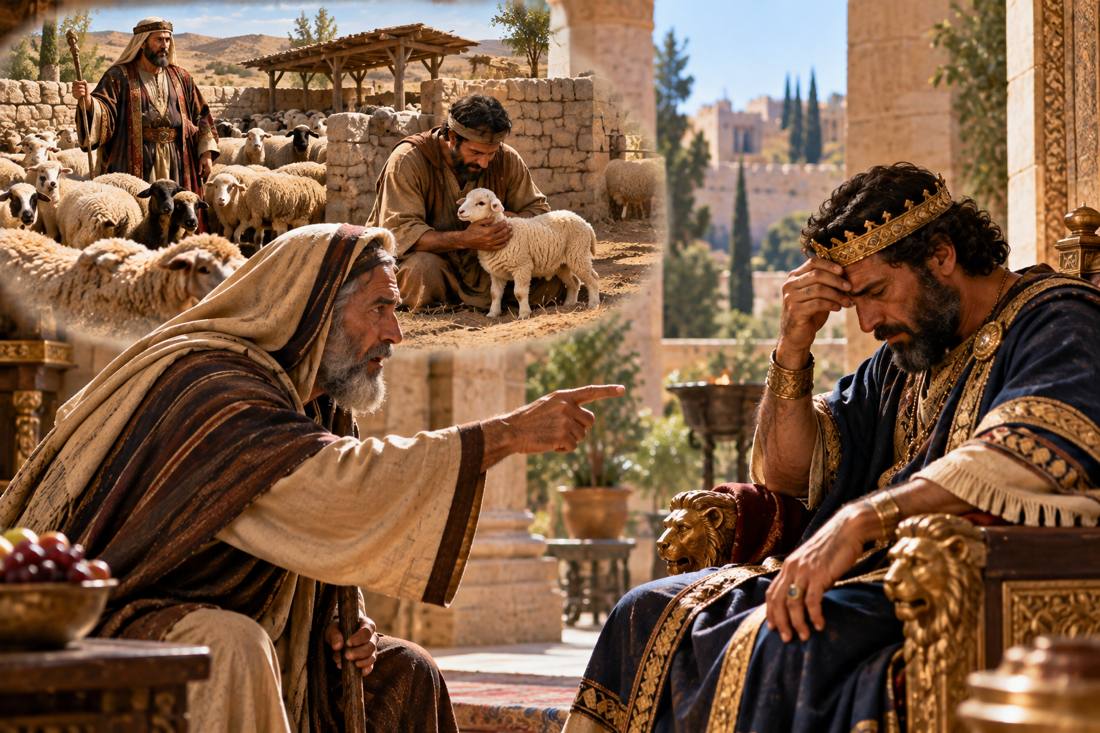
But something had happened. "The thing that David had done displeased the LORD" (2 Samuel 11:27). So God sent a preacher with a story. In Unit 1 we called Nathan's story a juridical parable: the prophet brings the king a case to judge, and the king pronounces sentence on himself. It is the clearest example in the Bible of what a parable can do. It slips past a hardened heart and opens it.
I. The Courage of Nathan
Nathan was a prophet, and we might call him the court preacher. He had brought David good news before: God's promise that David's throne would be established forever (2 Samuel 7). Now God sent him with bad news, and no one likes to carry bad news to a king. David held the power of life and death. Kings in the ancient world often punished the messenger. Nathan could easily have stayed quiet, as the rest of the court apparently did for a whole year. Instead he went.
But notice how he went. He did not burst into the throne room with an accusation. He told a story, and he let David's own sense of justice do the work. That is wisdom in confrontation. A frontal attack often makes a guilty person defensive; a parable lets him see the truth before he has time to raise his guard.
II. The Story (2 Samuel 12:1–4)
"There were two men in one city, one rich and the other poor." The rich man had "exceedingly many flocks and herds." The poor man had nothing "except one little ewe lamb which he had bought and nourished." The lamb grew up with him and his children. "It ate of his own food and drank from his own cup and lay in his bosom; and it was like a daughter to him" (12:3).
Every detail is chosen to stir the listener's heart. This is not livestock; it is a family pet, almost a child. Some interpreters notice that the Hebrew word for "daughter," bat, echoes the name Bath-sheba, and the detail that the lamb "lay in his bosom" quietly recalls what David had done with another man's wife. David does not catch the echo. He hears only a story about a lamb.
Then a traveler came to the rich man. Instead of taking one of his own many animals to prepare a meal, he took the poor man's only lamb and served it to his guest (12:4). It is a picture of selfish power: a man who had everything taking the one thing another man loved.
III. The Verdict (2 Samuel 12:5–7)
"So David's anger was greatly aroused against the man, and he said to Nathan, 'As the LORD lives, the man who has done this shall surely die! And he shall restore fourfold for the lamb, because he did this thing and because he had no pity'" (12:5–6). David knew the law: a stolen sheep was to be repaid four times over (Exodus 22:1). He was a good judge of other people's sins.
Then came four of the most powerful words in the Old Testament: "You are the man!" (12:7). The story snapped shut like a trap. David, the rich king with many wives, had taken the one wife of a poor soldier and then had him killed. He had condemned himself and pronounced his own sentence.
Nathan then spoke for God: "I anointed you king over Israel, and I delivered you from the hand of Saul. I gave you your master's house... and gave you the house of Israel and Judah. And if that had been too little, I also would have given you much more!" (12:7–8). Hear the echo of Isaiah's vineyard song from Unit 2: "What more could have been done to My vineyard?" In both parables, sin is shown against the background of God's generosity. David did not take Bathsheba because God had given him too little. He took her because he despised what God had given.
IV. The Consequences (2 Samuel 12:10–14)
"Now therefore, the sword shall never depart from your house" (12:10). The rest of 2 Samuel tells the painful story. The child born to Bathsheba died. David's son Amnon raped his half-sister Tamar, and her brother Absalom murdered Amnon. Absalom led a rebellion against his father and was killed. Later another son, Adonijah, was executed after trying to seize the throne. Jewish tradition noticed that four of David's sons died, and saw in it a grim echo of the "fourfold" David had pronounced over the rich man.
Here is a truth every pastor must teach carefully: forgiveness does not always remove consequences. God forgave David's guilt, and David did not die. But the sin had already set things in motion in his family that confession did not undo. Any sin leaves scars. We have an advantage over David, because Christ bore the penalty of our sin on the cross. But we should never imagine that because God forgives, sin costs nothing.
V. How David Responded
The turning point is verse 13: "I have sinned against the LORD." And Nathan said, "The LORD also has put away your sin; you shall not die." How differently we usually react when someone tells us we are sinners. David had at least four other choices, and we are tempted by every one of them.
He could have lied. He might have said, "You have no proof. You don't know what I have done." Even a small child learns quickly that lying seems easier than telling the truth. One police officer said he had never met a criminal who admitted to his crime. We readily lie our way out of sin.
He could have blamed someone else. He might have said that Bathsheba had enticed him. That is the oldest defense in the world. When God confronted Adam in the garden, Adam said, "The woman whom You gave to be with me, she gave me of the tree, and I ate" (Genesis 3:12). He blamed the woman and, in the same breath, blamed God.
He could have made excuses. He might have said that he had been a poor shepherd boy, that the pressures of government distracted him, or that Uriah and Bathsheba already had problems in their marriage. We often try to excuse our sin as well.
He could have become angry at the preacher. He might have had Nathan killed for his insolence. People still attack the messenger when they do not like the message.
Instead David admitted his sin. No excuse could suffice, because the all-knowing God looks directly into the heart and cannot be deceived. He knows our open sins and our secret sins, our sins of commission and our sins of omission. The One who counts the hairs of our heads knows about our sins. A heart that had been separated from God and frozen for a year was finally thawed.
VI. The Year of Silence and the Psalm of Confession
Psalm 51 is titled "when Nathan the prophet went to him, after he had gone in to Bathsheba." It begins, "Have mercy upon me, O God, according to Your lovingkindness," and it cries, "Against You, You only, have I sinned, and done this evil in Your sight" (Psalm 51:1, 4). David had sinned terribly against Bathsheba and Uriah, but he understood that every sin is ultimately a sin against God. Psalm 32, which many connect with the same season, describes the year he spent hiding his sin: "When I kept silent, my bones grew old through my groaning all the day long... I acknowledged my sin to You... and You forgave the iniquity of my sin" (Psalm 32:3–5).
Willful sin separates us from the sense of God's presence, and it is one of the main reasons prayer goes unanswered (Psalm 66:18). Rebellion against God never makes us happy. I remember reaching my teenage years and deciding that I could make my own decisions. I did not want my parents telling me to study, when to come home, or what chores to do. Eventually I rebelled against God too and decided church was not important for me. It took me several years to learn that doing what I wanted was not as good as it was supposed to be. In fact, it was the most miserable time of my life. Perhaps God allows us to hit rock bottom so that we have nowhere else to turn, and then He stands waiting for us with open arms. Jesus' prodigal son "came to himself" in the pigpen (Luke 15:17) and went home to a father who ran to meet him. God works to confront us with our sin, sometimes through conscience, sometimes through the hardships of life, and sometimes through a faithful friend like Nathan.
VII. Forgiveness and a New Direction
We cannot change the past. There is no time machine to go back and correct our sins. Lady Macbeth, in Shakespeare's play, tried in vain to wash imaginary bloodstains from her hands. We can never clear our own consciences. If we are to be forgiven, God must forgive us, and the Bible says He does. When we pray as the tax collector did, "God, be merciful to me a sinner!" (Luke 18:13), God answers, "Their sins and their lawless deeds I will remember no more" (Hebrews 8:12).
There was once a girl who grew up an orphan. Her mother had died, and her father had disappeared and was presumed dead. She had never known what it meant to be loved. Through the years her father had become successful, but he was unhappy, because he knew he had a daughter somewhere and could not find her. After nearly twenty years of searching, he followed a new lead to Atlanta. When he was sure she was his child, he drove to the cheap boarding house where she lived and said, "I am your father, and I have come to take you home." That is what forgiveness is like. We are not merely excused; we are brought home.
Confession also carries an obligation. When Zacchaeus met Jesus, he said, "If I have taken anything from anyone by false accusation, I restore fourfold" (Luke 19:8), the same fourfold that David had demanded of the rich man. We cannot change the past, but where possible we should make our wrongs right. And there is no real repentance if we are content to commit the same sins over and over. We never stand still in life; we are either moving toward God or away from Him. Even now you are writing the biography of the person you will be in five years.
VIII. Preaching the Ewe Lamb
A pastor can follow David's path: he was confronted with his sin, he acknowledged it without lies, blame, excuses, or anger, he was sorry for it, as Psalm 51 shows, and he turned from it to receive God's forgiveness. The sermon may also teach a word about confrontation itself. Pastors are sometimes called to be Nathans. The method of the parable, wise, indirect, and aimed at the conscience, is often more effective than a direct accusation, and it requires courage either way.
Nathan's parable belongs to a small family. The wise woman of Tekoa told David a made-up case about her sons to move him to bring Absalom home (2 Samuel 14:1–20). A wounded prophet told King Ahab a story about a lost prisoner, and Ahab judged himself (1 Kings 20:35–43). In each, a king sits as judge and discovers he is the defendant. Jesus used the same method when He asked the chief priests what the vineyard owner would do to the wicked tenants (Matthew 21:40–41).
Ian Maclaren told a story of a stern Scottish elder named Lachlan Campbell whose daughter Flora ran away from home. When reports came back of her sinful life, he struck her name from the family Bible. But a kind woman in the village wrote to Flora, and one night the prodigal came home. She found that her father's heart had broken and her name had been written back into the family Bible in the trembling hand of an old man. If a hard earthly father can receive a prodigal home, how much more gladly will God receive us?
Closing
"You are the man!" Those words are not only for David. Every one of us has taken what was not ours, justified ourselves, and judged others for the very sins we have committed. But Nathan did not come only to condemn. He came to bring David home. The same God who confronts us is the God who forgives, and the story that exposes our sin can become the story of our return.
— Dr. Wayne Cook
Chapala Theological Seminary
Orientación
David fue uno de los hombres más grandes que han vivido. Mató a Goliat, unió a las tribus de Israel, escribió muchos de los salmos y la Escritura lo llama "varón conforme al corazón de Dios". Sin embargo, David quebrantó tres de los Diez Mandamientos en una sola temporada. Codició a la mujer de su prójimo, cometió adulterio con Betsabé y dispuso la muerte de su esposo Urías, uno de sus soldados más leales (2 Samuel 11). Luego se casó con la viuda, nació el bebé, y durante cerca de un año David siguió adelante como si nada hubiera pasado.
Pero sí había pasado algo. "Esto que David había hecho, fue desagradable ante los ojos de Jehová" (2 Samuel 11:27). Así que Dios envió a un predicador con una historia. En la Unidad 1 llamamos a la historia de Natán una parábola judicial: el profeta presenta al rey un caso para juzgar, y el rey dicta sentencia contra sí mismo. Es el ejemplo más claro en la Biblia de lo que puede hacer una parábola. Pasa por encima de un corazón endurecido y lo abre.
I. El valor de Natán
Natán era profeta, y podríamos llamarlo el predicador de la corte. Ya le había llevado a David buenas noticias: la promesa de Dios de que el trono de David sería establecido para siempre (2 Samuel 7). Ahora Dios lo enviaba con malas noticias, y a nadie le gusta llevarle malas noticias a un rey. David tenía poder de vida y muerte. Los reyes del mundo antiguo a menudo castigaban al mensajero. Natán fácilmente pudo haberse quedado callado, como al parecer lo hizo el resto de la corte durante todo un año. En cambio, fue.
Pero note cómo fue. No irrumpió en la sala del trono con una acusación. Contó una historia y dejó que el propio sentido de justicia de David hiciera el trabajo. Eso es sabiduría al confrontar. Un ataque de frente a menudo pone a la defensiva a la persona culpable; una parábola le permite ver la verdad antes de que tenga tiempo de levantar la guardia.
II. La historia (2 Samuel 12:1–4)
"Había dos hombres en una ciudad, el uno rico, y el otro pobre." El rico tenía "numerosas ovejas y vacas". El pobre no tenía nada "sino una sola corderita, que él había comprado y criado". La corderita creció con él y con sus hijos. "Comiendo de su bocado y bebiendo de su vaso, y durmiendo en su seno; y la tenía como a una hija" (12:3).
Cada detalle está escogido para conmover el corazón del oyente. No es ganado; es una mascota de la familia, casi una hija. Algunos intérpretes notan que la palabra hebrea para "hija", bat, hace eco del nombre Betsabé (Bat-sheba), y el detalle de que la corderita "dormía en su seno" recuerda en silencio lo que David había hecho con la esposa de otro hombre. David no capta el eco. Solo oye una historia sobre una corderita.
Entonces llegó un visitante al hombre rico. En lugar de tomar uno de sus muchos animales para preparar la comida, tomó la única corderita del hombre pobre y la sirvió a su huésped (12:4). Es un cuadro del poder egoísta: un hombre que lo tenía todo tomando lo único que otro hombre amaba.
III. El veredicto (2 Samuel 12:5–7)
"Entonces se encendió el furor de David en gran manera contra aquel hombre, y dijo a Natán: Vive Jehová, que el que tal hizo es digno de muerte. Y debe pagar la cordera con cuatro tantos, porque hizo tal cosa, y no tuvo misericordia" (12:5–6). David conocía la ley: una oveja robada debía pagarse cuatro veces (Éxodo 22:1). Era un buen juez de los pecados ajenos.
Entonces vinieron cuatro de las palabras más poderosas del Antiguo Testamento: "Tú eres aquel hombre" (12:7). La historia se cerró como una trampa. David, el rey rico con muchas esposas, había tomado la única esposa de un soldado pobre y luego lo había hecho matar. Se había condenado a sí mismo y había dictado su propia sentencia.
Luego Natán habló de parte de Dios: "Yo te ungí por rey sobre Israel, y te libré de la mano de Saúl, y te di la casa de tu señor... y además te di la casa de Israel y de Judá; y si esto fuera poco, te habría añadido mucho más" (12:7–8). Oiga el eco del canto de la viña de Isaías de la Unidad 2: "¿Qué más se podía hacer a mi viña?" En ambas parábolas el pecado se muestra sobre el fondo de la generosidad de Dios. David no tomó a Betsabé porque Dios le hubiera dado demasiado poco. La tomó porque menospreció lo que Dios le había dado.
IV. Las consecuencias (2 Samuel 12:10–14)
"Por lo cual ahora no se apartará jamás de tu casa la espada" (12:10). El resto de 2 Samuel cuenta la dolorosa historia. El niño que nació de Betsabé murió. Amnón, hijo de David, violó a su media hermana Tamar, y el hermano de ella, Absalón, asesinó a Amnón. Absalón encabezó una rebelión contra su padre y fue muerto. Más tarde otro hijo, Adonías, fue ejecutado después de intentar apoderarse del trono. La tradición judía notó que cuatro de los hijos de David murieron, y vio en ello un eco sombrío del "cuatro tantos" que David había pronunciado sobre el hombre rico.
Aquí hay una verdad que todo pastor debe enseñar con cuidado: el perdón no siempre elimina las consecuencias. Dios perdonó la culpa de David, y David no murió. Pero el pecado ya había puesto en marcha en su familia cosas que la confesión no deshizo. Todo pecado deja cicatrices. Tenemos una ventaja sobre David, porque Cristo cargó el castigo de nuestro pecado en la cruz. Pero nunca debemos imaginar que, porque Dios perdona, el pecado no cuesta nada.
V. Cómo respondió David
El punto decisivo es el versículo 13: "Pequé contra Jehová." Y Natán dijo: "También Jehová ha remitido tu pecado; no morirás." Qué diferente solemos reaccionar cuando alguien nos dice que somos pecadores. David tenía al menos otras cuatro opciones, y nosotros somos tentados por cada una de ellas.
Pudo haber mentido. Pudo haber dicho: "No tienes pruebas. No sabes lo que he hecho." Aun un niño pequeño aprende pronto que mentir parece más fácil que decir la verdad. Un policía dijo que nunca había conocido a un criminal que admitiera su crimen. Fácilmente mentimos para salir de nuestro pecado.
Pudo haber culpado a otro. Pudo haber dicho que Betsabé lo había seducido. Esa es la defensa más antigua del mundo. Cuando Dios confrontó a Adán en el huerto, Adán dijo: "La mujer que me diste por compañera me dio del árbol, y yo comí" (Génesis 3:12). Culpó a la mujer y, en el mismo aliento, culpó a Dios.
Pudo haber puesto excusas. Pudo haber dicho que había sido un pobre pastorcito, que las presiones del gobierno lo distraían, o que Urías y Betsabé ya tenían problemas en su matrimonio. Nosotros también a menudo intentamos excusar nuestro pecado.
Pudo haberse enojado con el predicador. Pudo haber mandado matar a Natán por su insolencia. La gente todavía ataca al mensajero cuando no le gusta el mensaje.
En cambio, David admitió su pecado. Ninguna excusa bastaba, porque el Dios que todo lo sabe mira directamente al corazón y no puede ser engañado. Él conoce nuestros pecados públicos y nuestros pecados secretos, nuestros pecados de comisión y nuestros pecados de omisión. El que cuenta los cabellos de nuestra cabeza conoce nuestros pecados. Un corazón que había estado separado de Dios y congelado durante un año finalmente se derritió.
VI. El año de silencio y el salmo de confesión
El Salmo 51 lleva por título "cuando después que se llegó a Betsabé, vino a él Natán el profeta". Comienza: "Ten piedad de mí, oh Dios, conforme a tu misericordia", y clama: "Contra ti, contra ti solo he pecado, y he hecho lo malo delante de tus ojos" (Salmo 51:1, 4). David había pecado terriblemente contra Betsabé y Urías, pero entendió que todo pecado es, en última instancia, un pecado contra Dios. El Salmo 32, que muchos relacionan con la misma temporada, describe el año que pasó escondiendo su pecado: "Mientras callé, se envejecieron mis huesos en mi gemir todo el día... Mi pecado te declaré... y tú perdonaste la maldad de mi pecado" (Salmo 32:3–5).
El pecado voluntario nos separa del sentido de la presencia de Dios, y es una de las razones principales por las que la oración queda sin respuesta (Salmo 66:18). La rebelión contra Dios nunca nos hace felices. Recuerdo llegar a mi adolescencia y decidir que yo podía tomar mis propias decisiones. No quería que mis padres me dijeran que estudiara, a qué hora volver a casa o qué quehaceres hacer. Con el tiempo me rebelé también contra Dios y decidí que la iglesia no era importante para mí. Me tomó varios años aprender que hacer lo que yo quería no era tan bueno como parecía. De hecho, fue el tiempo más miserable de mi vida. Quizás Dios permite que toquemos fondo para que no tengamos adónde más volvernos, y entonces Él nos espera con los brazos abiertos. El hijo pródigo de Jesús "volviendo en sí" en el chiquero (Lucas 15:17) regresó a casa a un padre que corrió a su encuentro. Dios obra para confrontarnos con nuestro pecado, a veces por medio de la conciencia, a veces por las dificultades de la vida, y a veces por medio de un amigo fiel como Natán.
VII. El perdón y una nueva dirección
No podemos cambiar el pasado. No hay máquina del tiempo para regresar y corregir nuestros pecados. Lady Macbeth, en la obra de Shakespeare, intentó en vano lavar de sus manos unas manchas de sangre imaginarias. Nunca podemos limpiar nuestra propia conciencia. Si hemos de ser perdonados, Dios tiene que perdonarnos, y la Biblia dice que lo hace. Cuando oramos como el publicano: "Dios, sé propicio a mí, pecador" (Lucas 18:13), Dios responde: "nunca más me acordaré de sus pecados y de sus iniquidades" (Hebreos 8:12).
Había una vez una muchacha que creció huérfana. Su madre había muerto, y su padre había desaparecido y se le creía muerto. Nunca había sabido lo que era ser amada. Con los años su padre había llegado a tener éxito, pero era infeliz, porque sabía que tenía una hija en algún lugar y no podía encontrarla. Después de casi veinte años de búsqueda, siguió una nueva pista hasta Atlanta. Cuando estuvo seguro de que era su hija, llegó a la humilde casa de huéspedes donde ella vivía y le dijo: "Soy tu padre, y he venido a llevarte a casa." Así es el perdón. No solo somos disculpados; somos llevados a casa.
La confesión también trae una obligación. Cuando Zaqueo conoció a Jesús, dijo: "si en algo he defraudado a alguno, se lo devuelvo cuadruplicado" (Lucas 19:8), los mismos cuatro tantos que David había exigido al hombre rico. No podemos cambiar el pasado, pero donde sea posible debemos reparar nuestros males. Y no hay verdadero arrepentimiento si nos conformamos con cometer los mismos pecados una y otra vez. Nunca estamos quietos en la vida; o nos acercamos a Dios o nos alejamos de Él. Aun ahora usted está escribiendo la biografía de la persona que será dentro de cinco años.
VIII. Cómo predicar la Corderita
El pastor puede seguir el camino de David: fue confrontado con su pecado, lo reconoció sin mentiras, culpas, excusas ni enojo, estuvo arrepentido de él, como muestra el Salmo 51, y se volvió de él para recibir el perdón de Dios. El sermón también puede enseñar algo sobre la confrontación misma. A veces los pastores son llamados a ser Natanes. El método de la parábola, sabio, indirecto y dirigido a la conciencia, a menudo es más eficaz que una acusación directa, y de todos modos requiere valor.
La parábola de Natán pertenece a una pequeña familia. La mujer sabia de Tecoa le contó a David un caso inventado sobre sus hijos para moverlo a traer a Absalón de regreso (2 Samuel 14:1–20). Un profeta herido le contó al rey Acab una historia sobre un prisionero perdido, y Acab se juzgó a sí mismo (1 Reyes 20:35–43). En cada caso, un rey se sienta como juez y descubre que él es el acusado. Jesús usó el mismo método cuando preguntó a los principales sacerdotes qué haría el dueño de la viña a los labradores malvados (Mateo 21:40–41).
Ian Maclaren contó la historia de un severo anciano escocés llamado Lachlan Campbell, cuya hija Flora huyó de casa. Cuando llegaron noticias de su vida de pecado, él borró su nombre de la Biblia familiar. Pero una mujer bondadosa del pueblo le escribió a Flora, y una noche la pródiga volvió a casa. Descubrió que el corazón de su padre se había quebrantado y que su nombre había sido escrito de nuevo en la Biblia familiar con la mano temblorosa de un anciano. Si un padre terrenal duro puede recibir de vuelta a una hija pródiga, ¿cuánto más gustosamente nos recibirá Dios?
Conclusión
"Tú eres aquel hombre." Esas palabras no son solo para David. Cada uno de nosotros ha tomado lo que no era suyo, se ha justificado a sí mismo y ha juzgado a otros por los mismos pecados que ha cometido. Pero Natán no vino solo a condenar. Vino a llevar a David de regreso a casa. El mismo Dios que nos confronta es el Dios que perdona, y la historia que expone nuestro pecado puede convertirse en la historia de nuestro regreso.
— Dr. Wayne Cook
Seminario Teológico de Chapala
Unit 5 ExamExamen de la Unidad 5
Certificate track: the 20 multiple-choice questions. Associate: multiple choice and the 10 fill-in-the-blank questions. M.Div. and Th.M.: multiple choice, fill-ins and the 10 short-answer questions. 90% of each part is required to pass. If you do not pass, the exam waits a short time before you can try again.Certificado: las 20 preguntas de opción múltiple. Asociado: opción múltiple y las 10 preguntas de completar el espacio en blanco. M.Div. y Th.M.: opción múltiple, completar el espacio y las 10 preguntas de desarrollo. Se requiere 90% en cada parte para aprobar. Si no aprueba, el examen espera un tiempo breve antes de intentarlo de nuevo.