Register once, for every courseRegístrese una vez, para todos los cursos
Your progress is saved in this browser as you study, and kept with the seminary under your student code, so you can continue on any device. Keep the code private, like a password. A confirmed email is needed only to receive a certificate. What we keep.Su progreso se guarda en este navegador mientras estudia, y en el seminario bajo su código de estudiante, para que pueda continuar en cualquier dispositivo. Mantenga el código en privado, como una contraseña. Solo se necesita un correo confirmado para recibir un certificado. Lo que guardamos.
The Certificate track answers the multiple choice. The Associate adds the fill-in-the-blank questions; M.Div. and Th.M. add those and the short-answer questions. 90% of each part is required to pass.El trayecto de Certificado responde la opción múltiple. El Asociado añade las preguntas de completar el espacio en blanco; M.Div. y Th.M. añaden esas y las preguntas de desarrollo. Se requiere 90% en cada parte para aprobar.
Orientation
The phrase "Good Samaritan" is used around the world to describe anyone who goes out of his way to help a stranger. Hospitals are named after him, and many countries have "Good Samaritan laws" that protect people who stop to help in an emergency. The final episode of the American comedy Seinfeld in 1998 even ended with its four main characters arrested in a small Massachusetts town under a new "Good Samaritan law," because they had stood on the sidewalk joking and filming while a man was robbed, and never lifted a finger to help. I couldn't help but wonder whether the writers took the whole episode right out of Luke's story.
The parable is so familiar that it is easy to hear it as a simple lesson in being nice. But Jesus told it in a tense moment, to a man trying to trap Him and to justify himself. In Unit 1 we used this parable to show two dangers: over-allegorizing, as Augustine did, and moralizing, reducing the story to "be kind to people." In this unit we read it in its setting and let it do what Jesus meant it to do.
I. The Lawyer's Questions (Luke 10:25–29)
A lawyer, an expert in the law of Moses, "stood up and tested Him, saying, 'Teacher, what shall I do to inherit eternal life?'" (10:25). It was the most important question anyone can ask, but he asked it to make this Galilean carpenter with no degrees or credentials look foolish before the crowd. Jesus turned the question back to the expert: "What is written in the law? What is your reading of it?" The lawyer answered well, quoting Deuteronomy 6:5 and Leviticus 19:18: love God with all your heart, soul, strength, and mind, and "your neighbor as yourself." Jesus said, "You have answered rightly; do this and you will live" (10:28). The tester was now being tested.
"But he, wanting to justify himself, said to Jesus, 'And who is my neighbor?'" (10:29). In typical lawyer fashion, he tried to defend himself by narrowing the definition. Leviticus 19:18 speaks of "the children of your people," and many in that day limited "neighbor" to fellow Jews, and some to fellow Jews who kept the law as strictly as they did. If he could draw the circle small enough, he could claim to have kept the commandment. Jesus did not answer with a dictionary definition. He told a story.
II. The Robbers: "What's Yours Is Mine, and I Will Take It"
"A certain man went down from Jerusalem to Jericho, and fell among thieves, who stripped him of his clothing, wounded him, and departed, leaving him half dead" (10:30). The road from Jerusalem to Jericho runs about seventeen miles and drops some 3,300 feet through barren, rocky hills full of sharp turns and narrow passes where bandits could hide. Early Christian writers called part of it the "bloody way." The robbers took even the man's clothes and beat him almost to death.
The robbers represent a philosophy of life: "What's yours is mine, and I will take it." They saw the traveler not as a person but as an opportunity. That attitude is still with us. The eighth commandment says, "You shall not steal," and we can steal by not paying our debts, by not giving an honest day's work, and even, as Malachi 3:8 warns, by robbing God in tithes and offerings.
For years my wife Andi and I worked in prison ministry in Louisiana. An inmate named Scott later wrote about the prison where he had been living "like a king from a penitentiary perspective," smuggling phones and fighting. On Christmas of 2009 a gang member tried to steal his cell phone and stabbed him, and Scott believes guards friendly to that man tried to put him in the same cell. A few hours later, at two in the morning, Scott's name was called for a transfer that his grandfather and our ministry had already requested. He wrote that God had orchestrated it and saved his life, and that at the new prison he found peace and opportunities he would never have pursued on the streets. The robbers' philosophy nearly killed him. Grace rescued him.
III. The Religious: "What's Mine Is Mine, and I Will Keep It"
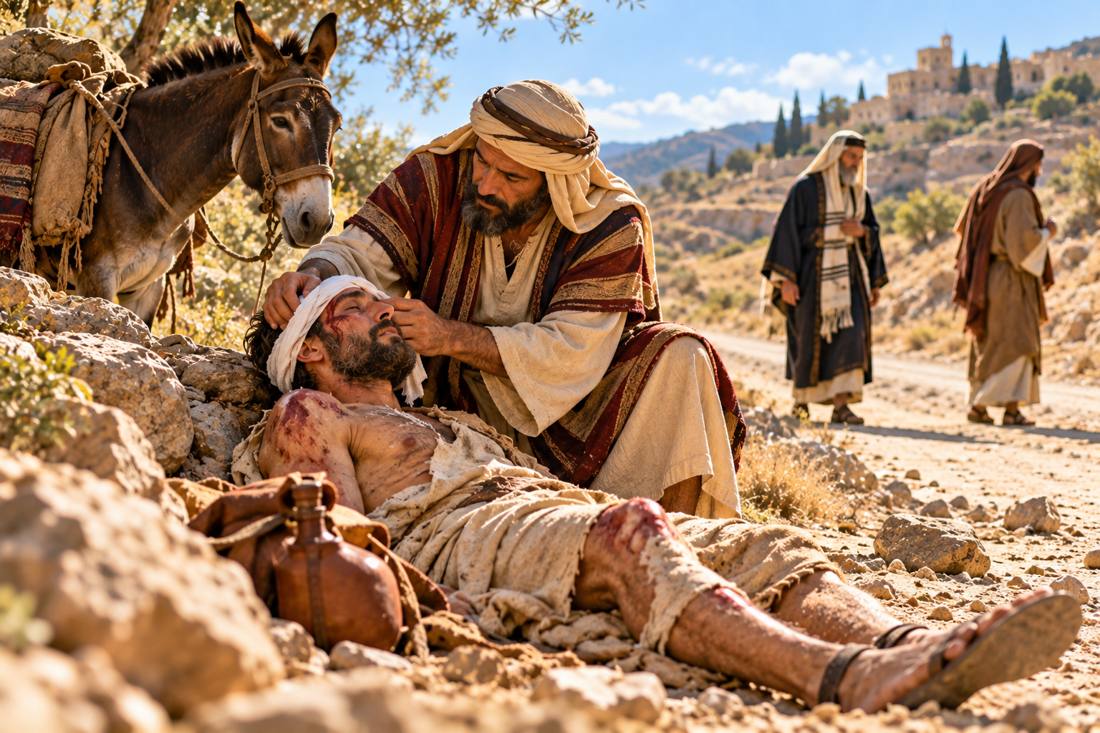
"Now by chance a certain priest came down that road. And when he saw him, he passed by on the other side. Likewise a Levite, when he arrived at the place, came and looked, and passed by on the other side" (10:31–32). There were so many priests in Israel that each one served in the temple for only two weeks a year, and many of them lived in Jericho. Jesus' hearers would have expected a man of God to rush to help. The Levite, a temple assistant, went a little further: he came and looked, and then hurried on.
They may have had their reasons. The law forbade priests to touch a dead body (Leviticus 21:1–4), and the man lay "half dead"; he might not have been moving. The Levite may have known that bandits sometimes used a "wounded" decoy to ambush travelers who stopped to help. Maybe you have passed someone broken down on the highway because you were afraid or in a hurry. But the law was just as clear about helping those in need, even an enemy: "If you meet your enemy's ox or his donkey going astray, you shall surely bring it back to him again" (Exodus 23:4). The priest was perfectly orthodox, and he left a man to die in a ditch. The religious philosophy says, "What's mine is mine, and I will keep it": my time, my safety, my purity, my schedule.
James asks, "If a brother or sister is naked and destitute of daily food, and one of you says to them, 'Depart in peace, be warmed and filled,' but you do not give them the things which are needed for the body, what does it profit?" (James 2:15–16). A Christian woman named Diane Dew wrote about the months she and her young son were homeless. At a prayer meeting she asked for prayer for a place to live, and the very next request came from a church member asking God to send a tenant for his empty apartment. When she asked to rent it, he turned her down and told her she needed to trust God more. A church refused her a box of food from its pantry because "we haven't seen you here lately," though the week before no one would give her a ride to the service. Pastors gave her verses and advice but no help. In the end, strangers who read her story in a newspaper offered housing and work. Jesus said, "Inasmuch as you did it to one of the least of these My brethren, you did it to Me" (Matthew 25:40). There is an old legend about Martin of Tours, a Roman soldier who cut his cloak in half to give to a freezing beggar at the city gate. That night he dreamed he saw Jesus in heaven wearing half a soldier's cloak. When an angel asked why, Jesus answered, "My servant Martin gave it to Me."
IV. The Redeemer: "What's Mine Is Yours, and I Will Share It"
"But a certain Samaritan, as he journeyed, came where he was. And when he saw him, he had compassion" (10:33). Up to this point everyone liked the story. After a priest and a Levite, the crowd expected the hero to be an ordinary Jewish man. Instead Jesus named the last person they wanted to hear. After Assyria conquered the northern kingdom in 722 BC, foreigners were settled in the land and intermarried with the Israelites who remained. The Jews of Jerusalem despised their descendants, the Samaritans, as half-breeds and heretics who worshiped on Mount Gerizim instead of in Jerusalem (John 4:20). The last person anyone expected to help a wounded Jew was a Samaritan.
Look at what he did. "He went to him and bandaged his wounds, pouring on oil and wine; and he set him on his own animal, brought him to an inn, and took care of him" (10:34). Oil soothed and wine cleaned the wounds. He walked so the wounded man could ride. He stayed the night. The next day he gave the innkeeper two denarii, two days' wages, and said, "Take care of him; and whatever more you spend, when I come again, I will repay you" (10:35). He handed the innkeeper a blank check for a stranger. His philosophy was, "What's mine is yours, and I will share it."
Alan Chalmers told of a famous engineer named Peter Holme who built bridges and railroads but lost everything and returned in poverty to his home village. His neighbor kept a vicious dog, and when Holme warned him, the old man cursed him. One day Holme came home to find the dog at his little daughter's throat, and she died. The whole village turned against the dog's owner; at planting time no one would sell him seed, and his plowed fields lay bare. Very early one morning, Holme took his own last half bushel of barley, climbed the fence, and sowed his neighbor's field. When the grain came up, the fields told the story: part of Holme's field lay bare, and his enemy's field was green. That is what the Samaritan did.
Compassion is still practical. In West Virginia a man named Stan Allman read in the newspaper about a forty-year-old father of three, on welfare, who was hitchhiking thirty miles each day to finish his engineering degree. Allman bagged groceries part-time, and his wife worked at a fast-food restaurant, but they had three vehicles and only two drivers. So they gave the student their old pickup truck. "Thank you, Jesus!" his wife cried when she heard.
V. The Question Turned Around (Luke 10:36–37)
Then Jesus gave the lawyer a test of his own: "Which of these three do you think was neighbor to him who fell among the thieves?" (10:36). Notice that Jesus changed the question. The lawyer had asked, "Who is my neighbor?" meaning, "Whom am I required to love?" Jesus asked, "Who proved to be a neighbor?" The real question is not "Who qualifies for my love?" but "To whom can I be a neighbor?" The lawyer could not even bring himself to say the word "Samaritan." He answered, "He who showed mercy on him." And Jesus said, "Go and do likewise" (10:37).
A pastor in Gary, Indiana, told of a woman in her Bible study who was hiding from an abusive husband who had tried to have her killed. She lived in a wretched apartment above a drug house. When someone broke down her back door one night, the police did not come, and social services had not been able to help her, but the drug dealers downstairs sat on the stairs all night to protect her. In her story the police were the priest, the social services were the Levite, and the drug dealers were the Samaritan. The parable still shocks us when we see who proves to be a neighbor, and who does not.
How can we know whether we love God? The old steam engines had great boilers, and it was impossible to see how much water was inside. So a small glass tube ran along the outside as a gauge. John gives us the gauge for our love for God: "Whoever has this world's goods, and sees his brother in need, and shuts up his heart from him, how does the love of God abide in him?" (1 John 3:17). Our love for others shows how much love for God is really inside.
VI. The Samaritan and the Savior
In Unit 1 we saw how Augustine turned every detail of this parable into a symbol: the inn became the church and the innkeeper became Paul. We should not do that. The inn is an inn. But we should not miss the larger truth either. The lawyer asked what he must do to inherit eternal life, and the parable shows that no one loves his neighbor perfectly. It exposes the lawyer's attempt to justify himself, and ours. We cannot earn eternal life by keeping this commandment; we have all passed by on the other side.
And we cannot help seeing Jesus in the Samaritan. Jesus was Himself despised and called a Samaritan by His enemies (John 8:48). We were the ones lying helpless by the road, wounded by sin, unable to pick ourselves up. Christ did not pass by on the other side. At the cost of His own life He came to where we were, bound up our wounds, and paid whatever it cost to make us whole. The tragedy is that many people today, like the lawyer, have seen Christ but have not recognized Him as their Savior. Only those who have received the Samaritan's mercy can truly "go and do likewise."
VII. Preaching the Good Samaritan
This parable preaches clearly with three philosophies of life: the robbers, "What's yours is mine, and I will take it"; the religious, "What's mine is mine, and I will keep it"; and the Redeemer, "What's mine is yours, and I will share it." Ask the congregation which philosophy rules their lives. Be sure to include the gospel: the parable shows our need of a Savior before it sends us out to serve. Close with practical application. Many of us need to relax our schedules so that we have energy to care; Jesus never seemed rushed, and the priest and Levite probably had important places to be. Mother Teresa, according to a well-known story, once answered a young man who asked how to make his life count with a card that said, "Find your own Calcutta."
Haddon Robinson told of asking his young son what he had learned in Sunday school. The boy described the Good Samaritan in detail. "Son, what is the spiritual lesson of the story?" his father asked. The boy thought and said, "That whenever I'm in trouble, you've got to help me." It is not the whole answer, but from the ditch beside the road, it is one way of looking at a neighbor.
Closing
All the world lies between Jerusalem and Jericho, and it is full of wounded people. The robbers still say, "What's yours is mine." The religious still say, "What's mine is mine." But the Redeemer came down that road and said, "What's mine is yours." A prayer traditionally attributed to Teresa of Ávila puts it this way: Christ has no body now on earth but yours, no hands but yours, no feet but yours. Having received His mercy, we hear His command: "Go and do likewise."
— Dr. Wayne Cook
Chapala Theological Seminary
Orientación
La frase "Buen Samaritano" se usa en todo el mundo para describir a cualquiera que se desvía de su camino para ayudar a un desconocido. Hay hospitales con su nombre, y muchos países tienen "leyes del Buen Samaritano" que protegen a quienes se detienen a ayudar en una emergencia. El último episodio de la comedia estadounidense Seinfeld en 1998 incluso terminó con sus cuatro personajes principales arrestados en un pueblito de Massachusetts bajo una nueva "ley del Buen Samaritano", porque se quedaron en la acera bromeando y filmando mientras asaltaban a un hombre, y nunca movieron un dedo para ayudar. No pude evitar preguntarme si los escritores sacaron todo el episodio directamente de la historia de Lucas.
La parábola es tan conocida que es fácil oírla como una simple lección de ser amables. Pero Jesús la contó en un momento tenso, a un hombre que intentaba atraparlo y justificarse a sí mismo. En la Unidad 1 usamos esta parábola para mostrar dos peligros: alegorizar en exceso, como hizo Agustín, y moralizar, reduciendo la historia a "sea amable con la gente". En esta unidad la leemos en su contexto y dejamos que haga lo que Jesús quiso que hiciera.
I. Las preguntas del intérprete de la ley (Lucas 10:25–29)
Un intérprete de la ley, un experto en la ley de Moisés, "se levantó y dijo, para probarle: Maestro, ¿haciendo qué cosa heredaré la vida eterna?" (10:25). Era la pregunta más importante que alguien puede hacer, pero la hizo para que este carpintero galileo sin títulos ni credenciales quedara en ridículo ante la multitud. Jesús devolvió la pregunta al experto: "¿Qué está escrito en la ley? ¿Cómo lees?" El intérprete respondió bien, citando Deuteronomio 6:5 y Levítico 19:18: amar a Dios con todo el corazón, el alma, las fuerzas y la mente, "y a tu prójimo como a ti mismo". Jesús dijo: "Bien has respondido; haz esto, y vivirás" (10:28). El que probaba ahora estaba siendo probado.
"Pero él, queriendo justificarse a sí mismo, dijo a Jesús: ¿Y quién es mi prójimo?" (10:29). Como buen abogado, trató de defenderse estrechando la definición. Levítico 19:18 habla de "los hijos de tu pueblo", y muchos en ese tiempo limitaban "prójimo" a los judíos, y algunos solo a los judíos que guardaban la ley tan estrictamente como ellos. Si podía dibujar un círculo lo bastante pequeño, podía afirmar que había cumplido el mandamiento. Jesús no respondió con una definición de diccionario. Contó una historia.
II. Los ladrones: "Lo tuyo es mío, y lo tomaré"
"Un hombre descendía de Jerusalén a Jericó, y cayó en manos de ladrones, los cuales le despojaron; e hiriéndole, se fueron, dejándole medio muerto" (10:30). El camino de Jerusalén a Jericó mide unos veintisiete kilómetros y baja más de mil metros por colinas áridas y rocosas, llenas de curvas cerradas y pasos angostos donde podían esconderse los bandidos. Escritores cristianos antiguos llamaron a parte de él el "camino sangriento". Los ladrones le quitaron aun la ropa y lo golpearon casi hasta matarlo.
Los ladrones representan una filosofía de vida: "Lo tuyo es mío, y lo tomaré". Vieron al viajero no como persona sino como oportunidad. Esa actitud sigue con nosotros. El octavo mandamiento dice: "No hurtarás", y podemos robar al no pagar nuestras deudas, al no dar un día de trabajo honrado, y aun, como advierte Malaquías 3:8, robándole a Dios en los diezmos y las ofrendas.
Durante años mi esposa Andi y yo trabajamos en el ministerio carcelario en Luisiana. Un preso llamado Scott escribió después acerca de la cárcel donde vivía "como un rey desde el punto de vista de la penitenciaría", metiendo teléfonos de contrabando y peleando. En la Navidad de 2009 un pandillero trató de robarle su celular y lo apuñaló, y Scott cree que guardias amigos de ese hombre intentaron ponerlo en la misma celda. Unas horas después, a las dos de la mañana, llamaron el nombre de Scott para un traslado que su abuelo y nuestro ministerio ya habían solicitado. Escribió que Dios lo había dispuesto todo y le había salvado la vida, y que en la nueva cárcel encontró paz y oportunidades que nunca habría buscado en la calle. La filosofía de los ladrones casi lo mata. La gracia lo rescató.
III. Los religiosos: "Lo mío es mío, y me lo quedo"
"Aconteció que descendió un sacerdote por aquel camino, y viéndole, pasó de largo. Asimismo un levita, llegando cerca de aquel lugar, y viéndole, pasó de largo" (10:31–32). Había tantos sacerdotes en Israel que cada uno servía en el templo solo dos semanas al año, y muchos vivían en Jericó. Los oyentes de Jesús esperaban que un hombre de Dios corriera a ayudar. El levita, un ayudante del templo, fue un poco más lejos: se acercó, miró y luego se apresuró a seguir.
Quizás tenían sus razones. La ley prohibía a los sacerdotes tocar un cadáver (Levítico 21:1–4), y el hombre estaba "medio muerto"; tal vez no se movía. El levita quizás sabía que los bandidos a veces usaban un "herido" como señuelo para asaltar a los viajeros que se detenían a ayudar. Quizás usted ha pasado junto a alguien descompuesto en la carretera por miedo o por prisa. Pero la ley era igualmente clara en cuanto a ayudar al necesitado, aun al enemigo: "Si encontrares el buey de tu enemigo o su asno extraviado, vuelve a llevárselo" (Éxodo 23:4). El sacerdote era perfectamente ortodoxo, y dejó morir a un hombre en una zanja. La filosofía religiosa dice: "Lo mío es mío, y me lo quedo": mi tiempo, mi seguridad, mi pureza, mi horario.
Santiago pregunta: "Y si un hermano o una hermana están desnudos, y tienen necesidad del mantenimiento de cada día, y alguno de vosotros les dice: Id en paz, calentaos y saciaos, pero no les dais las cosas que son necesarias para el cuerpo, ¿de qué aprovecha?" (Santiago 2:15–16). Una mujer cristiana llamada Diane Dew escribió acerca de los meses en que ella y su hijo pequeño estuvieron sin hogar. En una reunión de oración pidió oración por un lugar donde vivir, y la petición siguiente vino de un miembro de la iglesia que pedía que Dios le enviara un inquilino para su apartamento vacío. Cuando ella pidió rentarlo, él se negó y le dijo que necesitaba confiar más en Dios. Una iglesia le negó una caja de comida de su despensa porque "no la hemos visto por aquí últimamente", aunque la semana anterior nadie quiso llevarla al culto. Los pastores le dieron versículos y consejos pero ninguna ayuda. Al final, desconocidos que leyeron su historia en un periódico le ofrecieron vivienda y trabajo. Jesús dijo: "En cuanto lo hicisteis a uno de estos mis hermanos más pequeños, a mí lo hicisteis" (Mateo 25:40). Hay una antigua leyenda sobre Martín de Tours, un soldado romano que cortó su capa por la mitad para dársela a un mendigo que temblaba de frío a la puerta de la ciudad. Esa noche soñó que veía a Jesús en el cielo vistiendo media capa de soldado. Cuando un ángel le preguntó por qué, Jesús respondió: "Mi siervo Martín me la dio".
IV. El Redentor: "Lo mío es tuyo, y lo compartiré"
"Pero un samaritano, que iba de camino, vino cerca de él, y viéndole, fue movido a misericordia" (10:33). Hasta este punto a todos les gustaba la historia. Después de un sacerdote y un levita, la multitud esperaba que el héroe fuera un judío común. En cambio, Jesús nombró a la última persona que querían oír. Después de que Asiria conquistó el reino del norte en el 722 a. C., se establecieron extranjeros en la tierra y se mezclaron con los israelitas que quedaron. Los judíos de Jerusalén despreciaban a sus descendientes, los samaritanos, como mestizos y herejes que adoraban en el monte Gerizim en lugar de Jerusalén (Juan 4:20). La última persona que alguien esperaba que ayudara a un judío herido era un samaritano.
Mire lo que hizo: "Acercándose, vendó sus heridas, echándoles aceite y vino; y poniéndole en su cabalgadura, lo llevó al mesón, y cuidó de él" (10:34). El aceite aliviaba y el vino limpiaba las heridas. Caminó para que el herido pudiera montar. Se quedó la noche. Al día siguiente dio al mesonero dos denarios, dos días de salario, y dijo: "Cuídamelo; y todo lo que gastes de más, yo te lo pagaré cuando regrese" (10:35). Le dio al mesonero un cheque en blanco por un desconocido. Su filosofía era: "Lo mío es tuyo, y lo compartiré".
Alan Chalmers contó de un famoso ingeniero llamado Peter Holme que construyó puentes y ferrocarriles pero lo perdió todo y volvió pobre a su aldea natal. Su vecino tenía un perro feroz, y cuando Holme le advirtió, el anciano lo maldijo. Un día Holme llegó a casa y encontró al perro en la garganta de su hijita, y ella murió. Toda la aldea se volvió contra el dueño del perro; en el tiempo de la siembra nadie quiso venderle semilla, y sus campos arados quedaron vacíos. Muy temprano una mañana, Holme tomó su propio último medio bushel de cebada, saltó la cerca y sembró el campo de su vecino. Cuando brotó el grano, los campos contaron la historia: parte del campo de Holme quedó vacío, y el campo de su enemigo estaba verde. Eso hizo el samaritano.
La compasión sigue siendo práctica. En Virginia Occidental un hombre llamado Stan Allman leyó en el periódico acerca de un padre de tres hijos, de cuarenta años, que recibía asistencia pública y pedía aventón treinta millas diarias para terminar su carrera de ingeniería. Allman empacaba mandado a medio tiempo, y su esposa trabajaba en un restaurante de comida rápida, pero tenían tres vehículos y solo dos conductores. Así que le regalaron al estudiante su vieja camioneta. "¡Gracias, Jesús!", exclamó su esposa al saberlo.
V. La pregunta invertida (Lucas 10:36–37)
Entonces Jesús le dio al intérprete una prueba propia: "¿Quién, pues, de estos tres te parece que fue el prójimo del que cayó en manos de los ladrones?" (10:36). Note que Jesús cambió la pregunta. El intérprete había preguntado: "¿Quién es mi prójimo?", queriendo decir: "¿A quién estoy obligado a amar?" Jesús preguntó: "¿Quién resultó ser prójimo?" La verdadera pregunta no es "¿Quién califica para mi amor?", sino "¿De quién puedo yo ser prójimo?" El intérprete ni siquiera pudo pronunciar la palabra "samaritano". Respondió: "El que usó de misericordia con él". Y Jesús le dijo: "Ve, y haz tú lo mismo" (10:37).
Una pastora de Gary, Indiana, contó de una mujer de su estudio bíblico que se escondía de un esposo abusivo que había intentado mandarla matar. Vivía en un departamento miserable encima de una casa de drogas. Cuando alguien derribó su puerta trasera una noche, la policía no llegó, y los servicios sociales no habían podido ayudarla, pero los traficantes de abajo se sentaron en la escalera toda la noche para protegerla. En su historia la policía era el sacerdote, los servicios sociales eran el levita y los traficantes eran el samaritano. La parábola todavía nos asombra cuando vemos quién resulta ser prójimo, y quién no.
¿Cómo podemos saber si amamos a Dios? Las viejas locomotoras de vapor tenían grandes calderas, y era imposible ver cuánta agua había adentro. Así que un pequeño tubo de vidrio corría por fuera como indicador. Juan nos da el indicador de nuestro amor por Dios: "Pero el que tiene bienes de este mundo y ve a su hermano tener necesidad, y cierra contra él su corazón, ¿cómo mora el amor de Dios en él?" (1 Juan 3:17). Nuestro amor por los demás muestra cuánto amor por Dios hay realmente adentro.
VI. El samaritano y el Salvador
En la Unidad 1 vimos cómo Agustín convirtió cada detalle de esta parábola en un símbolo: el mesón se volvió la iglesia y el mesonero se volvió Pablo. No debemos hacer eso. El mesón es un mesón. Pero tampoco debemos pasar por alto la verdad más grande. El intérprete preguntó qué debía hacer para heredar la vida eterna, y la parábola muestra que nadie ama perfectamente a su prójimo. Expone el intento del intérprete de justificarse, y el nuestro. No podemos ganar la vida eterna guardando este mandamiento; todos hemos pasado de largo.
Y no podemos evitar ver a Jesús en el samaritano. Jesús mismo fue despreciado y llamado samaritano por Sus enemigos (Juan 8:48). Nosotros éramos los que estábamos tirados y sin fuerzas junto al camino, heridos por el pecado, incapaces de levantarnos. Cristo no pasó de largo. Al costo de Su propia vida vino hasta donde estábamos, vendó nuestras heridas y pagó todo lo que costó sanarnos. La tragedia es que muchas personas hoy, como el intérprete, han visto a Cristo pero no lo han reconocido como su Salvador. Solo los que han recibido la misericordia del Samaritano pueden de verdad "ir y hacer lo mismo".
VII. Cómo predicar el Buen Samaritano
Esta parábola se predica con claridad con tres filosofías de vida: los ladrones, "Lo tuyo es mío, y lo tomaré"; los religiosos, "Lo mío es mío, y me lo quedo"; y el Redentor, "Lo mío es tuyo, y lo compartiré". Pregunte a la congregación qué filosofía gobierna su vida. Asegúrese de incluir el evangelio: la parábola muestra nuestra necesidad de un Salvador antes de enviarnos a servir. Concluya con aplicación práctica. Muchos necesitamos aflojar nuestra agenda para tener energía para cuidar de otros; Jesús nunca parecía apresurado, y el sacerdote y el levita probablemente tenían lugares importantes adonde ir. Según una historia muy conocida, la Madre Teresa respondió una vez a un joven que le preguntó cómo hacer que su vida contara con una tarjeta que decía: "Encuentra tu propia Calcuta".
Haddon Robinson contó que preguntó a su hijo pequeño qué había aprendido en la escuela dominical. El niño describió al Buen Samaritano con todo detalle. "Hijo, ¿cuál es la lección espiritual de la historia?", preguntó su padre. El niño pensó y dijo: "Que cada vez que yo esté en problemas, tú tienes que ayudarme". No es la respuesta completa, pero desde la zanja junto al camino, es una manera de ver al prójimo.
Conclusión
Todo el mundo está entre Jerusalén y Jericó, y está lleno de gente herida. Los ladrones todavía dicen: "Lo tuyo es mío". Los religiosos todavía dicen: "Lo mío es mío". Pero el Redentor bajó por ese camino y dijo: "Lo mío es tuyo". Una oración atribuida tradicionalmente a Teresa de Ávila lo dice así: Cristo no tiene ahora en la tierra otro cuerpo que el tuyo, otras manos que las tuyas, otros pies que los tuyos. Habiendo recibido Su misericordia, oímos Su mandato: "Ve, y haz tú lo mismo".
— Dr. Wayne Cook
Seminario Teológico de Chapala
Unit 12 ExamExamen de la Unidad 12
Certificate track: the 20 multiple-choice questions. Associate: multiple choice and the 10 fill-in-the-blank questions. M.Div. and Th.M.: multiple choice, fill-ins and the 10 short-answer questions. 90% of each part is required to pass. If you do not pass, the exam waits a short time before you can try again.Certificado: las 20 preguntas de opción múltiple. Asociado: opción múltiple y las 10 preguntas de completar el espacio en blanco. M.Div. y Th.M.: opción múltiple, completar el espacio y las 10 preguntas de desarrollo. Se requiere 90% en cada parte para aprobar. Si no aprueba, el examen espera un tiempo breve antes de intentarlo de nuevo.