Register once, for every courseRegístrese una vez, para todos los cursos
Your progress is saved in this browser as you study, and kept with the seminary under your student code, so you can continue on any device. Keep the code private, like a password. A confirmed email is needed only to receive a certificate. What we keep.Su progreso se guarda en este navegador mientras estudia, y en el seminario bajo su código de estudiante, para que pueda continuar en cualquier dispositivo. Mantenga el código en privado, como una contraseña. Solo se necesita un correo confirmado para recibir un certificado. Lo que guardamos.
The Certificate track answers the multiple choice. The Associate adds the fill-in-the-blank questions; M.Div. and Th.M. add those and the short-answer questions. 90% of each part is required to pass.El trayecto de Certificado responde la opción múltiple. El Asociado añade las preguntas de completar el espacio en blanco; M.Div. y Th.M. añaden esas y las preguntas de desarrollo. Se requiere 90% en cada parte para aprobar.
Orientation
I like fixing things. If salitre is eating the plaster off a wall, I patch it. If a sock has a hole, I sew it. If something breaks, I reach for the superglue, and if the paint is dull, I paint it again. But some things cannot be fixed with a patch. Sometimes what is broken has to be started over.
That is the situation to which God sent the prophet Jeremiah. He did not send him first to preach a sermon. He sent him to watch one. "Arise and go down to the potter's house, and there I will cause you to hear My words" (Jeremiah 18:2). In Unit 1 we called this an enacted parable: a sermon preached through an action before it is preached in words. The identification is simple, because God makes it for us. God is the Potter, and Israel is the clay. But the application does not stop with Israel. Every person who has ever lived is clay on the Potter's wheel, and that includes you and me.
I. The Setting
Jeremiah was called as a young man in the thirteenth year of King Josiah, around 627 BC, and he preached for about forty years until Jerusalem fell to Babylon in 586 BC. His message to Judah was hard: the nation had turned to idols, the powerful oppressed the weak, and the people trusted in the temple as if it were a good-luck charm. Judgment was coming. Jeremiah preached with tears, and he was mocked, beaten, imprisoned, and thrown into a muddy cistern for his trouble.
Many of Jeremiah's messages came through object lessons. He buried a linen sash until it rotted (Jeremiah 13). He bought and shattered a clay flask (Jeremiah 19). He wore an ox yoke on his neck (Jeremiah 27). And in chapter 18 God sent him to a place every person in Jerusalem knew well: the potter's workshop in the lower part of the city.
II. The Potter at Work (Jeremiah 18:1–4)
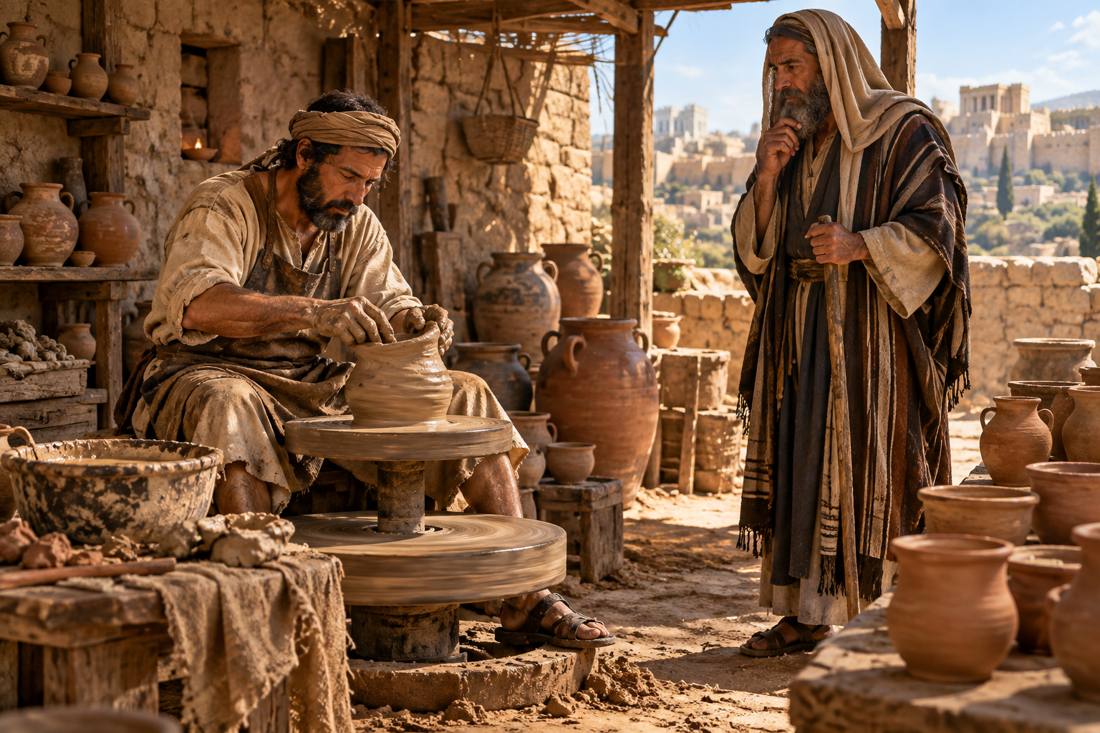
Let us go down to the potter's house and stand beside Jeremiah. The potter sits at "the wheel," literally "the two stones" in Hebrew: a lower stone turned by the potter's feet and an upper stone on which the clay spins. As his feet keep the wheel turning, his hands work skillfully in the wet clay, trying to form a vessel worth using.
Then something goes wrong. "The vessel that he made of clay was marred in the hand of the potter" (Jeremiah 18:4). Perhaps there was a pebble in the clay, or the clay was too dry, or it would not yield to his hands. So the potter pressed it down into a lump and started over, and "he made it again into another vessel, as it seemed good to the potter to make." He did not throw the clay away. He reshaped it.
Notice two things. First, the potter is in charge. The clay does not decide what it will become. Second, the potter is patient. The marred vessel is not the end of the story; it is the beginning of a new one.
III. The Meaning for Israel (Jeremiah 18:5–12)
Then the word of the LORD came to Jeremiah: "O house of Israel, can I not do with you as this potter?... Look, as the clay is in the potter's hand, so are you in My hand" (Jeremiah 18:6). God has the right and the power to shape nations as He wills.
But the next verses show that the Potter is not arbitrary. "The instant I speak concerning a nation and concerning a kingdom, to pluck up, to pull down, and to destroy it, if that nation against whom I have spoken turns from its evil, I will relent of the disaster that I thought to bring upon it" (Jeremiah 18:7–8). And the reverse is also true: if a nation God planned to bless turns to evil, He will reconsider the good He intended (vv. 9–10). The Potter is sovereign, but He responds to how the clay responds to Him. His warnings are real invitations to repent.
This is why the passage matters in discussions of God's sovereignty and human freedom. Interpreters in the Arminian and Wesleyan traditions often point to Jeremiah 18:7–10 as a clear picture of conditional dealings: God's announced plans for a nation depend on the nation's response. Interpreters in the Reformed tradition agree that the passage describes God's real responsiveness in history, and they usually add that God's responses themselves fall within His eternal purpose. Both agree on the practical point of the chapter: Judah could still turn, and God was pleading with them to do it.
Judah's answer was tragic. "That is hopeless! So we will walk according to our own plans" (Jeremiah 18:12). The clay refused the Potter's hands.
IV. The Potter and the Clay Across Scripture
The image of God as potter runs through the Bible. God formed Adam from the dust of the ground (Genesis 2:7), and the Hebrew word for "formed" is the word used of a potter. Isaiah rebukes those who turn things upside down, as if the clay could say to the potter, "He did not make me" (Isaiah 29:16; 45:9). And Isaiah turns the image into one of the most beautiful prayers of the Old Testament: "But now, O LORD, You are our Father; we are the clay, and You our potter; and all we are the work of Your hand" (Isaiah 64:8).
Paul uses the image in Romans 9:20–23: "Does not the potter have power over the clay, from the same lump to make one vessel for honor and another for dishonor?" Christians read this passage differently, and a pastor should know the conversation. Reformed interpreters generally understand Paul to be teaching God's sovereign choice of individuals for salvation. Arminian and Wesleyan interpreters generally note that Paul's argument in Romans 9–11 concerns God's right to set the terms of salvation for Jews and Gentiles alike, that Paul is echoing Jeremiah 18, where the potter's work depends on the clay's response, and that Romans 9:22 says God "endured with much longsuffering" the vessels of wrath. Both agree that the clay has no right to put the Potter on trial.
The New Testament also uses the image to encourage. "We have this treasure in earthen vessels, that the excellence of the power may be of God and not of us" (2 Corinthians 4:7). And Paul writes that in a great house there are vessels for honor and dishonor, and "if anyone cleanses himself" he will be "a vessel for honor, sanctified and useful for the Master" (2 Timothy 2:20–21).
V. Three Pictures of the Clay
1. A flawed lump of clay. The potter noticed a flaw and did not ignore it. Biographies of Christian heroes are often written without warts; we see the mountaintops and never the dark valleys. The Bible does not do that. God is a total realist, and the people He holds up as models are flawed. Peter walked on water and then sank. He confessed, "You are the Christ, the Son of the living God," and a short time later denied he knew Him. Later still he pulled back from Gentile believers under pressure (Galatians 2:11–13). Yet Jesus had said to him, "I have prayed for you, that your faith should not fail; and when you have returned to Me, strengthen your brethren" (Luke 22:32). John Mark deserted Paul and Barnabas on their first missionary journey, and Paul refused to take him again. Yet years later Paul wrote, "Get Mark and bring him with you, for he is useful to me for ministry" (2 Timothy 4:11), and Mark wrote the Gospel that bears his name. We often think we cannot serve God because of some flaw in ourselves. But the flaws are not fatal in the Master's hands.
2. A discarded lump of clay. When the clay would not yield, the potter pressed it down. It must have looked as if the clay were being thrown away. We know the little tags on new clothing that say "Inspected by." Sometimes we fail God's inspection, like Belshazzar, who was "weighed in the balances and found wanting" (Daniel 5:27). King David was a man after God's own heart, yet he committed adultery with Bathsheba and arranged the death of her husband, and for about a year he lived out of fellowship with God until Nathan came with his story of the ewe lamb (Unit 5). Moses struck the rock in anger and said, "Must we bring water for you out of this rock?" (Numbers 20:10), and God did not allow him to enter the Promised Land. These are pictures of discipline, and discipline hurts. But "whom the LORD loves He chastens" (Hebrews 12:6). God does not discipline us because He hates us but because He loves us. A visitor to a potter's shop once watched a worker pounding a lump of clay with a mallet and asked why. "Wait and watch," said the worker. Soon little bubbles rose to the surface. "Now you see why I pound it," he said. "I could never shape a good vessel if those bubbles stayed inside." God's hand on His people is sometimes heavy for the same reason.
3. A reshaped lump of clay. Sometimes we cannot simply be patched; God has to start over with us. Rahab, a prostitute in Jericho, turned to the God of Israel in faith and became an ancestor of Jesus (Matthew 1:5). Moses killed an Egyptian in anger and fled to the wilderness for forty years, and there God reshaped him and called him from a burning bush. Failure does not mean God has abandoned you. It means God has a better idea. Henry Ford once said that failure is simply the opportunity to begin again, this time more intelligently. In the Potter's hands, it is more than that. It is the opportunity to become what He intended all along.
None of us is a finished vessel yet. A certain church once held a contest to find the most upright, sober, well-behaved citizen in town. One entry read: "I don't smoke. I don't drink. I don't gamble. I am faithful to my wife and never look at another woman. I am hard-working, quiet, and obedient. I never go to the theater, I go to bed early every night and rise with the dawn, and I attend chapel every Sunday without fail." Then he added: "But wait till I get out of here." He was writing from prison. Outward good behavior is not the same as a heart reshaped by God. That is why we should never put a mere human being on a pedestal; every one of them will fall off. Every saint in the Bible was a sinner who fell short of the glory of God. The discipline and trials God sends are how the Potter works out our pride and self-will, so that He can form us into vessels able to hold the treasure of His grace.
VI. A Warning from Jeremiah 19
The very next chapter gives a second enacted parable, and it is a sobering one. God told Jeremiah to buy a finished clay flask, take some of the elders to the Valley of Hinnom, and smash it in front of them: "Even so I will break this people and this city, as one breaks a potter's vessel, which cannot be made whole again" (Jeremiah 19:11). The difference between chapters 18 and 19 is the difference between soft clay and a fired vessel. Soft clay on the wheel can be reshaped. A vessel that has been fired and hardened can only be broken. The lesson for every hearer is urgent: stay soft in the Potter's hands. Do not wait until your heart is hardened.
VII. Preaching the Potter's House
A pastor can follow the three pictures above as a simple outline: the flawed clay, the discarded clay, and the reshaped clay. Each point needs a biblical example and a modern one, and each should end by placing the listener on the wheel.
A familiar story helps many listeners. A water bearer in India carried two pots on a pole across his shoulders. One pot was perfect; the other had a crack and arrived at the master's house only half full. After two years the cracked pot apologized for its failure. The water bearer asked it to look along the path on the way back. On the cracked pot's side of the path, wildflowers were blooming. "I knew about your crack," he said, "so I planted seeds on your side, and every day you watered them." Each of us is a cracked pot, and God often uses the very weakness we thought disqualified us to make us a blessing.
Another well-loved illustration concerns the word "sincere." Preachers have long said it comes from two Latin words, sine cera, "without wax." Dishonest potters supposedly filled cracks with wax and glazed over them, and a wise buyer would hold a vessel up to the sunlight to see whether it was truly without wax. Honesty requires us to say that language scholars consider this origin uncertain and probably a later story rather than the true history of the word. But as an illustration it still makes the point well: God is not looking for vessels that hide their cracks. He is looking for vessels that are honest before Him, held up to His light.
Closing
Jeremiah went down to the potter's house and watched a sermon he would never forget. A marred vessel was not thrown away; it was pressed down and made again, "as it seemed good to the potter." The same Potter is still at work. He sees our flaws, He disciplines us in love, and He reshapes us for His purposes. The only question is whether we will yield to His hands or harden ourselves against Him. Isaiah's prayer is still the right one: "We are the clay, and You our potter; and all we are the work of Your hand."
— Dr. Wayne Cook
Chapala Theological Seminary
Orientación
Me gusta arreglar cosas. Si el salitre se está comiendo el enjarre de una pared, lo resano. Si un calcetín tiene un agujero, lo coso. Si algo se rompe, busco el pegamento, y si la pintura está opaca, vuelvo a pintar. Pero algunas cosas no se arreglan con un parche. A veces lo que está roto tiene que empezar de nuevo.
Esa es la situación a la que Dios envió al profeta Jeremías. No lo envió primero a predicar un sermón. Lo envió a ver uno: "Levántate y vete a casa del alfarero, y allí te haré oír mis palabras" (Jeremías 18:2). En la Unidad 1 llamamos a esto una parábola actuada: un sermón predicado por medio de una acción antes de ser predicado con palabras. La identificación es sencilla, porque Dios la hace por nosotros. Dios es el Alfarero, e Israel es el barro. Pero la aplicación no termina con Israel. Toda persona que ha vivido es barro en la rueda del Alfarero, y eso nos incluye a usted y a mí.
I. El contexto
Jeremías fue llamado siendo joven, en el año trece del rey Josías, alrededor del 627 a. C., y predicó cerca de cuarenta años hasta que Jerusalén cayó ante Babilonia en el 586 a. C. Su mensaje a Judá era duro: la nación se había vuelto a los ídolos, los poderosos oprimían a los débiles y el pueblo confiaba en el templo como si fuera un amuleto de la suerte. El juicio venía. Jeremías predicó con lágrimas, y por ello fue burlado, golpeado, encarcelado y echado en una cisterna de lodo.
Muchos de los mensajes de Jeremías vinieron por medio de lecciones visuales. Enterró un cinto de lino hasta que se pudrió (Jeremías 13). Compró una vasija de barro y la quebró (Jeremías 19). Llevó un yugo de buey en el cuello (Jeremías 27). Y en el capítulo 18 Dios lo envió a un lugar que toda persona en Jerusalén conocía bien: el taller del alfarero en la parte baja de la ciudad.
II. El alfarero trabajando (Jeremías 18:1–4)
Descendamos a casa del alfarero y pongámonos al lado de Jeremías. El alfarero está sentado junto a "la rueda", literalmente "las dos piedras" en hebreo: una piedra inferior que el alfarero hace girar con los pies y una piedra superior sobre la cual gira el barro. Mientras sus pies mantienen la rueda en movimiento, sus manos trabajan con destreza el barro húmedo, tratando de formar una vasija que sirva.
Entonces algo sale mal: "la vasija de barro que él hacía se echó a perder en su mano" (Jeremías 18:4). Quizás había una piedrecita en el barro, o el barro estaba demasiado seco, o no cedía a sus manos. Así que el alfarero lo aplastó en una masa y comenzó de nuevo, "y volvió y la hizo otra vasija, según le pareció mejor hacerla". No tiró el barro. Lo volvió a formar.
Note dos cosas. Primero, el alfarero es quien manda. El barro no decide lo que será. Segundo, el alfarero es paciente. La vasija echada a perder no es el fin de la historia; es el principio de una nueva.
III. El significado para Israel (Jeremías 18:5–12)
Entonces vino a Jeremías palabra de Jehová: "¿No podré yo hacer de vosotros como este alfarero, oh casa de Israel?... He aquí que como el barro en la mano del alfarero, así sois vosotros en mi mano" (Jeremías 18:6). Dios tiene el derecho y el poder de formar a las naciones como Él quiere.
Pero los versículos siguientes muestran que el Alfarero no es arbitrario. Si Dios habla contra una nación para arrancarla, derribarla y destruirla, y esa nación se convierte de su maldad, Él se arrepentirá del mal que había pensado hacerle (Jeremías 18:7–8). Y lo contrario también es cierto: si una nación que Dios pensaba bendecir se vuelve al mal, Él reconsiderará el bien que había querido hacerle (vv. 9–10). El Alfarero es soberano, pero responde a cómo el barro le responde a Él. Sus advertencias son verdaderas invitaciones al arrepentimiento.
Por eso este pasaje importa en las conversaciones sobre la soberanía de Dios y la libertad humana. Los intérpretes de las tradiciones arminiana y wesleyana a menudo señalan Jeremías 18:7–10 como un cuadro claro del trato condicional de Dios: los planes anunciados por Dios para una nación dependen de la respuesta de esa nación. Los intérpretes de la tradición reformada concuerdan en que el pasaje describe la verdadera respuesta de Dios en la historia, y suelen añadir que esas respuestas de Dios forman parte de Su propósito eterno. Ambos coinciden en el punto práctico del capítulo: Judá todavía podía volverse, y Dios le rogaba que lo hiciera.
La respuesta de Judá fue trágica: "Es en vano; porque en pos de nuestras imaginaciones iremos" (Jeremías 18:12). El barro rechazó las manos del Alfarero.
IV. El alfarero y el barro a lo largo de la Escritura
La imagen de Dios como alfarero recorre toda la Biblia. Dios formó a Adán del polvo de la tierra (Génesis 2:7), y la palabra hebrea para "formó" es la que se usa para el trabajo del alfarero. Isaías reprende a los que trastornan las cosas, como si el barro dijera al alfarero: "No me hizo" (Isaías 29:16; 45:9). E Isaías convierte la imagen en una de las oraciones más hermosas del Antiguo Testamento: "Ahora pues, Jehová, tú eres nuestro padre; nosotros barro, y tú el que nos formaste; así que obra de tus manos somos todos nosotros" (Isaías 64:8).
Pablo usa la imagen en Romanos 9:20–23: "¿O no tiene potestad el alfarero sobre el barro, para hacer de la misma masa un vaso para honra y otro para deshonra?" Los cristianos leen este pasaje de maneras diferentes, y el pastor debe conocer la conversación. Los intérpretes reformados generalmente entienden que Pablo enseña la elección soberana de Dios de individuos para salvación. Los intérpretes arminianos y wesleyanos generalmente señalan que el argumento de Pablo en Romanos 9–11 trata del derecho de Dios a fijar las condiciones de la salvación tanto para judíos como para gentiles, que Pablo hace eco de Jeremías 18, donde la obra del alfarero depende de la respuesta del barro, y que Romanos 9:22 dice que Dios "soportó con mucha paciencia" los vasos de ira. Ambos coinciden en que el barro no tiene derecho a juzgar al Alfarero.
El Nuevo Testamento también usa la imagen para animar: "tenemos este tesoro en vasos de barro, para que la excelencia del poder sea de Dios, y no de nosotros" (2 Corintios 4:7). Y Pablo escribe que en una casa grande hay vasos para honra y para deshonra, y que "si alguno se limpia" será "instrumento para honra, santificado, útil al Señor" (2 Timoteo 2:20–21).
V. Tres cuadros del barro
1. Una masa de barro defectuosa. El alfarero notó un defecto y no lo ignoró. Las biografías de los héroes cristianos a menudo se escriben sin sus defectos; vemos las cumbres y nunca los valles oscuros. La Biblia no hace eso. Dios es totalmente realista, y las personas que presenta como modelos tienen defectos. Pedro caminó sobre el agua y luego se hundió. Confesó: "Tú eres el Cristo, el Hijo del Dios viviente", y poco tiempo después negó conocerlo. Más tarde se apartó de los creyentes gentiles bajo presión (Gálatas 2:11–13). Sin embargo, Jesús le había dicho: "yo he rogado por ti, que tu fe no falte; y tú, una vez vuelto, confirma a tus hermanos" (Lucas 22:32). Juan Marcos abandonó a Pablo y a Bernabé en su primer viaje misionero, y Pablo se negó a llevarlo otra vez. Sin embargo, años después Pablo escribió: "Toma a Marcos y tráele contigo, porque me es útil para el ministerio" (2 Timoteo 4:11), y Marcos escribió el Evangelio que lleva su nombre. A menudo pensamos que no podemos servir a Dios por algún defecto en nosotros. Pero en las manos del Maestro los defectos no son fatales.
2. Una masa de barro desechada. Cuando el barro no cedía, el alfarero lo aplastaba. Debió parecer que el barro estaba siendo tirado. Conocemos las etiquetas de la ropa nueva que dicen "Inspeccionado por". A veces no pasamos la inspección de Dios, como Belsasar, que fue "pesado en balanza, y fue hallado falto" (Daniel 5:27). El rey David era un varón conforme al corazón de Dios; sin embargo, cometió adulterio con Betsabé y dispuso la muerte de su esposo, y por cerca de un año vivió fuera de la comunión con Dios hasta que Natán vino con su historia de la corderita (Unidad 5). Moisés golpeó la peña con enojo y dijo: "¿Os hemos de hacer salir aguas de esta peña?" (Números 20:10), y Dios no le permitió entrar en la Tierra Prometida. Estos son cuadros de disciplina, y la disciplina duele. Pero "el Señor al que ama, disciplina" (Hebreos 12:6). Dios no nos disciplina porque nos odie, sino porque nos ama. Un visitante en el taller de un alfarero vio una vez a un trabajador golpeando una masa de barro con un mazo y le preguntó por qué. "Espere y observe", dijo el trabajador. Pronto aparecieron pequeñas burbujas en la superficie. "Ahora ve por qué lo golpeo", dijo. "Nunca podría formar una buena vasija si esas burbujas se quedaran adentro." La mano de Dios sobre Su pueblo a veces es pesada por la misma razón.
3. Una masa de barro vuelta a formar. A veces no basta con un parche; Dios tiene que empezar de nuevo con nosotros. Rahab, una ramera de Jericó, se volvió con fe al Dios de Israel y llegó a ser antepasada de Jesús (Mateo 1:5). Moisés mató a un egipcio en un arranque de ira y huyó al desierto por cuarenta años, y allí Dios lo volvió a formar y lo llamó desde una zarza ardiente. El fracaso no significa que Dios lo haya abandonado. Significa que Dios tiene una idea mejor. Henry Ford dijo una vez que el fracaso es simplemente la oportunidad de comenzar de nuevo, esta vez con más inteligencia. En las manos del Alfarero es más que eso. Es la oportunidad de llegar a ser lo que Él quiso desde el principio.
Ninguno de nosotros es todavía una vasija terminada. Cierta iglesia organizó una vez un concurso para encontrar al ciudadano más recto, sobrio y de mejor conducta del pueblo. Una carta decía: "No fumo. No bebo. No apuesto. Soy fiel a mi esposa y nunca miro a otra mujer. Soy trabajador, callado y obediente. Nunca voy al teatro, me acuesto temprano cada noche y me levanto al amanecer, y asisto a la capilla todos los domingos sin falta." Luego añadió: "Pero espere a que salga de aquí." Escribía desde la cárcel. La buena conducta externa no es lo mismo que un corazón vuelto a formar por Dios. Por eso nunca debemos poner a un simple ser humano sobre un pedestal; todos se caerán. Cada santo de la Biblia fue un pecador que no alcanzó la gloria de Dios. La disciplina y las pruebas que Dios envía son la manera en que el Alfarero saca nuestro orgullo y nuestra terquedad, para formarnos como vasijas capaces de contener el tesoro de Su gracia.
VI. Una advertencia de Jeremías 19
El capítulo siguiente da una segunda parábola actuada, y es muy seria. Dios mandó a Jeremías comprar una vasija de barro terminada, llevar a algunos de los ancianos al valle de Hinom y quebrarla delante de ellos: "Así quebrantaré a este pueblo y a esta ciudad, como quien quiebra una vasija de barro, que no se puede restaurar más" (Jeremías 19:11). La diferencia entre los capítulos 18 y 19 es la diferencia entre el barro blando y una vasija cocida. El barro blando en la rueda puede volver a formarse. Una vasija que ya fue cocida y endurecida solo puede quebrarse. La lección para todo oyente es urgente: manténgase blando en las manos del Alfarero. No espere hasta que su corazón se endurezca.
VII. Cómo predicar la Casa del Alfarero
El pastor puede seguir los tres cuadros anteriores como un bosquejo sencillo: el barro defectuoso, el barro desechado y el barro vuelto a formar. Cada punto necesita un ejemplo bíblico y uno moderno, y cada uno debe terminar poniendo al oyente sobre la rueda.
Una historia conocida ayuda a muchos oyentes. Un aguador en la India llevaba dos cántaros colgados de un palo sobre los hombros. Un cántaro era perfecto; el otro estaba agrietado y llegaba a la casa del amo solo medio lleno. Después de dos años, el cántaro agrietado pidió perdón por su fracaso. El aguador le pidió que mirara el camino de regreso. Del lado del cántaro agrietado florecían flores silvestres. "Yo sabía de tu grieta", le dijo, "así que sembré semillas de tu lado del camino, y todos los días tú las regabas." Cada uno de nosotros es un cántaro agrietado, y Dios a menudo usa la misma debilidad que pensábamos que nos descalificaba para hacernos de bendición.
Otra ilustración muy querida trata de la palabra "sincero". Los predicadores han dicho por mucho tiempo que viene de dos palabras latinas, sine cera, "sin cera". Supuestamente, los alfareros deshonestos llenaban las grietas con cera y las cubrían con esmalte, y un comprador sabio levantaba la vasija a la luz del sol para ver si realmente estaba sin cera. La honestidad nos obliga a decir que los estudiosos del idioma consideran incierto ese origen, y probablemente una historia posterior más que la verdadera historia de la palabra. Pero como ilustración todavía comunica bien el punto: Dios no busca vasijas que escondan sus grietas. Busca vasijas que sean honestas delante de Él, levantadas a Su luz.
Conclusión
Jeremías descendió a casa del alfarero y vio un sermón que nunca olvidaría. Una vasija echada a perder no fue tirada; fue aplastada y hecha de nuevo, "según le pareció mejor" al alfarero. El mismo Alfarero sigue trabajando. Él ve nuestros defectos, nos disciplina con amor y nos vuelve a formar para Sus propósitos. La única pregunta es si cederemos a Sus manos o nos endureceremos contra Él. La oración de Isaías sigue siendo la correcta: "nosotros barro, y tú el que nos formaste; así que obra de tus manos somos todos nosotros".
— Dr. Wayne Cook
Seminario Teológico de Chapala
Unit 3 ExamExamen de la Unidad 3
Certificate track: the 20 multiple-choice questions. Associate: multiple choice and the 10 fill-in-the-blank questions. M.Div. and Th.M.: multiple choice, fill-ins and the 10 short-answer questions. 90% of each part is required to pass. If you do not pass, the exam waits a short time before you can try again.Certificado: las 20 preguntas de opción múltiple. Asociado: opción múltiple y las 10 preguntas de completar el espacio en blanco. M.Div. y Th.M.: opción múltiple, completar el espacio y las 10 preguntas de desarrollo. Se requiere 90% en cada parte para aprobar. Si no aprueba, el examen espera un tiempo breve antes de intentarlo de nuevo.