Jisajili mara moja, kwa kozi zote
Maendeleo yako yanahifadhiwa kwenye kivinjari hiki unaposoma, na seminari inayatunza chini ya msimbo wako wa mwanafunzi, ili uweze kuendelea kwenye kifaa chochote. Weka msimbo huo kwa siri, kama nenosiri. Barua pepe si lazima. Iongeze ili tukurudishie msimbo wako wa mwanafunzi, tukutumie vikumbusho na tukupe cheti. Unaweza kujiandikisha na kuendelea kusoma bila barua pepe. Tunachohifadhi.
Programu ya Cheti inajibu maswali ya kuchagua jibu. Shahada ya Mshiriki inaongeza maswali ya kujaza pengo; M.Div. na Th.M. zinaongeza hayo na maswali ya majibu mafupi. Asilimia 90 ya kila sehemu inahitajika ili kufaulu.
UtanguliziOrientation
Daudi alikuwa mmoja wa watu wakuu kabisa waliowahi kuishi. Alimuua Goliathi, aliunganisha kabila za Israeli, aliandika zaburi nyingi, na katika Maandiko anaitwa "mtu aupendezaye moyo wa Mungu." Hata hivyo Daudi alivunja amri tatu kati ya Amri Kumi katika kipindi kimoja. Alimtamani mke wa jirani yake, alizini na Bathsheba, na alipanga kifo cha mumewe Uria, mmoja wa askari wake waaminifu kabisa (2 Samweli 11). Kisha akamwoa mjane huyo, mtoto akazaliwa, na kwa takriban mwaka mmoja Daudi aliendelea kana kwamba hakuna kilichotokea.David was one of the greatest men who ever lived. He killed Goliath, united the tribes of Israel, wrote many of the psalms, and is called in Scripture "a man after God's own heart." Yet David broke three of the Ten Commandments in a single season. He coveted his neighbor's wife, he committed adultery with Bathsheba, and he arranged the death of her husband Uriah, one of his most loyal soldiers (2 Samuel 11). Then he married the widow, the baby was born, and for about a year David went on as if nothing had happened.
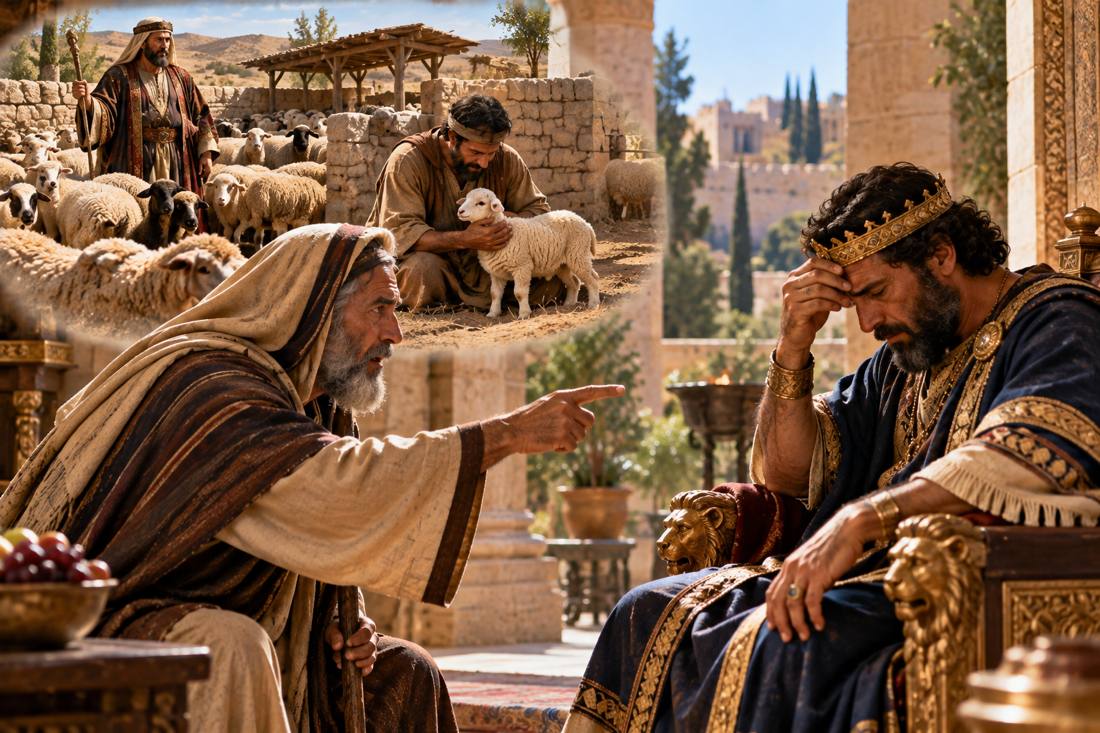
Lakini kitu kilikuwa kimetokea. "Lakini jambo lile alilolitenda Daudi likamchukiza BWANA" (2 Samweli 11:27). Kwa hiyo Mungu alimtuma mhubiri mwenye hadithi. Katika Sehemu ya 1 tuliuita mfano wa Nathani mfano wa kimahakama: nabii anamletea mfalme shauri ili alihukumu, na mfalme anajitolea hukumu yeye mwenyewe. Ni kielelezo kilicho wazi kuliko vyote katika Biblia cha kile ambacho mfano unaweza kufanya. Unapenya na kupita moyo uliokuwa mgumu na kuufungua.But something had happened. "The thing that David had done displeased the LORD" (2 Samuel 11:27). So God sent a preacher with a story. In Unit 1 we called Nathan's story a juridical parable: the prophet brings the king a case to judge, and the king pronounces sentence on himself. It is the clearest example in the Bible of what a parable can do. It slips past a hardened heart and opens it.
I. Ujasiri wa NathaniI. The Courage of Nathan
Nathani alikuwa nabii, na tunaweza kumwita mhubiri wa ikulu. Alikuwa amemletea Daudi habari njema hapo awali: ahadi ya Mungu kwamba kiti cha enzi cha Daudi kingethibitishwa milele (2 Samweli 7). Sasa Mungu alimtuma na habari mbaya, na hakuna mtu anayependa kumpelekea mfalme habari mbaya. Daudi alishika mamlaka ya uhai na kifo. Wafalme wa ulimwengu wa kale mara nyingi walimwadhibu mjumbe. Nathani angeweza kwa urahisi kunyamaza, kama inavyoonekana watu wengine wote wa ikulu walivyofanya kwa mwaka mzima. Badala yake alikwenda.Nathan was a prophet, and we might call him the court preacher. He had brought David good news before: God's promise that David's throne would be established forever (2 Samuel 7). Now God sent him with bad news, and no one likes to carry bad news to a king. David held the power of life and death. Kings in the ancient world often punished the messenger. Nathan could easily have stayed quiet, as the rest of the court apparently did for a whole year. Instead he went.
Lakini angalia jinsi alivyokwenda. Hakuingia ghafla katika chumba cha kiti cha enzi na shtaka. Alisimulia hadithi, na akaiacha hisia ya haki ya Daudi mwenyewe ifanye kazi. Hiyo ndiyo hekima katika kumkabili mtu. Shambulio la ana kwa ana mara nyingi humfanya mtu mwenye hatia ajitetee; mfano humwezesha kuuona ukweli kabla hajapata muda wa kujikinga.But notice how he went. He did not burst into the throne room with an accusation. He told a story, and he let David's own sense of justice do the work. That is wisdom in confrontation. A frontal attack often makes a guilty person defensive; a parable lets him see the truth before he has time to raise his guard.
II. Hadithi (2 Samweli 12:1–4)II. The Story (2 Samuel 12:1–4)
"Kulikuwa na watu wawili katika mji mmoja; mmoja wao alikuwa tajiri, na wa pili maskini." Yule tajiri alikuwa na "kondoo na ng'ombe wengi sana." Yule maskini hakuwa na kitu "ila mwana-kondoo mke mmoja mdogo, aliyekuwa amemnunua na kumlisha." Mwana-kondoo huyo alikua pamoja naye na watoto wake. "Akila chakula chake mwenyewe, akinywa katika kikombe chake mwenyewe, akilala kifuani mwake, naye alikuwa kwake kama binti" (12:3)."There were two men in one city, one rich and the other poor." The rich man had "exceedingly many flocks and herds." The poor man had nothing "except one little ewe lamb which he had bought and nourished." The lamb grew up with him and his children. "It ate of his own food and drank from his own cup and lay in his bosom; and it was like a daughter to him" (12:3).
Kila undani umechaguliwa ili kuugusa moyo wa msikilizaji. Huyu si mfugo tu; ni mnyama kipenzi wa familia, karibu kama mtoto. Baadhi ya wafasiri wanaona kwamba neno la Kiebrania la "binti," bat, linaliita akilini jina Bath-sheba, na undani kwamba mwana-kondoo "alilala kifuani mwake" unakumbusha kimya kimya kile Daudi alichokuwa amefanya na mke wa mtu mwingine. Daudi haukamati mwangwi huo. Anasikia tu hadithi kuhusu mwana-kondoo.Every detail is chosen to stir the listener's heart. This is not livestock; it is a family pet, almost a child. Some interpreters notice that the Hebrew word for "daughter," bat, echoes the name Bath-sheba, and the detail that the lamb "lay in his bosom" quietly recalls what David had done with another man's wife. David does not catch the echo. He hears only a story about a lamb.
Kisha msafiri alimjia yule tajiri. Badala ya kuchukua mmoja wa wanyama wake wengi ili kuandaa chakula, alimchukua mwana-kondoo pekee wa yule maskini akamwandalia mgeni wake (12:4). Ni picha ya mamlaka ya ubinafsi: mtu aliyekuwa na kila kitu akichukua kitu kimoja ambacho mtu mwingine alikipenda.Then a traveler came to the rich man. Instead of taking one of his own many animals to prepare a meal, he took the poor man's only lamb and served it to his guest (12:4). It is a picture of selfish power: a man who had everything taking the one thing another man loved.
III. Hukumu (2 Samweli 12:5–7)III. The Verdict (2 Samuel 12:5–7)
"Hasira ya Daudi ikawaka sana juu ya mtu yule; akamwambia Nathani, Kama BWANA aishivyo, mtu aliyetenda jambo hili astahili kufa; naye atalipa mwana-kondoo mara nne, kwa sababu alitenda jambo hili, na kwa sababu hakuona huruma" (12:5–6). Daudi aliijua sheria: kondoo aliyeibwa alipaswa kulipwa mara nne (Kutoka 22:1). Alikuwa mwamuzi mzuri wa dhambi za watu wengine."So David's anger was greatly aroused against the man, and he said to Nathan, 'As the LORD lives, the man who has done this shall surely die! And he shall restore fourfold for the lamb, because he did this thing and because he had no pity'" (12:5–6). David knew the law: a stolen sheep was to be repaid four times over (Exodus 22:1). He was a good judge of other people's sins.
Kisha yakaja maneno manne yenye nguvu kuliko mengi katika Agano la Kale: "Wewe ndiwe mtu huyo" (12:7). Hadithi ilifunga ghafla kama mtego. Daudi, mfalme tajiri mwenye wake wengi, alikuwa amemchukua mke mmoja wa askari maskini kisha akamwua. Alikuwa amejihukumu mwenyewe na kutamka adhabu yake mwenyewe.Then came four of the most powerful words in the Old Testament: "You are the man!" (12:7). The story snapped shut like a trap. David, the rich king with many wives, had taken the one wife of a poor soldier and then had him killed. He had condemned himself and pronounced his own sentence.
Kisha Nathani akanena kwa niaba ya Mungu: "Mimi nilikutia mafuta uwe mfalme juu ya Israeli, nami nikakuokoa na mkono wa Sauli; nikakupa nyumba ya bwana wako... nikakupa nyumba ya Israeli na ya Yuda; na kama hayo yangekuwa machache, ningekuongezea mambo mengine kadha wa kadha" (12:7–8). Sikia mwangwi wa wimbo wa Isaya wa shamba la mizabibu kutoka Sehemu ya 2: "Je! Ni nini zaidi ambacho ningeweza kulitendea shamba langu la mizabibu?" Katika mifano yote miwili, dhambi inaonyeshwa dhidi ya mandhari ya ukarimu wa Mungu. Daudi hakumchukua Bathsheba kwa sababu Mungu alikuwa amempa kidogo mno. Alimchukua kwa sababu alidharau kile Mungu alichokuwa amempa.Nathan then spoke for God: "I anointed you king over Israel, and I delivered you from the hand of Saul. I gave you your master's house... and gave you the house of Israel and Judah. And if that had been too little, I also would have given you much more!" (12:7–8). Hear the echo of Isaiah's vineyard song from Unit 2: "What more could have been done to My vineyard?" In both parables, sin is shown against the background of God's generosity. David did not take Bathsheba because God had given him too little. He took her because he despised what God had given.
IV. Matokeo (2 Samweli 12:10–14)IV. The Consequences (2 Samuel 12:10–14)
"Basi sasa, upanga hautaondoka kamwe nyumbani mwako" (12:10). Sehemu iliyobaki ya 2 Samweli inasimulia hadithi yenye uchungu. Mtoto aliyezaliwa na Bathsheba alikufa. Mwana wa Daudi, Amnoni, alimbaka dada yake wa kambo Tamari, na kaka yake Tamari, Absalomu, akamwua Amnoni. Absalomu aliongoza uasi dhidi ya baba yake akauawa. Baadaye mwana mwingine, Adonia, aliuawa baada ya kujaribu kunyakua kiti cha enzi. Mapokeo ya Kiyahudi yaliona kwamba wana wanne wa Daudi walikufa, na yakaona ndani yake mwangwi wa kutisha wa ile "mara nne" ambayo Daudi alikuwa ametamka juu ya yule tajiri."Now therefore, the sword shall never depart from your house" (12:10). The rest of 2 Samuel tells the painful story. The child born to Bathsheba died. David's son Amnon raped his half-sister Tamar, and her brother Absalom murdered Amnon. Absalom led a rebellion against his father and was killed. Later another son, Adonijah, was executed after trying to seize the throne. Jewish tradition noticed that four of David's sons died, and saw in it a grim echo of the "fourfold" David had pronounced over the rich man.
Hapa kuna kweli ambayo kila mchungaji lazima aifundishe kwa uangalifu: msamaha hauondoi matokeo kila mara. Mungu alimsamehe Daudi hatia yake, na Daudi hakufa. Lakini dhambi ilikuwa tayari imeanzisha mambo katika familia yake ambayo kukiri hakukuyatangua. Dhambi yoyote huacha makovu. Sisi tuna faida kuliko Daudi, kwa sababu Kristo alichukua adhabu ya dhambi yetu msalabani. Lakini hatupaswi kamwe kudhani kwamba kwa sababu Mungu husamehe, dhambi haigharimu kitu.Here is a truth every pastor must teach carefully: forgiveness does not always remove consequences. God forgave David's guilt, and David did not die. But the sin had already set things in motion in his family that confession did not undo. Any sin leaves scars. We have an advantage over David, because Christ bore the penalty of our sin on the cross. But we should never imagine that because God forgives, sin costs nothing.
V. Jinsi Daudi AlivyoitikiaV. How David Responded
Hatua ya mabadiliko ni mstari wa 13: "Nimemfanyia BWANA dhambi." Naye Nathani akasema, "BWANA naye ameiondoa dhambi yako; hutakufa." Ni tofauti jinsi gani na tunavyoitikia kwa kawaida mtu anapotuambia kwamba sisi ni wenye dhambi. Daudi alikuwa na angalau njia nyingine nne za kuchagua, na sisi hujaribiwa na kila mojawapo.The turning point is verse 13: "I have sinned against the LORD." And Nathan said, "The LORD also has put away your sin; you shall not die." How differently we usually react when someone tells us we are sinners. David had at least four other choices, and we are tempted by every one of them.
Angeweza kusema uongo. Angeweza kusema, "Huna ushahidi. Hujui nilichofanya." Hata mtoto mdogo hujifunza haraka kwamba kusema uongo kunaonekana rahisi kuliko kusema kweli. Afisa mmoja wa polisi alisema hajawahi kukutana na mhalifu aliyekiri uhalifu wake. Sisi kwa urahisi hutumia uongo ili kujiondoa katika dhambi.He could have lied. He might have said, "You have no proof. You don't know what I have done." Even a small child learns quickly that lying seems easier than telling the truth. One police officer said he had never met a criminal who admitted to his crime. We readily lie our way out of sin.
Angeweza kumlaumu mtu mwingine. Angeweza kusema kwamba Bathsheba ndiye aliyemshawishi. Huo ndio utetezi wa zamani kuliko yote duniani. Mungu alipomkabili Adamu bustanini, Adamu alisema, "Huyu mwanamke uliyenipa awe pamoja nami, ndiye aliyenipa matunda ya mti, nami nikala" (Mwanzo 3:12). Alimlaumu mwanamke na, kwa pumzi ile ile, akamlaumu Mungu.He could have blamed someone else. He might have said that Bathsheba had enticed him. That is the oldest defense in the world. When God confronted Adam in the garden, Adam said, "The woman whom You gave to be with me, she gave me of the tree, and I ate" (Genesis 3:12). He blamed the woman and, in the same breath, blamed God.
Angeweza kutoa visingizio. Angeweza kusema kwamba alikuwa kijana maskini wa kuchunga kondoo, kwamba shinikizo za utawala zilimvuruga, au kwamba Uria na Bathsheba tayari walikuwa na matatizo katika ndoa yao. Mara nyingi sisi pia hujaribu kuitolea dhambi yetu visingizio.He could have made excuses. He might have said that he had been a poor shepherd boy, that the pressures of government distracted him, or that Uriah and Bathsheba already had problems in their marriage. We often try to excuse our sin as well.
Angeweza kumkasirikia mhubiri. Angeweza kuamuru Nathani auawe kwa ujeuri wake. Watu bado humshambulia mjumbe wasipoupenda ujumbe.He could have become angry at the preacher. He might have had Nathan killed for his insolence. People still attack the messenger when they do not like the message.
Badala yake Daudi aliikiri dhambi yake. Hakuna kisingizio kingetosha, kwa sababu Mungu mjuzi wa yote hutazama moja kwa moja ndani ya moyo wala hawezi kudanganywa. Anajua dhambi zetu za wazi na dhambi zetu za siri, dhambi za kutenda na dhambi za kuacha kutenda. Yeye anayehesabu nywele za vichwa vyetu anazijua dhambi zetu. Moyo uliokuwa umetengwa na Mungu na kuganda kwa mwaka mzima hatimaye uliyeyuka.Instead David admitted his sin. No excuse could suffice, because the all-knowing God looks directly into the heart and cannot be deceived. He knows our open sins and our secret sins, our sins of commission and our sins of omission. The One who counts the hairs of our heads knows about our sins. A heart that had been separated from God and frozen for a year was finally thawed.
VI. Mwaka wa Ukimya na Zaburi ya TobaVI. The Year of Silence and the Psalm of Confession
Zaburi 51 ina kichwa "Nathani nabii alipomwendea, baada ya yeye kuingia kwa Bathsheba." Inaanza, "Ee Mungu, unirehemu, sawasawa na fadhili zako," na inalia, "Nimekutenda dhambi Wewe peke yako, na kufanya maovu mbele za macho yako" (Zaburi 51:1, 4). Daudi alikuwa amemkosea vibaya sana Bathsheba na Uria, lakini alielewa kwamba kila dhambi hatimaye ni dhambi dhidi ya Mungu. Zaburi 32, ambayo wengi huihusisha na kipindi hicho hicho, inaeleza mwaka aliotumia kuificha dhambi yake: "Niliponyamaza mifupa yangu ilichakaa kwa kuugua kwangu mchana kutwa... Nalikujulisha dhambi yangu... Nawe ukanisamehe upotovu wa dhambi yangu" (Zaburi 32:3–5).Psalm 51 is titled "when Nathan the prophet went to him, after he had gone in to Bathsheba." It begins, "Have mercy upon me, O God, according to Your lovingkindness," and it cries, "Against You, You only, have I sinned, and done this evil in Your sight" (Psalm 51:1, 4). David had sinned terribly against Bathsheba and Uriah, but he understood that every sin is ultimately a sin against God. Psalm 32, which many connect with the same season, describes the year he spent hiding his sin: "When I kept silent, my bones grew old through my groaning all the day long... I acknowledged my sin to You... and You forgave the iniquity of my sin" (Psalm 32:3–5).
Dhambi ya makusudi hututenga na hisia ya uwepo wa Mungu, na ni mojawapo ya sababu kuu za maombi kutojibiwa (Zaburi 66:18). Kumwasi Mungu hakutufanyi kamwe kuwa na furaha. Nakumbuka nilipofikia umri wa ujana na kuamua kwamba ningeweza kufanya maamuzi yangu mwenyewe. Sikutaka wazazi wangu waniambie nisome, nirudi nyumbani saa ngapi, au nifanye kazi gani za nyumbani. Hatimaye nilimwasi Mungu pia nikaamua kwamba kanisa halikuwa muhimu kwangu. Ilinichukua miaka kadhaa kujifunza kwamba kufanya nilichotaka hakukuwa kuzuri kama ilivyodhaniwa. Kwa kweli, ulikuwa wakati wenye taabu kuliko wote maishani mwangu. Labda Mungu huturuhusu kufika chini kabisa ili tusiwe na pengine pa kugeukia, kisha anasimama akitungojea kwa mikono iliyo wazi. Mwana mpotevu wa Yesu "alipozingatia moyoni" katika zizi la nguruwe (Luka 15:17) alirudi nyumbani kwa baba aliyekimbia kumlaki. Mungu hufanya kazi ili kutukabili na dhambi yetu, wakati mwingine kupitia dhamiri, wakati mwingine kupitia magumu ya maisha, na wakati mwingine kupitia rafiki mwaminifu kama Nathani.Willful sin separates us from the sense of God's presence, and it is one of the main reasons prayer goes unanswered (Psalm 66:18). Rebellion against God never makes us happy. I remember reaching my teenage years and deciding that I could make my own decisions. I did not want my parents telling me to study, when to come home, or what chores to do. Eventually I rebelled against God too and decided church was not important for me. It took me several years to learn that doing what I wanted was not as good as it was supposed to be. In fact, it was the most miserable time of my life. Perhaps God allows us to hit rock bottom so that we have nowhere else to turn, and then He stands waiting for us with open arms. Jesus' prodigal son "came to himself" in the pigpen (Luke 15:17) and went home to a father who ran to meet him. God works to confront us with our sin, sometimes through conscience, sometimes through the hardships of life, and sometimes through a faithful friend like Nathan.
VII. Msamaha na Mwelekeo MpyaVII. Forgiveness and a New Direction
Hatuwezi kubadilisha yaliyopita. Hakuna mashine ya wakati ya kurudi nyuma na kusahihisha dhambi zetu. Lady Macbeth, katika tamthilia ya Shakespeare, alijaribu bure kuosha madoa ya damu ya kufikirika mikononi mwake. Hatuwezi kamwe kuzisafisha dhamiri zetu wenyewe. Ikiwa tutasamehewa, Mungu lazima atusamehe, na Biblia inasema anafanya hivyo. Tunapoomba kama yule mtoza ushuru, "Ee Mungu, uniwie radhi mimi mwenye dhambi" (Luka 18:13), Mungu anajibu, "dhambi zao sitazikumbuka tena" (Waebrania 8:12).We cannot change the past. There is no time machine to go back and correct our sins. Lady Macbeth, in Shakespeare's play, tried in vain to wash imaginary bloodstains from her hands. We can never clear our own consciences. If we are to be forgiven, God must forgive us, and the Bible says He does. When we pray as the tax collector did, "God, be merciful to me a sinner!" (Luke 18:13), God answers, "Their sins and their lawless deeds I will remember no more" (Hebrews 8:12).
Palikuwa na msichana aliyekua yatima. Mama yake alikuwa amekufa, na baba yake alikuwa ametoweka na ilidhaniwa amekufa. Hakuwahi kujua maana ya kupendwa. Kwa miaka mingi baba yake alikuwa amefanikiwa, lakini hakuwa na furaha, kwa sababu alijua alikuwa na binti mahali fulani lakini hakuweza kumpata. Baada ya karibu miaka ishirini ya kutafuta, alifuata dalili mpya hadi Atlanta. Alipokuwa na uhakika kwamba ni mtoto wake, aliendesha gari hadi kwenye nyumba ya kupanga ya bei nafuu alimoishi na kusema, "Mimi ni baba yako, nami nimekuja kukupeleka nyumbani." Hivyo ndivyo msamaha ulivyo. Hatuachiliwi tu; tunaletwa nyumbani.There was once a girl who grew up an orphan. Her mother had died, and her father had disappeared and was presumed dead. She had never known what it meant to be loved. Through the years her father had become successful, but he was unhappy, because he knew he had a daughter somewhere and could not find her. After nearly twenty years of searching, he followed a new lead to Atlanta. When he was sure she was his child, he drove to the cheap boarding house where she lived and said, "I am your father, and I have come to take you home." That is what forgiveness is like. We are not merely excused; we are brought home.
Kukiri pia kunabeba wajibu. Zakayo alipokutana na Yesu, alisema, "kama nimemnyang'anya mtu kitu chochote kwa hila, namrudishia mara nne" (Luka 19:8), ile ile mara nne ambayo Daudi alikuwa amedai kutoka kwa yule tajiri. Hatuwezi kubadilisha yaliyopita, lakini pale inapowezekana tunapaswa kusahihisha makosa yetu. Na hakuna toba ya kweli ikiwa tunaridhika kutenda dhambi zile zile tena na tena. Kamwe hatusimami tuli maishani; tunasonga ama kumwelekea Mungu ama kumwacha. Hata sasa unaandika wasifu wa mtu utakayekuwa baada ya miaka mitano.Confession also carries an obligation. When Zacchaeus met Jesus, he said, "If I have taken anything from anyone by false accusation, I restore fourfold" (Luke 19:8), the same fourfold that David had demanded of the rich man. We cannot change the past, but where possible we should make our wrongs right. And there is no real repentance if we are content to commit the same sins over and over. We never stand still in life; we are either moving toward God or away from Him. Even now you are writing the biography of the person you will be in five years.
VIII. Kuhubiri Mwana-Kondoo MkeVIII. Preaching the Ewe Lamb
Mchungaji anaweza kufuata njia ya Daudi: alikabiliwa na dhambi yake, aliikiri bila uongo, lawama, visingizio, wala hasira, alijuta kwa ajili yake, kama Zaburi 51 inavyoonyesha, na aligeuka kutoka kwayo ili kupokea msamaha wa Mungu. Mahubiri yanaweza pia kufundisha neno kuhusu kumkabili mtu yenyewe. Wachungaji wakati mwingine huitwa kuwa akina Nathani. Njia ya mfano, yenye hekima, isiyo ya moja kwa moja, na inayolenga dhamiri, mara nyingi ina matokeo mazuri zaidi kuliko shtaka la moja kwa moja, na kwa vyovyote vile inahitaji ujasiri.A pastor can follow David's path: he was confronted with his sin, he acknowledged it without lies, blame, excuses, or anger, he was sorry for it, as Psalm 51 shows, and he turned from it to receive God's forgiveness. The sermon may also teach a word about confrontation itself. Pastors are sometimes called to be Nathans. The method of the parable, wise, indirect, and aimed at the conscience, is often more effective than a direct accusation, and it requires courage either way.
Mfano wa Nathani ni wa familia ndogo. Yule mwanamke mwenye hekima wa Tekoa alimsimulia Daudi shauri la kubuni kuhusu wanawe ili kumsukuma amrudishe Absalomu nyumbani (2 Samweli 14:1–20). Nabii aliyejeruhiwa alimsimulia Mfalme Ahabu hadithi kuhusu mfungwa aliyetoroka, na Ahabu akajihukumu mwenyewe (1 Wafalme 20:35–43). Katika kila mmoja, mfalme anaketi kama mwamuzi na kugundua kwamba yeye ndiye mshtakiwa. Yesu alitumia njia hiyo hiyo alipowauliza wakuu wa makuhani yule mwenye shamba la mizabibu atawatenda nini wale wakulima waovu (Mathayo 21:40–41).Nathan's parable belongs to a small family. The wise woman of Tekoa told David a made-up case about her sons to move him to bring Absalom home (2 Samuel 14:1–20). A wounded prophet told King Ahab a story about a lost prisoner, and Ahab judged himself (1 Kings 20:35–43). In each, a king sits as judge and discovers he is the defendant. Jesus used the same method when He asked the chief priests what the vineyard owner would do to the wicked tenants (Matthew 21:40–41).
Ian Maclaren alisimulia hadithi ya mzee mkali wa kanisa huko Uskoti aitwaye Lachlan Campbell ambaye binti yake Flora alitoroka nyumbani. Habari za maisha yake ya dhambi ziliporudi, alilifuta jina lake katika Biblia ya familia. Lakini mwanamke mmoja mwema kijijini alimwandikia Flora, na usiku mmoja yule mpotevu alirudi nyumbani. Aligundua kwamba moyo wa baba yake ulikuwa umevunjika na jina lake lilikuwa limeandikwa tena katika Biblia ya familia kwa mkono unaotetemeka wa mzee. Ikiwa baba mgumu wa duniani anaweza kumpokea mpotevu nyumbani, si zaidi sana Mungu atatupokea kwa furaha?Ian Maclaren told a story of a stern Scottish elder named Lachlan Campbell whose daughter Flora ran away from home. When reports came back of her sinful life, he struck her name from the family Bible. But a kind woman in the village wrote to Flora, and one night the prodigal came home. She found that her father's heart had broken and her name had been written back into the family Bible in the trembling hand of an old man. If a hard earthly father can receive a prodigal home, how much more gladly will God receive us?
HitimishoClosing
"Wewe ndiwe mtu huyo!" Maneno hayo si kwa ajili ya Daudi peke yake. Kila mmoja wetu amechukua kisichokuwa chake, amejihesabia haki, na amewahukumu wengine kwa dhambi zile zile tulizozitenda sisi wenyewe. Lakini Nathani hakuja tu kuhukumu. Alikuja kumrudisha Daudi nyumbani. Mungu yule yule anayetukabili ndiye Mungu anayesamehe, na hadithi inayofunua dhambi yetu inaweza kuwa hadithi ya kurudi kwetu."You are the man!" Those words are not only for David. Every one of us has taken what was not ours, justified ourselves, and judged others for the very sins we have committed. But Nathan did not come only to condemn. He came to bring David home. The same God who confronts us is the God who forgives, and the story that exposes our sin can become the story of our return.
— Dkt. Wayne Cook
Seminari ya Teolojia ya Chapala— Dr. Wayne Cook
Chapala Theological Seminary
Mtihani wa Sehemu ya 5Unit 5 Exam
Cheti: maswali 20 ya kuchagua jibu. Shahada ya Mshiriki: maswali ya kuchagua jibu na maswali 10 ya kujaza nafasi zilizoachwa wazi. Shahada ya Uzamili ya Huduma ya Kiungu (M.Div.) na Shahada ya Uzamili ya Teolojia (Th.M.): maswali ya kuchagua jibu, ya kujaza nafasi na maswali 10 ya majibu mafupi. Unahitaji asilimia 90 ya kila sehemu ili kufaulu. Usipofaulu, mtihani utakusubirisha muda mfupi kabla ya kujaribu tena.Certificate track: the 20 multiple-choice questions. Associate: multiple choice and the 10 fill-in-the-blank questions. M.Div. and Th.M.: multiple choice, fill-ins and the 10 short-answer questions. 90% of each part is required to pass. If you do not pass, the exam waits a short time before you can try again.
M.Div. na Th.M.: masomo yote matano yaliyopangwa ni sehemu ya kozi. Mtihani wake tofauti ni wa lazima baada ya kuanzishwa; tazama ukurasa wake kwa kanuni ya sasa. Heshima inabaki kuwa ya hiari na haichukui nafasi ya mtihani.
Fungua Masomo ya Kozi →