Register once, for every course
Your progress is saved in this browser as you study, and kept with the seminary under your student code, so you can continue on any device. Keep the code private, like a password. Email is optional. Add one so we can return your student code, send reminders, and deliver a certificate. You can enroll and keep studying without it. What we keep.
The Certificate track answers the multiple choice. The Associate adds the fill-in-the-blank questions; M.Div. and Th.M. add those and the short-answer questions. 90% of each part is required to pass.
Orientation
David was one of the greatest men who ever lived. He killed Goliath, united the tribes of Israel, wrote many of the psalms, and is called in Scripture "a man after God's own heart." Yet David broke three of the Ten Commandments in a single season. He coveted his neighbor's wife, he committed adultery with Bathsheba, and he arranged the death of her husband Uriah, one of his most loyal soldiers (2 Samuel 11). Then he married the widow, the baby was born, and for about a year David went on as if nothing had happened.
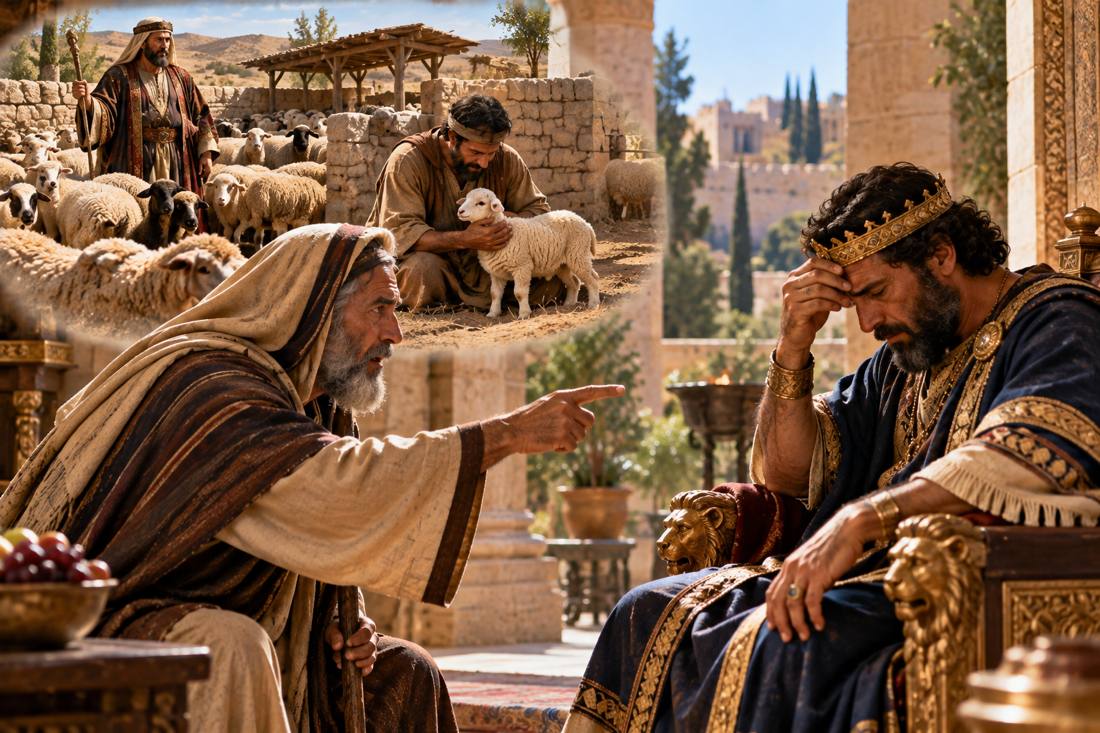
But something had happened. "The thing that David had done displeased the LORD" (2 Samuel 11:27). So God sent a preacher with a story. In Unit 1 we called Nathan's story a juridical parable: the prophet brings the king a case to judge, and the king pronounces sentence on himself. It is the clearest example in the Bible of what a parable can do. It slips past a hardened heart and opens it.
I. The Courage of Nathan
Nathan was a prophet, and we might call him the court preacher. He had brought David good news before: God's promise that David's throne would be established forever (2 Samuel 7). Now God sent him with bad news, and no one likes to carry bad news to a king. David held the power of life and death. Kings in the ancient world often punished the messenger. Nathan could easily have stayed quiet, as the rest of the court apparently did for a whole year. Instead he went.
But notice how he went. He did not burst into the throne room with an accusation. He told a story, and he let David's own sense of justice do the work. That is wisdom in confrontation. A frontal attack often makes a guilty person defensive; a parable lets him see the truth before he has time to raise his guard.
II. The Story (2 Samuel 12:1–4)
"There were two men in one city, one rich and the other poor." The rich man had "exceedingly many flocks and herds." The poor man had nothing "except one little ewe lamb which he had bought and nourished." The lamb grew up with him and his children. "It ate of his own food and drank from his own cup and lay in his bosom; and it was like a daughter to him" (12:3).
Every detail is chosen to stir the listener's heart. This is not livestock; it is a family pet, almost a child. Some interpreters notice that the Hebrew word for "daughter," bat, echoes the name Bath-sheba, and the detail that the lamb "lay in his bosom" quietly recalls what David had done with another man's wife. David does not catch the echo. He hears only a story about a lamb.
Then a traveler came to the rich man. Instead of taking one of his own many animals to prepare a meal, he took the poor man's only lamb and served it to his guest (12:4). It is a picture of selfish power: a man who had everything taking the one thing another man loved.
III. The Verdict (2 Samuel 12:5–7)
"So David's anger was greatly aroused against the man, and he said to Nathan, 'As the LORD lives, the man who has done this shall surely die! And he shall restore fourfold for the lamb, because he did this thing and because he had no pity'" (12:5–6). David knew the law: a stolen sheep was to be repaid four times over (Exodus 22:1). He was a good judge of other people's sins.
Then came four of the most powerful words in the Old Testament: "You are the man!" (12:7). The story snapped shut like a trap. David, the rich king with many wives, had taken the one wife of a poor soldier and then had him killed. He had condemned himself and pronounced his own sentence.
Nathan then spoke for God: "I anointed you king over Israel, and I delivered you from the hand of Saul. I gave you your master's house... and gave you the house of Israel and Judah. And if that had been too little, I also would have given you much more!" (12:7–8). Hear the echo of Isaiah's vineyard song from Unit 2: "What more could have been done to My vineyard?" In both parables, sin is shown against the background of God's generosity. David did not take Bathsheba because God had given him too little. He took her because he despised what God had given.
IV. The Consequences (2 Samuel 12:10–14)
"Now therefore, the sword shall never depart from your house" (12:10). The rest of 2 Samuel tells the painful story. The child born to Bathsheba died. David's son Amnon raped his half-sister Tamar, and her brother Absalom murdered Amnon. Absalom led a rebellion against his father and was killed. Later another son, Adonijah, was executed after trying to seize the throne. Jewish tradition noticed that four of David's sons died, and saw in it a grim echo of the "fourfold" David had pronounced over the rich man.
Here is a truth every pastor must teach carefully: forgiveness does not always remove consequences. God forgave David's guilt, and David did not die. But the sin had already set things in motion in his family that confession did not undo. Any sin leaves scars. We have an advantage over David, because Christ bore the penalty of our sin on the cross. But we should never imagine that because God forgives, sin costs nothing.
V. How David Responded
The turning point is verse 13: "I have sinned against the LORD." And Nathan said, "The LORD also has put away your sin; you shall not die." How differently we usually react when someone tells us we are sinners. David had at least four other choices, and we are tempted by every one of them.
He could have lied. He might have said, "You have no proof. You don't know what I have done." Even a small child learns quickly that lying seems easier than telling the truth. One police officer said he had never met a criminal who admitted to his crime. We readily lie our way out of sin.
He could have blamed someone else. He might have said that Bathsheba had enticed him. That is the oldest defense in the world. When God confronted Adam in the garden, Adam said, "The woman whom You gave to be with me, she gave me of the tree, and I ate" (Genesis 3:12). He blamed the woman and, in the same breath, blamed God.
He could have made excuses. He might have said that he had been a poor shepherd boy, that the pressures of government distracted him, or that Uriah and Bathsheba already had problems in their marriage. We often try to excuse our sin as well.
He could have become angry at the preacher. He might have had Nathan killed for his insolence. People still attack the messenger when they do not like the message.
Instead David admitted his sin. No excuse could suffice, because the all-knowing God looks directly into the heart and cannot be deceived. He knows our open sins and our secret sins, our sins of commission and our sins of omission. The One who counts the hairs of our heads knows about our sins. A heart that had been separated from God and frozen for a year was finally thawed.
VI. The Year of Silence and the Psalm of Confession
Psalm 51 is titled "when Nathan the prophet went to him, after he had gone in to Bathsheba." It begins, "Have mercy upon me, O God, according to Your lovingkindness," and it cries, "Against You, You only, have I sinned, and done this evil in Your sight" (Psalm 51:1, 4). David had sinned terribly against Bathsheba and Uriah, but he understood that every sin is ultimately a sin against God. Psalm 32, which many connect with the same season, describes the year he spent hiding his sin: "When I kept silent, my bones grew old through my groaning all the day long... I acknowledged my sin to You... and You forgave the iniquity of my sin" (Psalm 32:3–5).
Willful sin separates us from the sense of God's presence, and it is one of the main reasons prayer goes unanswered (Psalm 66:18). Rebellion against God never makes us happy. I remember reaching my teenage years and deciding that I could make my own decisions. I did not want my parents telling me to study, when to come home, or what chores to do. Eventually I rebelled against God too and decided church was not important for me. It took me several years to learn that doing what I wanted was not as good as it was supposed to be. In fact, it was the most miserable time of my life. Perhaps God allows us to hit rock bottom so that we have nowhere else to turn, and then He stands waiting for us with open arms. Jesus' prodigal son "came to himself" in the pigpen (Luke 15:17) and went home to a father who ran to meet him. God works to confront us with our sin, sometimes through conscience, sometimes through the hardships of life, and sometimes through a faithful friend like Nathan.
VII. Forgiveness and a New Direction
We cannot change the past. There is no time machine to go back and correct our sins. Lady Macbeth, in Shakespeare's play, tried in vain to wash imaginary bloodstains from her hands. We can never clear our own consciences. If we are to be forgiven, God must forgive us, and the Bible says He does. When we pray as the tax collector did, "God, be merciful to me a sinner!" (Luke 18:13), God answers, "Their sins and their lawless deeds I will remember no more" (Hebrews 8:12).
There was once a girl who grew up an orphan. Her mother had died, and her father had disappeared and was presumed dead. She had never known what it meant to be loved. Through the years her father had become successful, but he was unhappy, because he knew he had a daughter somewhere and could not find her. After nearly twenty years of searching, he followed a new lead to Atlanta. When he was sure she was his child, he drove to the cheap boarding house where she lived and said, "I am your father, and I have come to take you home." That is what forgiveness is like. We are not merely excused; we are brought home.
Confession also carries an obligation. When Zacchaeus met Jesus, he said, "If I have taken anything from anyone by false accusation, I restore fourfold" (Luke 19:8), the same fourfold that David had demanded of the rich man. We cannot change the past, but where possible we should make our wrongs right. And there is no real repentance if we are content to commit the same sins over and over. We never stand still in life; we are either moving toward God or away from Him. Even now you are writing the biography of the person you will be in five years.
VIII. Preaching the Ewe Lamb
A pastor can follow David's path: he was confronted with his sin, he acknowledged it without lies, blame, excuses, or anger, he was sorry for it, as Psalm 51 shows, and he turned from it to receive God's forgiveness. The sermon may also teach a word about confrontation itself. Pastors are sometimes called to be Nathans. The method of the parable, wise, indirect, and aimed at the conscience, is often more effective than a direct accusation, and it requires courage either way.
Nathan's parable belongs to a small family. The wise woman of Tekoa told David a made-up case about her sons to move him to bring Absalom home (2 Samuel 14:1–20). A wounded prophet told King Ahab a story about a lost prisoner, and Ahab judged himself (1 Kings 20:35–43). In each, a king sits as judge and discovers he is the defendant. Jesus used the same method when He asked the chief priests what the vineyard owner would do to the wicked tenants (Matthew 21:40–41).
Ian Maclaren told a story of a stern Scottish elder named Lachlan Campbell whose daughter Flora ran away from home. When reports came back of her sinful life, he struck her name from the family Bible. But a kind woman in the village wrote to Flora, and one night the prodigal came home. She found that her father's heart had broken and her name had been written back into the family Bible in the trembling hand of an old man. If a hard earthly father can receive a prodigal home, how much more gladly will God receive us?
Closing
"You are the man!" Those words are not only for David. Every one of us has taken what was not ours, justified ourselves, and judged others for the very sins we have committed. But Nathan did not come only to condemn. He came to bring David home. The same God who confronts us is the God who forgives, and the story that exposes our sin can become the story of our return.
— Dr. Wayne Cook
Chapala Theological Seminary
Unit 5 Exam
Certificate track: the 20 multiple-choice questions. Associate: multiple choice and the 10 fill-in-the-blank questions. M.Div. and Th.M.: multiple choice, fill-ins and the 10 short-answer questions. 90% of each part is required to pass. If you do not pass, the exam waits a short time before you can try again.
M.Div. and Th.M.: all five assigned readings are part of the course. Their separate exam is required after activation; see its page for the current rule. Honors remains optional and does not replace the exam.
Open Course Readings →