Jisajili mara moja, kwa kozi zote
Maendeleo yako yanahifadhiwa kwenye kivinjari hiki unaposoma, na seminari inayatunza chini ya msimbo wako wa mwanafunzi, ili uweze kuendelea kwenye kifaa chochote. Weka msimbo huo kwa siri, kama nenosiri. Barua pepe si lazima. Iongeze ili tukurudishie msimbo wako wa mwanafunzi, tukutumie vikumbusho na tukupe cheti. Unaweza kujiandikisha na kuendelea kusoma bila barua pepe. Tunachohifadhi.
Programu ya Cheti inajibu maswali ya kuchagua jibu. Shahada ya Mshiriki inaongeza maswali ya kujaza pengo; M.Div. na Th.M. zinaongeza hayo na maswali ya majibu mafupi. Asilimia 90 ya kila sehemu inahitajika ili kufaulu.
UtanguliziOrientation
Napenda kutengeneza vitu. Ikiwa salitre (chumvi ya unyevu inayokula kuta) inabandua lipu ukutani, mimi naziba. Soksi ikiwa na tundu, naishona. Kitu kikivunjika, nachukua gundi kali, na rangi ikififia, napaka tena. Lakini vitu vingine haviwezi kutengenezwa kwa kuziba tu. Wakati mwingine kilichovunjika lazima kianzwe upya.I like fixing things. If salitre is eating the plaster off a wall, I patch it. If a sock has a hole, I sew it. If something breaks, I reach for the superglue, and if the paint is dull, I paint it again. But some things cannot be fixed with a patch. Sometimes what is broken has to be started over.
Hiyo ndiyo hali ambayo Mungu alimtuma nabii Yeremia kuiendea. Hakumtuma kwanza kuhubiri mahubiri. Alimtuma kutazama mahubiri. "Ondoka, ushuke mpaka nyumba ya mfinyanzi, nami huko nitakusikizisha maneno yangu" (Yeremia 18:2). Katika Sehemu ya 1 tuliuita huu mfano wa matendo: mahubiri yanayohubiriwa kupitia tendo kabla hayajahubiriwa kwa maneno. Utambulisho ni rahisi, kwa sababu Mungu anautoa mwenyewe kwa ajili yetu. Mungu ndiye Mfinyanzi, na Israeli ndiyo udongo. Lakini matumizi hayaishii kwa Israeli. Kila mtu aliyewahi kuishi ni udongo juu ya gurudumu la Mfinyanzi, na hilo linanijumuisha mimi na wewe.That is the situation to which God sent the prophet Jeremiah. He did not send him first to preach a sermon. He sent him to watch one. "Arise and go down to the potter's house, and there I will cause you to hear My words" (Jeremiah 18:2). In Unit 1 we called this an enacted parable: a sermon preached through an action before it is preached in words. The identification is simple, because God makes it for us. God is the Potter, and Israel is the clay. But the application does not stop with Israel. Every person who has ever lived is clay on the Potter's wheel, and that includes you and me.
I. MazingiraI. The Setting
Yeremia aliitwa akiwa kijana katika mwaka wa kumi na tatu wa Mfalme Yosia, takriban 627 K.K., naye alihubiri kwa takriban miaka arobaini hadi Yerusalemu ilipoangukia Babeli mwaka 586 K.K. Ujumbe wake kwa Yuda ulikuwa mgumu: taifa lilikuwa limegeukia sanamu, wenye nguvu waliwadhulumu wanyonge, na watu waliliamini hekalu kana kwamba ni hirizi ya bahati njema. Hukumu ilikuwa ikija. Yeremia alihubiri kwa machozi, naye alidhihakiwa, akapigwa, akafungwa gerezani, na akatupwa katika shimo la matope kwa sababu ya kazi yake.Jeremiah was called as a young man in the thirteenth year of King Josiah, around 627 BC, and he preached for about forty years until Jerusalem fell to Babylon in 586 BC. His message to Judah was hard: the nation had turned to idols, the powerful oppressed the weak, and the people trusted in the temple as if it were a good-luck charm. Judgment was coming. Jeremiah preached with tears, and he was mocked, beaten, imprisoned, and thrown into a muddy cistern for his trouble.
Jumbe nyingi za Yeremia zilikuja kupitia mafunzo ya vitu halisi. Alifukia mshipi wa kitani hadi ukaoza (Yeremia 13). Alinunua chupa ya udongo akaivunja (Yeremia 19). Alivaa nira ya ng'ombe shingoni mwake (Yeremia 27). Na katika sura ya 18 Mungu alimtuma mahali ambapo kila mtu wa Yerusalemu alipajua vizuri: karakana ya mfinyanzi katika sehemu ya chini ya mji.Many of Jeremiah's messages came through object lessons. He buried a linen sash until it rotted (Jeremiah 13). He bought and shattered a clay flask (Jeremiah 19). He wore an ox yoke on his neck (Jeremiah 27). And in chapter 18 God sent him to a place every person in Jerusalem knew well: the potter's workshop in the lower part of the city.
II. Mfinyanzi Kazini (Yeremia 18:1–4)II. The Potter at Work (Jeremiah 18:1–4)
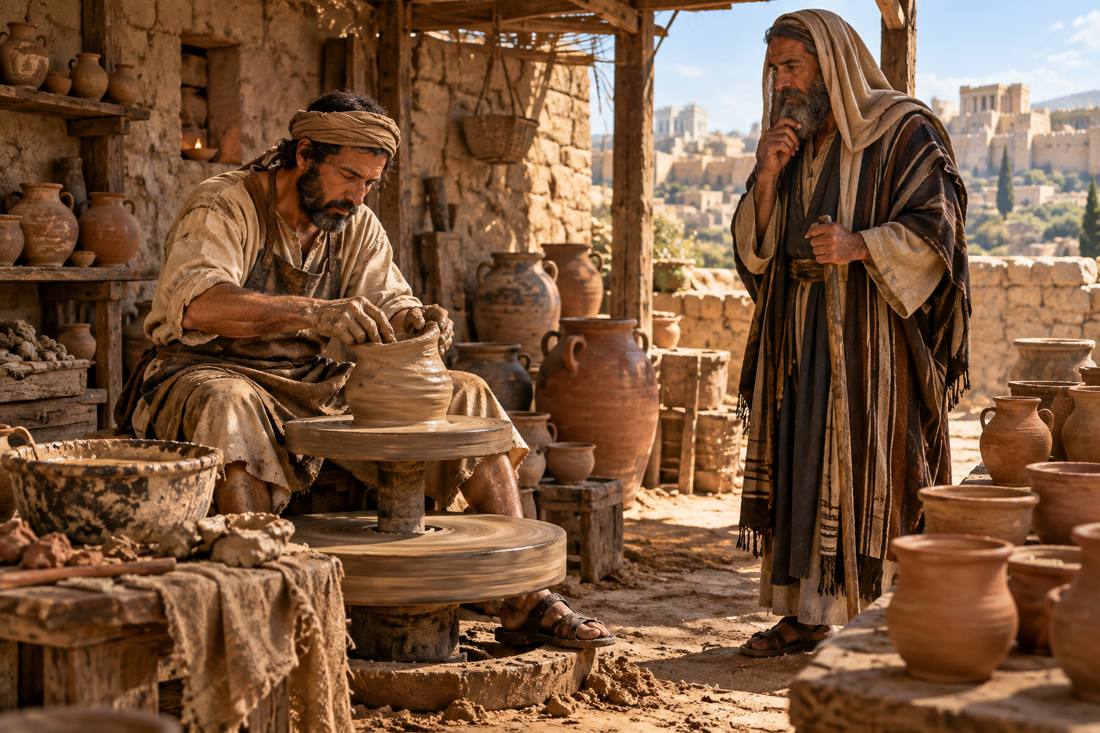
Tushuke hadi nyumba ya mfinyanzi tusimame kando ya Yeremia. Mfinyanzi ameketi kwenye "gurudumu," kwa Kiebrania kwa maana halisi "mawe mawili": jiwe la chini linalozungushwa kwa miguu ya mfinyanzi na jiwe la juu ambalo udongo huzunguka juu yake. Miguu yake ikiendelea kulizungusha gurudumu, mikono yake inafanya kazi kwa ustadi katika udongo ulio na maji, akijaribu kuunda chombo kinachofaa kutumika.Let us go down to the potter's house and stand beside Jeremiah. The potter sits at "the wheel," literally "the two stones" in Hebrew: a lower stone turned by the potter's feet and an upper stone on which the clay spins. As his feet keep the wheel turning, his hands work skillfully in the wet clay, trying to form a vessel worth using.
Kisha jambo linaharibika. "Na kile chombo alichokuwa akikifanya kwa udongo kikaharibika mkononi mwa mfinyanzi" (Yeremia 18:4). Labda kulikuwa na kijiwe ndani ya udongo, au udongo ulikuwa mkavu mno, au haukukubali kufinyangwa na mikono yake. Basi mfinyanzi aliukandamiza ukawa donge na akaanza upya, "akakifanya tena kuwa chombo kingine, kama alivyoona vema mfinyanzi kukifanya." Hakuutupa udongo. Aliufinyanga upya.Then something goes wrong. "The vessel that he made of clay was marred in the hand of the potter" (Jeremiah 18:4). Perhaps there was a pebble in the clay, or the clay was too dry, or it would not yield to his hands. So the potter pressed it down into a lump and started over, and "he made it again into another vessel, as it seemed good to the potter to make." He did not throw the clay away. He reshaped it.
Angalia mambo mawili. Kwanza, mfinyanzi ndiye mwenye mamlaka. Udongo hauamui utakuwa nini. Pili, mfinyanzi ni mvumilivu. Chombo kilichoharibika si mwisho wa hadithi; ni mwanzo wa hadithi mpya.Notice two things. First, the potter is in charge. The clay does not decide what it will become. Second, the potter is patient. The marred vessel is not the end of the story; it is the beginning of a new one.
III. Maana kwa Israeli (Yeremia 18:5–12)III. The Meaning for Israel (Jeremiah 18:5–12)
Kisha neno la BWANA likamjia Yeremia: "Ee nyumba ya Israeli, je! Mimi siwezi kuwatenda ninyi kama mfinyanzi huyu?... Tazama, kama vile udongo ulivyo mkononi mwa mfinyanzi, ndivyo mlivyo ninyi mkononi mwangu" (Yeremia 18:6). Mungu ana haki na uwezo wa kuyaunda mataifa kama apendavyo.Then the word of the LORD came to Jeremiah: "O house of Israel, can I not do with you as this potter?... Look, as the clay is in the potter's hand, so are you in My hand" (Jeremiah 18:6). God has the right and the power to shape nations as He wills.
Lakini mistari inayofuata inaonyesha kwamba Mfinyanzi hatendi kiholela. "Wakati wo wote nitakaponena habari za taifa moja, au habari za ufalme mmoja, ya kuung'oa, na kuuvunja, na kuuangamiza; ikiwa taifa lile nililolinena litaghairi, na kuuacha uovu wake, nitaghairi mabaya niliyokusudia kuwatenda" (Yeremia 18:7–8). Na kinyume chake pia ni kweli: ikiwa taifa ambalo Mungu alipanga kulibariki litageukia uovu, atayafikiria upya mema aliyokusudia (mist. 9–10). Mfinyanzi ni mwenye enzi, lakini huitikia jinsi udongo unavyomwitikia. Maonyo yake ni mialiko halisi ya kutubu.But the next verses show that the Potter is not arbitrary. "The instant I speak concerning a nation and concerning a kingdom, to pluck up, to pull down, and to destroy it, if that nation against whom I have spoken turns from its evil, I will relent of the disaster that I thought to bring upon it" (Jeremiah 18:7–8). And the reverse is also true: if a nation God planned to bless turns to evil, He will reconsider the good He intended (vv. 9–10). The Potter is sovereign, but He responds to how the clay responds to Him. His warnings are real invitations to repent.
Hii ndiyo sababu kifungu hiki ni muhimu katika mijadala kuhusu enzi ya Mungu na uhuru wa mwanadamu. Wafasiri wa mapokeo ya Kiarminiani na ya Kiwesley mara nyingi huonyesha Yeremia 18:7–10 kama picha ya wazi ya jinsi Mungu anavyoshughulika kwa masharti: mipango ambayo Mungu ametangaza kwa taifa hutegemea jinsi taifa hilo linavyoitikia. Wafasiri wa mapokeo ya Kireformed wanakubali kwamba kifungu hiki kinaeleza mwitikio halisi wa Mungu katika historia, na kwa kawaida huongeza kwamba mwitikio huo wenyewe uko ndani ya kusudi lake la milele. Wote wanakubaliana juu ya hoja ya vitendo ya sura hii: Yuda ingeweza bado kugeuka, na Mungu alikuwa akiwasihi wafanye hivyo.This is why the passage matters in discussions of God's sovereignty and human freedom. Interpreters in the Arminian and Wesleyan traditions often point to Jeremiah 18:7–10 as a clear picture of conditional dealings: God's announced plans for a nation depend on the nation's response. Interpreters in the Reformed tradition agree that the passage describes God's real responsiveness in history, and they usually add that God's responses themselves fall within His eternal purpose. Both agree on the practical point of the chapter: Judah could still turn, and God was pleading with them to do it.
Jibu la Yuda lilikuwa la kusikitisha. "Hapana matumaini; kwa maana tutakwenda kwa kufuata mashauri yetu wenyewe" (Yeremia 18:12). Udongo uliikataa mikono ya Mfinyanzi.Judah's answer was tragic. "That is hopeless! So we will walk according to our own plans" (Jeremiah 18:12). The clay refused the Potter's hands.
IV. Mfinyanzi na Udongo Katika Maandiko YoteIV. The Potter and the Clay Across Scripture
Picha ya Mungu kama mfinyanzi inapita katika Biblia yote. Mungu alimfanya Adamu kwa mavumbi ya ardhi (Mwanzo 2:7), na neno la Kiebrania la "akamfanya" ndilo neno linalotumika kwa mfinyanzi. Isaya anawakemea wale wanaopindua mambo, kana kwamba udongo ungeweza kumwambia mfinyanzi, "Hakunifanya" (Isaya 29:16; 45:9). Na Isaya anaigeuza picha hiyo kuwa mojawapo ya maombi mazuri zaidi ya Agano la Kale: "Lakini sasa, Ee BWANA, wewe u baba yetu; sisi tu udongo, nawe u mfinyanzi wetu; sisi sote tu kazi ya mikono yako" (Isaya 64:8).The image of God as potter runs through the Bible. God formed Adam from the dust of the ground (Genesis 2:7), and the Hebrew word for "formed" is the word used of a potter. Isaiah rebukes those who turn things upside down, as if the clay could say to the potter, "He did not make me" (Isaiah 29:16; 45:9). And Isaiah turns the image into one of the most beautiful prayers of the Old Testament: "But now, O LORD, You are our Father; we are the clay, and You our potter; and all we are the work of Your hand" (Isaiah 64:8).
Paulo anaitumia picha hiyo katika Warumi 9:20–23: "Au mfinyanzi je! Hana amri juu ya udongo, kwa fungu moja la udongo kufanya chombo kimoja kiwe cha heshima na kimoja kiwe hakina heshima?" Wakristo husoma kifungu hiki kwa njia tofauti, na mchungaji anapaswa kujua mjadala huo. Wafasiri wa Kireformed kwa jumla huelewa kwamba Paulo anafundisha uchaguzi wa enzi ya Mungu wa watu mmoja mmoja kwa ajili ya wokovu. Wafasiri wa Kiarminiani na wa Kiwesley kwa jumla huonyesha kwamba hoja ya Paulo katika Warumi 9–11 inahusu haki ya Mungu ya kuweka masharti ya wokovu kwa Wayahudi na Mataifa sawasawa, kwamba Paulo anarejea Yeremia 18, ambapo kazi ya mfinyanzi hutegemea mwitikio wa udongo, na kwamba Warumi 9:22 inasema Mungu "alichukuliana kwa uvumilivu mwingi" na vile vyombo vya ghadhabu. Wote wanakubali kwamba udongo hauna haki ya kumshtaki Mfinyanzi.Paul uses the image in Romans 9:20–23: "Does not the potter have power over the clay, from the same lump to make one vessel for honor and another for dishonor?" Christians read this passage differently, and a pastor should know the conversation. Reformed interpreters generally understand Paul to be teaching God's sovereign choice of individuals for salvation. Arminian and Wesleyan interpreters generally note that Paul's argument in Romans 9–11 concerns God's right to set the terms of salvation for Jews and Gentiles alike, that Paul is echoing Jeremiah 18, where the potter's work depends on the clay's response, and that Romans 9:22 says God "endured with much longsuffering" the vessels of wrath. Both agree that the clay has no right to put the Potter on trial.
Agano Jipya pia linaitumia picha hiyo ili kutia moyo. "Lakini tuna hazina hii katika vyombo vya udongo, ili adhama ya uweza huo iwe ya Mungu, wala isitoke kwetu" (2 Wakorintho 4:7). Na Paulo anaandika kwamba katika nyumba kubwa kuna vyombo vya heshima na visivyo na heshima, na "ikiwa mtu amejitakasa" atakuwa "chombo cha heshima, kilichotakaswa, kimfaacho Bwana" (2 Timotheo 2:20–21).The New Testament also uses the image to encourage. "We have this treasure in earthen vessels, that the excellence of the power may be of God and not of us" (2 Corinthians 4:7). And Paul writes that in a great house there are vessels for honor and dishonor, and "if anyone cleanses himself" he will be "a vessel for honor, sanctified and useful for the Master" (2 Timothy 2:20–21).
V. Picha Tatu za UdongoV. Three Pictures of the Clay
1. Donge la udongo lenye kasoro. Mfinyanzi aliona kasoro na hakuipuuza. Wasifu wa mashujaa wa Kikristo mara nyingi huandikwa bila kuonyesha madoa yao; tunaona vilele vya milima na kamwe hatuoni mabonde ya giza. Biblia haifanyi hivyo. Mungu ni mwenye kuyaona mambo kama yalivyo kabisa, na watu anaowaweka mbele kama vielelezo wana kasoro. Petro alitembea juu ya maji kisha akazama. Alikiri, "Wewe ndiwe Kristo, Mwana wa Mungu aliye hai," na muda mfupi baadaye akakana kwamba anamjua. Baadaye tena alijitenga na waamini wa Mataifa alipobanwa (Wagalatia 2:11–13). Hata hivyo Yesu alikuwa amemwambia, "lakini mimi nimekuombea wewe, ili imani yako isitindike; nawe utakapoongoka, uwathibitishe ndugu zako" (Luka 22:32). Yohana Marko aliwaacha Paulo na Barnaba katika safari yao ya kwanza ya kimisionari, na Paulo akakataa kumchukua tena. Hata hivyo miaka mingi baadaye Paulo aliandika, "Mtwae Marko, umlete pamoja nawe; maana anifaa kwa utumishi" (2 Timotheo 4:11), na Marko akaandika Injili inayoitwa kwa jina lake. Mara nyingi tunadhani hatuwezi kumtumikia Mungu kwa sababu ya kasoro fulani ndani yetu. Lakini kasoro hizo si za kuua mikononi mwa Bwana.1. A flawed lump of clay. The potter noticed a flaw and did not ignore it. Biographies of Christian heroes are often written without warts; we see the mountaintops and never the dark valleys. The Bible does not do that. God is a total realist, and the people He holds up as models are flawed. Peter walked on water and then sank. He confessed, "You are the Christ, the Son of the living God," and a short time later denied he knew Him. Later still he pulled back from Gentile believers under pressure (Galatians 2:11–13). Yet Jesus had said to him, "I have prayed for you, that your faith should not fail; and when you have returned to Me, strengthen your brethren" (Luke 22:32). John Mark deserted Paul and Barnabas on their first missionary journey, and Paul refused to take him again. Yet years later Paul wrote, "Get Mark and bring him with you, for he is useful to me for ministry" (2 Timothy 4:11), and Mark wrote the Gospel that bears his name. We often think we cannot serve God because of some flaw in ourselves. But the flaws are not fatal in the Master's hands.
2. Donge la udongo lililotupwa. Udongo uliposhindwa kukubali, mfinyanzi aliukandamiza. Lazima ilionekana kana kwamba udongo unatupwa. Tunavijua vibandiko vidogo kwenye nguo mpya vinavyosema "Imekaguliwa na." Wakati mwingine tunashindwa ukaguzi wa Mungu, kama Belshaza, aliyeambiwa "Umepimwa katika mizani, nawe umeonekana kuwa umepunguka" (Danieli 5:27). Mfalme Daudi alikuwa mtu aliyeupendeza moyo wa Mungu, hata hivyo alizini na Bathsheba na akapanga kifo cha mumewe, na kwa takriban mwaka mmoja aliishi nje ya ushirika na Mungu hadi Nathani alipokuja na hadithi yake ya mwana-kondoo jike (Sehemu ya 5). Musa aliupiga mwamba kwa hasira akasema, "je! Sisi tuwatokezee maji katika mwamba huu?" (Hesabu 20:10), na Mungu hakumruhusu aingie Nchi ya Ahadi. Hizi ni picha za adabu ya Mungu, na adabu huumiza. Lakini "yeye ambaye Bwana ampenda, humrudi" (Waebrania 12:6). Mungu hatuadibishi kwa sababu anatuchukia bali kwa sababu anatupenda. Mgeni mmoja katika karakana ya mfinyanzi aliwahi kumtazama mfanyakazi akipiga donge la udongo kwa nyundo ya mbao, akauliza kwa nini. "Subiri uone," mfanyakazi alisema. Punde viputo vidogo vya hewa vikapanda juu. "Sasa unaona kwa nini ninaupiga," alisema. "Nisingeweza kamwe kufinyanga chombo kizuri kama viputo hivyo vingebaki ndani." Mkono wa Mungu juu ya watu wake wakati mwingine ni mzito kwa sababu hiyo hiyo.2. A discarded lump of clay. When the clay would not yield, the potter pressed it down. It must have looked as if the clay were being thrown away. We know the little tags on new clothing that say "Inspected by." Sometimes we fail God's inspection, like Belshazzar, who was "weighed in the balances and found wanting" (Daniel 5:27). King David was a man after God's own heart, yet he committed adultery with Bathsheba and arranged the death of her husband, and for about a year he lived out of fellowship with God until Nathan came with his story of the ewe lamb (Unit 5). Moses struck the rock in anger and said, "Must we bring water for you out of this rock?" (Numbers 20:10), and God did not allow him to enter the Promised Land. These are pictures of discipline, and discipline hurts. But "whom the LORD loves He chastens" (Hebrews 12:6). God does not discipline us because He hates us but because He loves us. A visitor to a potter's shop once watched a worker pounding a lump of clay with a mallet and asked why. "Wait and watch," said the worker. Soon little bubbles rose to the surface. "Now you see why I pound it," he said. "I could never shape a good vessel if those bubbles stayed inside." God's hand on His people is sometimes heavy for the same reason.
3. Donge la udongo lililofinyangwa upya. Wakati mwingine hatuwezi kuzibwa tu; Mungu inabidi aanze upya nasi. Rahabu, kahaba wa Yeriko, alimgeukia Mungu wa Israeli kwa imani na akawa mmoja wa wahenga wa Yesu (Mathayo 1:5). Musa alimuua Mmisri kwa hasira akakimbilia jangwani kwa miaka arobaini, na huko Mungu alimfinyanga upya na kumwita kutoka kichaka kilichokuwa kikiwaka moto. Kushindwa hakumaanishi kwamba Mungu amekuacha. Kunamaanisha Mungu ana wazo bora zaidi. Henry Ford aliwahi kusema kwamba kushindwa ni nafasi tu ya kuanza tena, safari hii kwa akili zaidi. Mikononi mwa Mfinyanzi, ni zaidi ya hilo. Ni nafasi ya kuwa kile alichokikusudia tangu mwanzo.3. A reshaped lump of clay. Sometimes we cannot simply be patched; God has to start over with us. Rahab, a prostitute in Jericho, turned to the God of Israel in faith and became an ancestor of Jesus (Matthew 1:5). Moses killed an Egyptian in anger and fled to the wilderness for forty years, and there God reshaped him and called him from a burning bush. Failure does not mean God has abandoned you. It means God has a better idea. Henry Ford once said that failure is simply the opportunity to begin again, this time more intelligently. In the Potter's hands, it is more than that. It is the opportunity to become what He intended all along.
Hakuna hata mmoja wetu aliye chombo kilichokamilika bado. Kanisa moja liliwahi kufanya shindano la kumtafuta raia mnyoofu zaidi, mwenye kiasi, na mwenye tabia njema zaidi mjini. Barua moja ya mshiriki ilisema: "Sivuti sigara. Sinywi pombe. Sichezi kamari. Ni mwaminifu kwa mke wangu na kamwe simtazami mwanamke mwingine. Ni mchapakazi, mtulivu, na mtiifu. Kamwe siendi kwenye ukumbi wa michezo ya kuigiza, nalala mapema kila usiku na kuamka alfajiri, nami huhudhuria ibada kanisani kila Jumapili bila kukosa." Kisha akaongeza: "Lakini subirini mpaka nitoke humu." Alikuwa akiandika kutoka gerezani. Tabia njema ya nje si sawa na moyo uliofinyangwa upya na Mungu. Ndiyo maana hatupaswi kamwe kumweka mwanadamu tu juu ya jukwaa la heshima; kila mmoja wao ataanguka. Kila mtakatifu katika Biblia alikuwa mwenye dhambi aliyepungukiwa na utukufu wa Mungu. Adabu na majaribu ambayo Mungu hutuletea ndiyo njia ambayo Mfinyanzi huondoa kiburi chetu na ukaidi wetu, ili atufinyange kuwa vyombo vinavyoweza kuibeba hazina ya neema yake.None of us is a finished vessel yet. A certain church once held a contest to find the most upright, sober, well-behaved citizen in town. One entry read: "I don't smoke. I don't drink. I don't gamble. I am faithful to my wife and never look at another woman. I am hard-working, quiet, and obedient. I never go to the theater, I go to bed early every night and rise with the dawn, and I attend chapel every Sunday without fail." Then he added: "But wait till I get out of here." He was writing from prison. Outward good behavior is not the same as a heart reshaped by God. That is why we should never put a mere human being on a pedestal; every one of them will fall off. Every saint in the Bible was a sinner who fell short of the glory of God. The discipline and trials God sends are how the Potter works out our pride and self-will, so that He can form us into vessels able to hold the treasure of His grace.
VI. Onyo Kutoka Yeremia 19VI. A Warning from Jeremiah 19
Sura inayofuata moja kwa moja inatoa mfano wa pili wa matendo, nao ni wa kutisha. Mungu alimwambia Yeremia anunue chupa ya udongo iliyokamilika, awachukue baadhi ya wazee hadi Bonde la Hinomu, na kuivunja mbele yao: "Vivyo hivyo nitawavunja watu hawa na mji huu, kama mtu avunjavyo chombo cha mfinyanzi, kisichoweza kutengenezwa tena" (Yeremia 19:11). Tofauti kati ya sura ya 18 na 19 ni tofauti kati ya udongo laini na chombo kilichochomwa motoni. Udongo laini juu ya gurudumu unaweza kufinyangwa upya. Chombo kilichochomwa na kuwa kigumu kinaweza kuvunjwa tu. Funzo kwa kila msikilizaji ni la dharura: baki laini mikononi mwa Mfinyanzi. Usisubiri mpaka moyo wako uwe mgumu.The very next chapter gives a second enacted parable, and it is a sobering one. God told Jeremiah to buy a finished clay flask, take some of the elders to the Valley of Hinnom, and smash it in front of them: "Even so I will break this people and this city, as one breaks a potter's vessel, which cannot be made whole again" (Jeremiah 19:11). The difference between chapters 18 and 19 is the difference between soft clay and a fired vessel. Soft clay on the wheel can be reshaped. A vessel that has been fired and hardened can only be broken. The lesson for every hearer is urgent: stay soft in the Potter's hands. Do not wait until your heart is hardened.
VII. Kuhubiri Nyumba ya MfinyanziVII. Preaching the Potter's House
Mchungaji anaweza kufuata picha tatu zilizo hapo juu kama muhtasari rahisi: udongo wenye kasoro, udongo uliotupwa, na udongo uliofinyangwa upya. Kila hoja inahitaji mfano wa kibiblia na mfano wa kisasa, na kila moja inapaswa kumalizika kwa kumweka msikilizaji juu ya gurudumu.A pastor can follow the three pictures above as a simple outline: the flawed clay, the discarded clay, and the reshaped clay. Each point needs a biblical example and a modern one, and each should end by placing the listener on the wheel.
Hadithi inayojulikana huwasaidia wasikilizaji wengi. Mbeba maji mmoja huko India alibeba vyungu viwili kwenye mti uliowekwa mabegani mwake. Chungu kimoja kilikuwa kizima kabisa; kingine kilikuwa na ufa na kilifika nyumbani kwa bwana wake kikiwa nusu tu. Baada ya miaka miwili chungu chenye ufa kiliomba msamaha kwa kushindwa kwake. Mbeba maji akakiomba kiangalie kando ya njia wakati wa kurudi. Upande wa njia wa chungu chenye ufa, maua ya porini yalikuwa yamechanua. "Nilijua kuhusu ufa wako," alisema, "kwa hiyo nilipanda mbegu upande wako, na kila siku wewe ulizitia maji." Kila mmoja wetu ni chungu chenye ufa, na mara nyingi Mungu hutumia udhaifu ule ule tuliodhani unatufanya tusifae ili kutufanya baraka.A familiar story helps many listeners. A water bearer in India carried two pots on a pole across his shoulders. One pot was perfect; the other had a crack and arrived at the master's house only half full. After two years the cracked pot apologized for its failure. The water bearer asked it to look along the path on the way back. On the cracked pot's side of the path, wildflowers were blooming. "I knew about your crack," he said, "so I planted seeds on your side, and every day you watered them." Each of us is a cracked pot, and God often uses the very weakness we thought disqualified us to make us a blessing.
Kielelezo kingine kinachopendwa sana kinahusu neno la Kiingereza "sincere" (mnyoofu, asiye na unafiki). Wahubiri kwa muda mrefu wamesema linatokana na maneno mawili ya Kilatini, sine cera, "bila nta." Inasemekana wafinyanzi wasio waaminifu walijaza nyufa kwa nta na kuzipaka rangi ya kung'aa juu yake, na mnunuzi mwenye busara angekiinua chombo kwenye mwanga wa jua ili kuona kama kweli hakina nta. Uaminifu unatulazimu kusema kwamba wataalamu wa lugha wanaona asili hii kuwa haina uhakika, na huenda ni hadithi ya baadaye kuliko historia halisi ya neno hilo. Lakini kama kielelezo bado kinaeleza hoja vizuri: Mungu hatafuti vyombo vinavyoficha nyufa zao. Anatafuta vyombo vilivyo waaminifu mbele zake, vilivyoinuliwa kwenye nuru yake.Another well-loved illustration concerns the word "sincere." Preachers have long said it comes from two Latin words, sine cera, "without wax." Dishonest potters supposedly filled cracks with wax and glazed over them, and a wise buyer would hold a vessel up to the sunlight to see whether it was truly without wax. Honesty requires us to say that language scholars consider this origin uncertain and probably a later story rather than the true history of the word. But as an illustration it still makes the point well: God is not looking for vessels that hide their cracks. He is looking for vessels that are honest before Him, held up to His light.
HitimishoClosing
Yeremia alishuka hadi nyumba ya mfinyanzi na kutazama mahubiri ambayo asingeyasahau kamwe. Chombo kilichoharibika hakikutupwa; kilikandamizwa na kufanywa tena, "kama alivyoona vema mfinyanzi." Mfinyanzi huyo huyo bado yuko kazini. Huziona kasoro zetu, hutuadibisha kwa upendo, na hutufinyanga upya kwa makusudi yake. Swali pekee ni kama tutaikubali mikono yake au tutajifanya wagumu dhidi yake. Ombi la Isaya bado ndilo sahihi: "Sisi tu udongo, nawe u mfinyanzi wetu; sisi sote tu kazi ya mikono yako."Jeremiah went down to the potter's house and watched a sermon he would never forget. A marred vessel was not thrown away; it was pressed down and made again, "as it seemed good to the potter." The same Potter is still at work. He sees our flaws, He disciplines us in love, and He reshapes us for His purposes. The only question is whether we will yield to His hands or harden ourselves against Him. Isaiah's prayer is still the right one: "We are the clay, and You our potter; and all we are the work of Your hand."
— Dkt. Wayne Cook
Seminari ya Teolojia ya Chapala— Dr. Wayne Cook
Chapala Theological Seminary
Mtihani wa Sehemu ya 3Unit 3 Exam
Cheti: maswali 20 ya kuchagua jibu. Shahada ya Mshiriki: maswali ya kuchagua jibu na maswali 10 ya kujaza nafasi. Shahada ya Uzamili ya Huduma ya Kiungu (M.Div.) na Shahada ya Uzamili ya Teolojia (Th.M.): maswali ya kuchagua jibu, ya kujaza nafasi na maswali 10 ya majibu mafupi. Unahitaji kupata 90% katika kila sehemu ili kufaulu. Usipofaulu, mtihani utasubiri muda mfupi kabla hujaweza kujaribu tena.Certificate track: the 20 multiple-choice questions. Associate: multiple choice and the 10 fill-in-the-blank questions. M.Div. and Th.M.: multiple choice, fill-ins and the 10 short-answer questions. 90% of each part is required to pass. If you do not pass, the exam waits a short time before you can try again.
M.Div. na Th.M.: masomo yote matano yaliyopangwa ni sehemu ya kozi. Mtihani wake tofauti ni wa lazima baada ya kuanzishwa; tazama ukurasa wake kwa kanuni ya sasa. Heshima inabaki kuwa ya hiari na haichukui nafasi ya mtihani.
Fungua Masomo ya Kozi →