Register once, for every course
Your progress is saved in this browser as you study, and kept with the seminary under your student code, so you can continue on any device. Keep the code private, like a password. Email is optional. Add one so we can return your student code, send reminders, and deliver a certificate. You can enroll and keep studying without it. What we keep.
The Certificate track answers the multiple choice. The Associate adds the fill-in-the-blank questions; M.Div. and Th.M. add those and the short-answer questions. 90% of each part is required to pass.
Orientation
I like fixing things. If salitre is eating the plaster off a wall, I patch it. If a sock has a hole, I sew it. If something breaks, I reach for the superglue, and if the paint is dull, I paint it again. But some things cannot be fixed with a patch. Sometimes what is broken has to be started over.
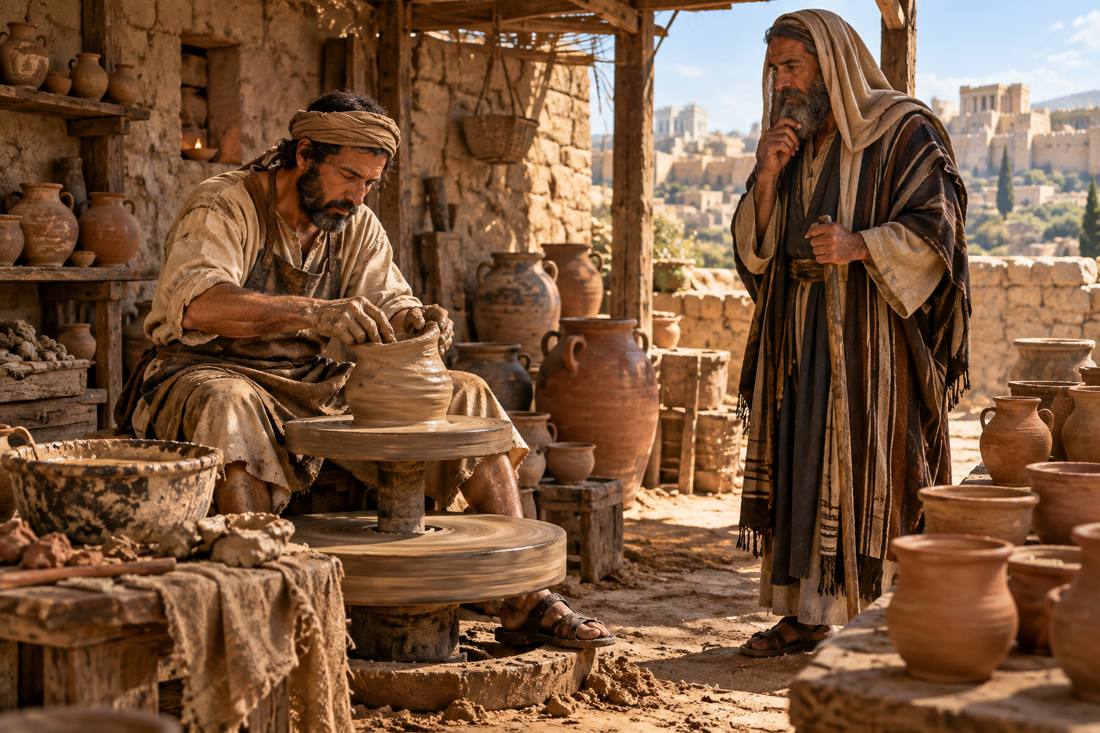
That is the situation to which God sent the prophet Jeremiah. He did not send him first to preach a sermon. He sent him to watch one. "Arise and go down to the potter's house, and there I will cause you to hear My words" (Jeremiah 18:2). In Unit 1 we called this an enacted parable: a sermon preached through an action before it is preached in words. The identification is simple, because God makes it for us. God is the Potter, and Israel is the clay. But the application does not stop with Israel. Every person who has ever lived is clay on the Potter's wheel, and that includes you and me.
I. The Setting
Jeremiah was called as a young man in the thirteenth year of King Josiah, around 627 BC, and he preached for about forty years until Jerusalem fell to Babylon in 586 BC. His message to Judah was hard: the nation had turned to idols, the powerful oppressed the weak, and the people trusted in the temple as if it were a good-luck charm. Judgment was coming. Jeremiah preached with tears, and he was mocked, beaten, imprisoned, and thrown into a muddy cistern for his trouble.
Many of Jeremiah's messages came through object lessons. He buried a linen sash until it rotted (Jeremiah 13). He bought and shattered a clay flask (Jeremiah 19). He wore an ox yoke on his neck (Jeremiah 27). And in chapter 18 God sent him to a place every person in Jerusalem knew well: the potter's workshop in the lower part of the city.
II. The Potter at Work (Jeremiah 18:1–4)
Let us go down to the potter's house and stand beside Jeremiah. The potter sits at "the wheel," literally "the two stones" in Hebrew: a lower stone turned by the potter's feet and an upper stone on which the clay spins. As his feet keep the wheel turning, his hands work skillfully in the wet clay, trying to form a vessel worth using.
Then something goes wrong. "The vessel that he made of clay was marred in the hand of the potter" (Jeremiah 18:4). Perhaps there was a pebble in the clay, or the clay was too dry, or it would not yield to his hands. So the potter pressed it down into a lump and started over, and "he made it again into another vessel, as it seemed good to the potter to make." He did not throw the clay away. He reshaped it.
Notice two things. First, the potter is in charge. The clay does not decide what it will become. Second, the potter is patient. The marred vessel is not the end of the story; it is the beginning of a new one.
III. The Meaning for Israel (Jeremiah 18:5–12)
Then the word of the LORD came to Jeremiah: "O house of Israel, can I not do with you as this potter?... Look, as the clay is in the potter's hand, so are you in My hand" (Jeremiah 18:6). God has the right and the power to shape nations as He wills.
But the next verses show that the Potter is not arbitrary. "The instant I speak concerning a nation and concerning a kingdom, to pluck up, to pull down, and to destroy it, if that nation against whom I have spoken turns from its evil, I will relent of the disaster that I thought to bring upon it" (Jeremiah 18:7–8). And the reverse is also true: if a nation God planned to bless turns to evil, He will reconsider the good He intended (vv. 9–10). The Potter is sovereign, but He responds to how the clay responds to Him. His warnings are real invitations to repent.
This is why the passage matters in discussions of God's sovereignty and human freedom. Interpreters in the Arminian and Wesleyan traditions often point to Jeremiah 18:7–10 as a clear picture of conditional dealings: God's announced plans for a nation depend on the nation's response. Interpreters in the Reformed tradition agree that the passage describes God's real responsiveness in history, and they usually add that God's responses themselves fall within His eternal purpose. Both agree on the practical point of the chapter: Judah could still turn, and God was pleading with them to do it.
Judah's answer was tragic. "That is hopeless! So we will walk according to our own plans" (Jeremiah 18:12). The clay refused the Potter's hands.
IV. The Potter and the Clay Across Scripture
The image of God as potter runs through the Bible. God formed Adam from the dust of the ground (Genesis 2:7), and the Hebrew word for "formed" is the word used of a potter. Isaiah rebukes those who turn things upside down, as if the clay could say to the potter, "He did not make me" (Isaiah 29:16; 45:9). And Isaiah turns the image into one of the most beautiful prayers of the Old Testament: "But now, O LORD, You are our Father; we are the clay, and You our potter; and all we are the work of Your hand" (Isaiah 64:8).
Paul uses the image in Romans 9:20–23: "Does not the potter have power over the clay, from the same lump to make one vessel for honor and another for dishonor?" Christians read this passage differently, and a pastor should know the conversation. Reformed interpreters generally understand Paul to be teaching God's sovereign choice of individuals for salvation. Arminian and Wesleyan interpreters generally note that Paul's argument in Romans 9–11 concerns God's right to set the terms of salvation for Jews and Gentiles alike, that Paul is echoing Jeremiah 18, where the potter's work depends on the clay's response, and that Romans 9:22 says God "endured with much longsuffering" the vessels of wrath. Both agree that the clay has no right to put the Potter on trial.
The New Testament also uses the image to encourage. "We have this treasure in earthen vessels, that the excellence of the power may be of God and not of us" (2 Corinthians 4:7). And Paul writes that in a great house there are vessels for honor and dishonor, and "if anyone cleanses himself" he will be "a vessel for honor, sanctified and useful for the Master" (2 Timothy 2:20–21).
V. Three Pictures of the Clay
1. A flawed lump of clay. The potter noticed a flaw and did not ignore it. Biographies of Christian heroes are often written without warts; we see the mountaintops and never the dark valleys. The Bible does not do that. God is a total realist, and the people He holds up as models are flawed. Peter walked on water and then sank. He confessed, "You are the Christ, the Son of the living God," and a short time later denied he knew Him. Later still he pulled back from Gentile believers under pressure (Galatians 2:11–13). Yet Jesus had said to him, "I have prayed for you, that your faith should not fail; and when you have returned to Me, strengthen your brethren" (Luke 22:32). John Mark deserted Paul and Barnabas on their first missionary journey, and Paul refused to take him again. Yet years later Paul wrote, "Get Mark and bring him with you, for he is useful to me for ministry" (2 Timothy 4:11), and Mark wrote the Gospel that bears his name. We often think we cannot serve God because of some flaw in ourselves. But the flaws are not fatal in the Master's hands.
2. A discarded lump of clay. When the clay would not yield, the potter pressed it down. It must have looked as if the clay were being thrown away. We know the little tags on new clothing that say "Inspected by." Sometimes we fail God's inspection, like Belshazzar, who was "weighed in the balances and found wanting" (Daniel 5:27). King David was a man after God's own heart, yet he committed adultery with Bathsheba and arranged the death of her husband, and for about a year he lived out of fellowship with God until Nathan came with his story of the ewe lamb (Unit 5). Moses struck the rock in anger and said, "Must we bring water for you out of this rock?" (Numbers 20:10), and God did not allow him to enter the Promised Land. These are pictures of discipline, and discipline hurts. But "whom the LORD loves He chastens" (Hebrews 12:6). God does not discipline us because He hates us but because He loves us. A visitor to a potter's shop once watched a worker pounding a lump of clay with a mallet and asked why. "Wait and watch," said the worker. Soon little bubbles rose to the surface. "Now you see why I pound it," he said. "I could never shape a good vessel if those bubbles stayed inside." God's hand on His people is sometimes heavy for the same reason.
3. A reshaped lump of clay. Sometimes we cannot simply be patched; God has to start over with us. Rahab, a prostitute in Jericho, turned to the God of Israel in faith and became an ancestor of Jesus (Matthew 1:5). Moses killed an Egyptian in anger and fled to the wilderness for forty years, and there God reshaped him and called him from a burning bush. Failure does not mean God has abandoned you. It means God has a better idea. Henry Ford once said that failure is simply the opportunity to begin again, this time more intelligently. In the Potter's hands, it is more than that. It is the opportunity to become what He intended all along.
None of us is a finished vessel yet. A certain church once held a contest to find the most upright, sober, well-behaved citizen in town. One entry read: "I don't smoke. I don't drink. I don't gamble. I am faithful to my wife and never look at another woman. I am hard-working, quiet, and obedient. I never go to the theater, I go to bed early every night and rise with the dawn, and I attend chapel every Sunday without fail." Then he added: "But wait till I get out of here." He was writing from prison. Outward good behavior is not the same as a heart reshaped by God. That is why we should never put a mere human being on a pedestal; every one of them will fall off. Every saint in the Bible was a sinner who fell short of the glory of God. The discipline and trials God sends are how the Potter works out our pride and self-will, so that He can form us into vessels able to hold the treasure of His grace.
VI. A Warning from Jeremiah 19
The very next chapter gives a second enacted parable, and it is a sobering one. God told Jeremiah to buy a finished clay flask, take some of the elders to the Valley of Hinnom, and smash it in front of them: "Even so I will break this people and this city, as one breaks a potter's vessel, which cannot be made whole again" (Jeremiah 19:11). The difference between chapters 18 and 19 is the difference between soft clay and a fired vessel. Soft clay on the wheel can be reshaped. A vessel that has been fired and hardened can only be broken. The lesson for every hearer is urgent: stay soft in the Potter's hands. Do not wait until your heart is hardened.
VII. Preaching the Potter's House
A pastor can follow the three pictures above as a simple outline: the flawed clay, the discarded clay, and the reshaped clay. Each point needs a biblical example and a modern one, and each should end by placing the listener on the wheel.
A familiar story helps many listeners. A water bearer in India carried two pots on a pole across his shoulders. One pot was perfect; the other had a crack and arrived at the master's house only half full. After two years the cracked pot apologized for its failure. The water bearer asked it to look along the path on the way back. On the cracked pot's side of the path, wildflowers were blooming. "I knew about your crack," he said, "so I planted seeds on your side, and every day you watered them." Each of us is a cracked pot, and God often uses the very weakness we thought disqualified us to make us a blessing.
Another well-loved illustration concerns the word "sincere." Preachers have long said it comes from two Latin words, sine cera, "without wax." Dishonest potters supposedly filled cracks with wax and glazed over them, and a wise buyer would hold a vessel up to the sunlight to see whether it was truly without wax. Honesty requires us to say that language scholars consider this origin uncertain and probably a later story rather than the true history of the word. But as an illustration it still makes the point well: God is not looking for vessels that hide their cracks. He is looking for vessels that are honest before Him, held up to His light.
Closing
Jeremiah went down to the potter's house and watched a sermon he would never forget. A marred vessel was not thrown away; it was pressed down and made again, "as it seemed good to the potter." The same Potter is still at work. He sees our flaws, He disciplines us in love, and He reshapes us for His purposes. The only question is whether we will yield to His hands or harden ourselves against Him. Isaiah's prayer is still the right one: "We are the clay, and You our potter; and all we are the work of Your hand."
— Dr. Wayne Cook
Chapala Theological Seminary
Unit 3 Exam
Certificate track: the 20 multiple-choice questions. Associate: multiple choice and the 10 fill-in-the-blank questions. M.Div. and Th.M.: multiple choice, fill-ins and the 10 short-answer questions. 90% of each part is required to pass. If you do not pass, the exam waits a short time before you can try again.
M.Div. and Th.M.: all five assigned readings are part of the course. Their separate exam is required after activation; see its page for the current rule. Honors remains optional and does not replace the exam.
Open Course Readings →