Une seule inscription pour tous les coursRegister once, for every course
Votre progression est enregistrée dans ce navigateur et conservée par le séminaire sous votre code étudiant, pour continuer sur tout appareil. Gardez ce code privé, comme un mot de passe. L’adresse e-mail est facultative. Ajoutez-la afin que nous puissions vous renvoyer votre code étudiant, vous envoyer des rappels et vous remettre un certificat. Vous pouvez vous inscrire et continuer à étudier sans elle. Les informations conservées.Your progress is saved in this browser as you study, and kept with the seminary under your student code, so you can continue on any device. Keep the code private, like a password. Email is optional. Add one so we can return your student code, send reminders, and deliver a certificate. You can enroll and keep studying without it. What we keep.
Le parcours Certificat comprend les questions à choix multiple. Le diplôme associé ajoute les questions à compléter ; les parcours M.Div. et Th.M. ajoutent aussi les questions à réponse courte. Il faut 90 % dans chaque partie pour réussir.The Certificate track answers the multiple choice. The Associate adds the fill-in-the-blank questions; M.Div. and Th.M. add those and the short-answer questions. 90% of each part is required to pass.
OrientationOrientation
Avec cette unité, nous passons des prophètes aux paraboles de Jésus, et nous commençons là où Jésus lui-même semble avoir commencé. Quand les disciples l'interrogèrent sur la parabole du semeur, il leur répondit : « Vous ne comprenez pas cette parabole? Comment donc comprendrez-vous toutes les paraboles? » (Marc 4:13). C'est la parabole qui nous apprend à écouter toutes les autres paraboles. Elle parle de l'écoute elle-même.With this unit we cross from the prophets to the parables of Jesus, and we begin where Jesus Himself seems to have begun. When the disciples asked Him about the parable of the sower, He answered, "Do you not understand this parable? How then will you understand all the parables?" (Mark 4:13). This is the parable that teaches us how to hear every other parable. It is about hearing itself.
Marc 4 plante le décor. Une foule si nombreuse s'était assemblée au bord de la mer de Galilée que Jésus monta dans une barque et s'y assit, tandis que toute la foule se tenait sur le rivage (Marc 4:1). Les champs qu'il décrivait étaient probablement visibles sur les collines, derrière les gens. « Écoutez », commença-t-il. « Un semeur sortit pour semer » (4:3). Dans cette unité, nous étudions la parabole du semeur et l'explication que Jésus en donne, puis deux courtes paraboles qui la suivent en Marc 4 : la lampe et la mesure, et la semence qui pousse d'elle-même. Ensemble, elles enseignent comment la parole de Dieu est reçue, comment il faut l'écouter et comment elle grandit.Mark 4 sets the scene. So great a crowd gathered by the Sea of Galilee that Jesus got into a boat and sat in it, and the whole multitude stood on the shore (Mark 4:1). The fields He described were probably visible on the hillsides behind them. "Listen!" He began. "Behold, a sower went out to sow" (4:3). In this unit we study the parable of the sower and Jesus' explanation of it, and then two short parables that follow it in Mark 4: the lamp and the measure, and the seed that grows by itself. Together they teach how the word of God is received, how it must be heard, and how it grows.
I. Les terrains : comment les gens reçoivent la parole (Marc 4:1–20)I. The Soils: How People Receive the Word (Mark 4:1–20)
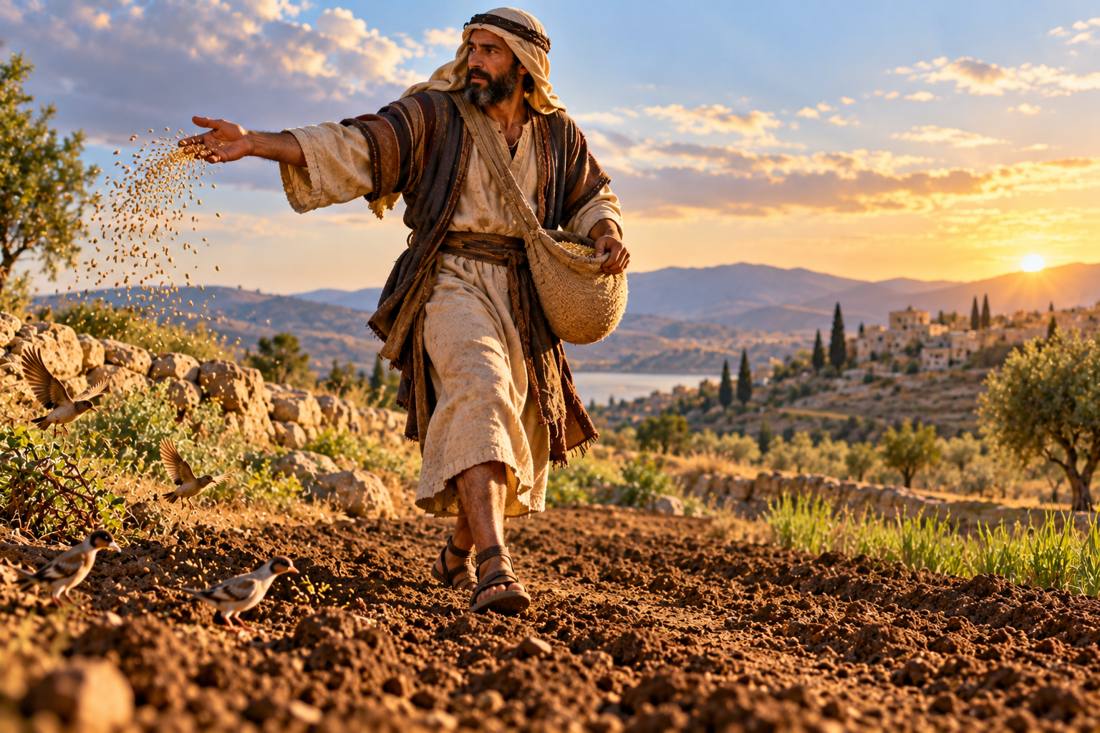
« On a décrit la parabole comme une histoire terrestre qui porte un sens céleste. » J'ai commencé par ces mots un sermon, un dimanche de baptêmes en 1981, et ils conviennent parfaitement à cette parabole. Jésus peint le tableau d'un cultivateur en Palestine. L'homme plonge la main dans le sac qu'il porte à la ceinture, prend une poignée de semence et la lance à la volée sur son champ. Certains spécialistes pensent qu'au temps de Jésus, les cultivateurs semaient souvent d'abord et labouraient ensuite pour enfouir la semence, ce qui expliquerait pourquoi la semence tombait sur tant de sortes de terrains. Jésus explique lui-même l'histoire : « Le semeur sème la parole » (Marc 4:14). Dans cette parabole, l'accent n'est mis ni sur le semeur, ni sur la semence, mais sur les terrains. Quand les gens entendent parler de Jésus, quatre choses peuvent arriver."A parable has been described as an earthly story with a heavenly meaning." I began a Baptism Sunday sermon with those words in 1981, and they fit this parable perfectly. Jesus paints a picture of a farmer in Palestine. He reaches into the bag at his waist, grabs a handful of seed, and broadcasts it across his field. Some scholars believe farmers in Jesus' day often sowed first and plowed the seed in afterward, which would explain why seed fell in so many kinds of ground. Jesus Himself explains the story: "The sower sows the word" (Mark 4:14). In this parable the emphasis is not on the sower, nor on the seed. It is on the soils. When people hear about Jesus, four things can happen.
1. Certains refusent d'écouter. En Palestine, les champs étaient divisés en longues bandes étroites. Il n'y avait pas de clôtures ; d'étroits chemins passaient donc entre les champs, et les gens y marchaient tant que ces chemins devenaient durs comme du ciment. La semence qui tombait sur le chemin ne pouvait pas pénétrer la surface, et les oiseaux la mangeaient. Certaines personnes ferment leur esprit à l'Évangile. Certaines sont indifférentes : elles ne sont pas hostiles, cela leur est simplement égal, comme certains restent indifférents à un sport qui ne les intéresse pas. Mais la vie est très courte, et l'éternité est très longue. D'autres sont endurcies : elles savent que recevoir Christ signifie partager leur vie avec lui, et elles refusent d'abaisser le pont-levis de leur cœur. Jésus dit qu'aussitôt Satan vient et enlève la parole (4:15).1. Some people refuse to hear. In Palestine the fields were divided into long, narrow strips. There were no fences, so narrow footpaths ran between them, and people walked them until they were as hard as cement. Seed that fell there could not penetrate the surface, and the birds took it. Some people close their minds to the gospel. Some are indifferent: they are not hostile, they simply could not care less, the way some people feel about a sport that does not interest them. But life is very short, and eternity is very long. Others are hardened; they know that receiving Christ means sharing their lives with Him, and they will not let down the drawbridge. Jesus says that Satan comes immediately and takes away the word (4:15).
2. Certains ont une réponse superficielle. Le sol pierreux n'était pas une terre mêlée de pierres. C'était une mince couche de terre posée sur une dalle de calcaire. La semence levait vite, mais les racines ne pouvaient pas descendre, et quand le soleil tapait fort, la jeune plante séchait. Ce sont ceux qui « la reçoivent d'abord avec joie; mais ils n'ont pas de racine en eux-mêmes, ils manquent de persistance » (4:16–17). Nous avons tous entendu parler de « conversions de tranchée », ces conversions faites sous la menace du danger. J'ai connu autrefois un jeune homme qui était alcoolique et joueur compulsif. Sa femme était sur le point de le quitter, et il a vécu une expérience religieuse. Quand je l'ai revu, il buvait toujours, jouait toujours et vivait avec une autre femme. La première difficulté qu'il a rencontrée a détruit son expérience. Peut-être avait-il essayé de remplacer la foi par l'enthousiasme. La joie a sa place dans la vie chrétienne, mais la joie est un bien pauvre substitut de la foi. Quand Paul a rencontré le Christ ressuscité sur le chemin de Damas, il n'a pas sauté de joie ; il a passé trois jours aveugle, dans la prière et le jeûne, à réfléchir à ce qui lui était arrivé (Actes 9:9).2. Some people have a shallow response. The rocky ground was not soil with stones in it. It was a thin skin of soil over a shelf of limestone. The seed sprang up quickly, but the roots could not go down, and when the sun beat down, the young plant withered. These are the ones who "immediately receive it with gladness; and they have no root in themselves, and so endure only for a time" (4:16–17). We have all heard of foxhole conversions. I once knew a young man who was an alcoholic and a compulsive gambler. His wife was about to leave him, and he had a religious experience. The next time I saw him he was still drinking, still gambling, and living with another woman. The first trouble he met destroyed his experience. Perhaps he tried to substitute enthusiasm for faith. There is a place for joy in the Christian life, but joy is a poor substitute for faith. When Paul met the risen Christ on the road to Damascus, he did not jump for joy; he spent three days in blindness, prayer, and fasting, considering what had happened to him (Acts 9:9).
Quand j'enseignais dans un séminaire, un de mes étudiants m'a raconté le soir où il était devenu chrétien. Plusieurs autres personnes avaient pris une décision en même temps, et certaines étaient si excitées qu'elles sautaient sur place. Pour lui, disait-il, c'était plutôt : « Bon, d'accord, je vais devenir chrétien. » Beaucoup de ceux qui s'étaient tant enthousiasmés se sont détournés par la suite. Mais ce jeune homme tranquille a continué de grandir, et il a fini par entrer au séminaire. L'ampleur de la première réponse ne permet pas de prévoir la profondeur de la racine.When I was teaching seminary, one of my students told me about the night he became a Christian. Several others made decisions at the same time, and some were so excited they were jumping up and down. For him, he said, it was more like, "Yeah, okay, I'll become a Christian." Many of those excited ones later fell away. But that quiet young man kept growing, and he ended up in seminary. The size of the first response does not predict the depth of the root.
3. Certains ont le cœur partagé. Le terrain plein d'épines appartenait peut-être à un cultivateur paresseux qui, au lieu d'arracher les mauvaises herbes, les avait coupées et brûlées. Le champ paraissait propre, mais les racines étaient toujours là. Quand les pluies sont venues, les épines ont poussé plus vite que le blé et l'ont étouffé. Ce sont ceux en qui « les soucis du siècle, la séduction des richesses et l'invasion des autres convoitises, étouffent la parole » (4:19). L'un dit : « J'accepterai Christ, mais je ne peux pas arrêter de boire. » Un autre dit : « J'aime ce que dit Jésus, mais je ne renoncerai pas à ma conduite immorale. » Le jeune homme riche voulait la vie éternelle, mais il aimait davantage son argent, et il s'en alla tout triste (Marc 10:17–22). Peu à peu, Dieu passe au second plan, et d'autres amours prennent toute la place.3. Some people have divided hearts. The thorny ground may have belonged to a lazy farmer who, instead of pulling up the weeds, cut them down and burned them. The field looked clean, but the roots were still there. When the rains came, the thorns grew faster than the wheat and choked it. These are the ones in whom "the cares of this world, the deceitfulness of riches, and the desires for other things entering in choke the word" (4:19). One person says, "I will accept Christ, but I cannot stop drinking." Another says, "I like what Jesus says, but I will not give up my immoral conduct." The rich young ruler wanted eternal life, but he loved his money more, and he went away sad (Mark 10:17–22). God slowly moves to the back burner, and other loves crowd Him out.
4. Certains reçoivent la parole et portent du fruit. La bonne terre est ouverte, profonde et sans partage. Elle reçoit la semence, la nourrit et rapporte « trente, soixante, et cent pour un » (4:20). Les spécialistes discutent de ce qu'était une récolte ordinaire dans cette région, mais ils s'accordent à dire que de tels rendements auraient stupéfié les auditeurs de Jésus. Les chrétiens qui donnent tout à Christ produisent souvent bien plus que leur petit nombre ne le laisserait attendre. Un jour de Noël, en Afrique de l'Ouest, une jeune convertie apporta à son missionnaire une pièce d'argent, alors que la plupart des membres de cette assemblée pauvre apportaient des légumes ou des fleurs. Le missionnaire craignit qu'elle ne l'ait obtenue malhonnêtement. Elle expliqua qu'elle s'était vendue à un planteur voisin comme servante pour toute sa vie, afin de pouvoir déposer aux pieds de son Seigneur le prix de sa vie entière. Christ ne veut pas seulement notre argent, notre présence au culte ou nos talents. Il nous veut tout entiers.4. Some people receive the word and bear fruit. Good soil is open, deep, and undivided. It receives the seed, nourishes it, and produces "some thirtyfold, some sixty, and some a hundred" (4:20). Scholars debate what an ordinary harvest was in that region, but they agree that yields like these would have astonished Jesus' hearers. Christians who give Christ everything often produce far out of proportion to their numbers. A young convert in West Africa once brought her missionary a silver coin on Christmas Day, when most of the poor congregation brought vegetables or flowers. The missionary feared she had gotten it dishonestly. She explained that she had sold herself to a neighboring planter as a lifelong servant, so that she could lay the price of her whole life at the feet of her Lord. Christ does not only want our money, our attendance, or our talents. He wants all of us.
II. L'histoire vue du côté du semeurII. The Sower's Side of the Story
L'accent de la parabole est mis sur les terrains, mais elle apporte aussi un grand encouragement à tous ceux qui sèment la parole. Le cultivateur de l'histoire n'a pas examiné chaque mètre carré de terrain avant de lancer sa semence. Il a semé généreusement, sachant qu'une partie serait perdue, parce qu'il savait qu'une partie tomberait dans la bonne terre. Nous ne maîtrisons pas le terrain. Nous sommes appelés à semer.The emphasis of the parable is on the soils, but it also carries great encouragement for everyone who sows the word. The farmer in the story did not examine each square foot of ground before he threw his seed. He sowed generously, knowing that some would be lost, because he knew some would fall on good ground. We do not control the soil. We are called to sow.
Leigh Richmond, un pasteur anglais, distribua un jour des traités à ses compagnons de voyage en diligence, alors qu'ils montaient à pied une forte côte pour soulager les chevaux. Un homme, en colère, tordit son traité et le jeta par terre. « Eh bien, celui-là, vous l'avez perdu », dit quelqu'un. « Peut-être pas, répondit Richmond. Dieu s'en occupera. » Le vent emporta le traité dans un champ où des faucheurs de foin travaillaient. Ils le défroissèrent et le lurent ensemble ; et quand l'homme en colère se retourna et vit tout un groupe d'hommes en train de lire ce qu'il avait jeté, il fut touché dans sa conscience. Plus tard, il se convertit et devint lui-même distributeur de traités. « Heureux vous qui partout semez le long des eaux » (Ésaïe 32:20).Leigh Richmond, an English pastor, once handed tracts to his fellow coach passengers as they walked up a steep hill to spare the horses. One man angrily twisted his tract and threw it on the ground. "Well, you lost that one," someone said. "Maybe not," Richmond answered. "God will take care of it." The wind carried the tract into a field where some haymakers were working. They smoothed it out and read it together, and when the angry man looked back and saw a whole band of men reading what he had thrown away, he was convicted. He was later converted and became a distributor of tracts himself. "Blessed are you who sow beside all waters" (Isaiah 32:20).
Dieu peut se servir du plus humble semeur. John R. Rice, qui prêcha ensuite pendant plus de cinquante ans et écrivit de nombreux livres, racontait une soirée où, alors qu'il était professeur d'université, il était allé aider à la mission Pacific Garden, à Chicago, aux États-Unis. Le prédicateur ce soir-là était Holland Oates, un tailleur de pierre qui n'avait pas dépassé la cinquième année primaire et qui, autrefois, buvait et jurait avec ses ouvriers, jusqu'à ce que Dieu le sauve. Oates raconta qu'un jour, après s'être écrasé l'orteil avec une pierre, il avait fermé la porte de son bureau et prié : « Seigneur, veux-tu autre chose ? Si tu me veux, je suis à toi. Si tu veux que je vende cette entreprise, j'irai prêcher. » Quand il rouvrit la porte, un homme entra et lui demanda s'il voulait vendre son entreprise de pierres de taille. Il la vendit en une demi-heure pour la moitié de sa valeur. Oates acheta une petite camionnette, y installa un carillon et un petit orgue, procura un cornet à pistons à son fils, et s'en alla aux coins des rues de Chicago. Quand une foule se rassemblait, il expliquait de son mieux comment être sauvé et distribuait de petits miroirs. Sur un côté, on lisait : « Vous voulez voir un pécheur ? Regardez de l'autre côté. » Pendant qu'Oates citait la parole d'Ésaïe, « Me voici, envoie-moi », le cœur du professeur fut remué. Lui aussi dit : « Seigneur, envoie-moi », et ce soir-là il conduisit à Christ un homme ivre. Il dit : « Seigneur, l'enseignement à l'université n'a jamais été comme ça ! » Le tailleur de pierre avait semé la semence, et Dieu donna un fruit qui dura un demi-siècle.God can use the humblest sower. John R. Rice, who later preached for more than fifty years and wrote many books, told of an evening when he was teaching college and went to help at the Pacific Garden Mission in Chicago. The preacher that night was Holland Oates, a stonemason with a fifth-grade education who had once drunk and cursed with his workers until God saved him. Oates told how, one day after smashing his toe with a stone, he shut his office door and prayed, "Lord, is there anything else You want? If You want me, You can have me. If You want me to sell this business, I'll go to preaching." When he unlocked the door, a man walked in and asked if he would sell his stoneyard. He sold it in half an hour for half its worth. Oates bought a small truck, put a set of chimes and a little organ in it, got a cornet for his son, and went out to the street corners of Chicago. When a crowd gathered, he told them as best he could how to be saved and handed out little mirrors. One side said, "Want to see a sinner? See the other side." As Oates quoted Isaiah's "Here am I; send me," the college teacher's heart was stirred. He too said, "Lord, send me," and that night he led a drunken man to Christ. He said, "Lord, college teaching never was like this!" The stonemason sowed the seed, and God gave fruit that went on for half a century.
III. La lampe et la mesure (Marc 4:21–25)III. The Lamp and the Measure (Mark 4:21–25)
Juste après avoir expliqué la parabole du semeur, Jésus ajouta deux courtes paroles. « Apporte-t-on la lampe pour la mettre sous le boisseau, ou sous le lit? N'est-ce pas pour la mettre sur le chandelier? Car il n'est rien de caché qui ne doive être découvert » (4:21–22). Le boisseau était un récipient qui servait à mesurer le grain. Dans l'Unité 1, nous avons vu que les paraboles à la fois révèlent et cachent. Ici, Jésus montre clairement que ce qui est caché ne l'est que pour un temps. La lumière du royaume n'a pas été donnée pour rester cachée. Ce qu'il disait tout bas à ses disciples serait un jour proclamé dans le monde entier, et ceux qui reçoivent la parole doivent la laisser briller.Right after explaining the sower, Jesus added two short sayings. "Is a lamp brought to be put under a basket or under a bed? Is it not to be set on a lampstand? For there is nothing hidden which will not be revealed" (4:21–22). In Unit 1 we saw that parables both reveal and conceal. Here Jesus makes clear that the concealing is temporary. The light of the kingdom was not given to be hidden. What He whispered to the disciples would one day be proclaimed to the whole world, and those who receive the word are to let it shine.
Puis il dit : « Prenez garde à ce que vous entendez. On vous mesurera avec la mesure dont vous vous serez servis, et on y ajoutera pour vous. Car on donnera à celui qui a; mais à celui qui n'a pas on ôtera même ce qu'il a » (4:24–25). Une partie des manuscrits grecs ajoute ici « à vous qui entendez » : celui qui écoute recevra donc davantage. C'est la parabole des terrains résumée en un proverbe. Écouter n'est jamais neutre. Celui qui reçoit la parole avec un cœur ouvert voit sa compréhension grandir ; celui qui la rejette voit s'échapper même le peu qu'il avait. Le chemin dur devient plus dur, et la bonne terre devient plus riche. Chaque sermon que nous entendons nous attendrit ou nous endurcit.Then He said, "Take heed what you hear. With the same measure you use, it will be measured to you; and to you who hear, more will be given. For whoever has, to him more will be given; but whoever does not have, even what he has will be taken away from him" (4:24–25). This is the parable of the soils put into a proverb. Hearing is never neutral. The one who receives the word with an open heart finds that understanding grows; the one who shuts it out finds that even what little he had slips away. The hard path grows harder, and the good soil grows richer. Every sermon we hear either softens us or hardens us.
IV. La semence qui pousse d'elle-même (Marc 4:26–29)IV. The Seed That Grows by Itself (Mark 4:26–29)
Seul Marc rapporte cette petite parabole. « Il en est du royaume de Dieu comme quand un homme jette de la semence en terre; qu'il dorme ou qu'il veille, nuit et jour, la semence germe et croît sans qu'il sache comment. La terre produit d'elle-même, d'abord l'herbe, puis l'épi, puis le grain tout formé dans l'épi; et, dès que le fruit est mûr, on y met la faucille, car la moisson est là » (4:26–29).Only Mark records this little parable. "The kingdom of God is as if a man should scatter seed on the ground, and should sleep by night and rise by day, and the seed should sprout and grow, he himself does not know how. For the earth yields crops by itself: first the blade, then the head, after that the full grain in the head. But when the grain ripens, immediately he puts in the sickle, because the harvest has come" (4:26–29).
Le cultivateur fait sa part : il jette la semence. Puis il va se coucher. Il ne peut pas faire pousser la semence en se tourmentant, et il ne comprend pas comment elle pousse. L'expression grecque traduite par « d'elle-même » nous a donné le mot automatique. La croissance vient de la vie que Dieu a mise dans la semence et dans la terre. Paul a dit la même chose au sujet du ministère : « J'ai planté, Apollos a arrosé, mais Dieu a fait croître, en sorte que ce n'est pas celui qui plante qui est quelque chose, ni celui qui arrose, mais Dieu qui fait croître » (1 Corinthiens 3:6–7). C'est Dieu qui donne la croissance.The farmer does his part: he scatters the seed. Then he goes to bed. He cannot make the seed grow by worrying over it, and he does not understand how it grows. The Greek words translated "by itself" give us our word automatic. The growth comes from the life God has put in the seed and the soil. Paul said the same thing about ministry: "I planted, Apollos watered, but God gave the increase. So then neither he who plants is anything, nor he who waters, but God who gives the increase" (1 Corinthians 3:6–7).
C'est une parole de repos pour les pasteurs inquiets. Nous ne pouvons faire entrer personne dans le royaume à force d'arguments, et nous ne pouvons pas imposer la croissance spirituelle selon notre propre calendrier. La croissance vient aussi par étapes : « d'abord l'herbe, puis l'épi, puis le grain tout formé dans l'épi ». Un nouveau croyant n'est pas encore un croyant mûr, et nous ne devons pas attendre un épi plein de grain d'une pousse sortie de terre la semaine dernière. Mais la parabole regarde aussi vers la fin : quand le grain est mûr, la faucille arrive. La croissance silencieuse et cachée du royaume avance vers une moisson. Le travail du semeur est de semer fidèlement, de dormir en paix et de confier à Dieu la croissance.This is a word of rest for anxious pastors. We cannot argue anyone into the kingdom, and we cannot force spiritual growth on our timetable. Growth also comes in stages, "first the blade, then the head, after that the full grain." A new believer is not yet a mature one, and we should not expect a full head of grain from a blade that sprouted last week. But the parable also looks to the end: when the grain is ripe, the sickle comes. The quiet, hidden growth of the kingdom is moving toward a harvest. The sower's job is to sow faithfully, sleep peacefully, and trust God with the growth.
V. Prêcher la parabole du semeurV. Preaching the Sower
La parabole des terrains se prêche bien en quatre points : certains refusent d'écouter, certains ont une réponse superficielle, certains ont le cœur partagé, et certains portent du fruit. Chaque point a besoin d'une image claire du terrain et d'une image claire de la personne. Terminez en demandant aux auditeurs quel terrain les décrit aujourd'hui, et invitez-les à recevoir la parole dans une terre bonne, profonde et sans partage. Un second sermon peut s'adresser aux semeurs de l'assemblée : semez généreusement, comme le cultivateur ; semez fidèlement, comme Holland Oates ; et reposez-vous sur la puissance de Dieu pour donner la croissance, comme l'homme qui dormait pendant que la semence poussait. Souvenez-vous de l'avertissement de Jésus lui-même, « Prenez garde à ce que vous entendez », et souvenez-vous qu'il s'applique d'abord au prédicateur.The parable of the soils preaches well with four points: some people refuse to hear, some have a shallow response, some have divided hearts, and some bear fruit. Each point needs a clear picture of the soil and a clear picture of the person. Close by asking listeners which soil describes them today, and invite them to receive the word into good, deep, undivided ground. A second sermon can speak to the sowers in the congregation: sow generously, like the farmer; sow faithfully, like Holland Oates; and rest in God's power to give the growth, like the man who slept while the seed grew. Remember Jesus' own warning, "Take heed what you hear," and remember that it applies to the preacher first.
ConclusionClosing
Jésus termina la parabole du semeur par un appel : « Que celui qui a des oreilles pour entendre entende » (Marc 4:9). La semence est bonne, et le Semeur est fidèle. La question, c'est le terrain. Laisserons-nous la parole rester en surface, lever puis sécher, ou être étouffée par d'autres amours ? Ou bien la recevrons-nous dans une terre bonne, profonde et sans partage, en donnant tout à Christ ? Il ne veut pas seulement une partie de nous. Il nous veut tout entiers.Jesus ended the parable of the sower with a call: "He who has ears to hear, let him hear!" (Mark 4:9). The seed is good, and the Sower is faithful. The question is the soil. Will we let the word stay on the surface, spring up and wither, or be choked by other loves? Or will we receive it into good, deep, undivided ground, and give Christ everything? He does not want only part of us. He wants all of us.
— Dr Wayne Cook
Séminaire Théologique de Chapala— Dr. Wayne Cook
Chapala Theological Seminary
Examen de l'Unité 7Unit 7 Exam
Parcours Certificat : les 20 questions à choix multiples. Parcours Associé en divinité : les questions à choix multiples et les 10 phrases à compléter. M.Div. et Th.M. : les questions à choix multiples, les phrases à compléter et les 10 questions à réponse courte. Il faut obtenir 90 % dans chaque partie pour réussir. Si vous échouez, vous devrez attendre un court moment avant de pouvoir repasser l'examen.Certificate track: the 20 multiple-choice questions. Associate: multiple choice and the 10 fill-in-the-blank questions. M.Div. and Th.M.: multiple choice, fill-ins and the 10 short-answer questions. 90% of each part is required to pass. If you do not pass, the exam waits a short time before you can try again.
M.Div. et Th.M. : les cinq lectures assignées font partie du cours. Leur examen distinct est obligatoire après son activation ; consultez sa page pour la règle en vigueur. La mention reste facultative et ne remplace pas l’examen.
Ouvrir les lectures du cours →