Register once, for every course
Your progress is saved in this browser as you study, and kept with the seminary under your student code, so you can continue on any device. Keep the code private, like a password. Email is optional. Add one so we can return your student code, send reminders, and deliver a certificate. You can enroll and keep studying without it. What we keep.
The Certificate track answers the multiple choice. The Associate adds the fill-in-the-blank questions; M.Div. and Th.M. add those and the short-answer questions. 90% of each part is required to pass.
Orientation
The phrase "Good Samaritan" is used around the world to describe anyone who goes out of his way to help a stranger. Hospitals are named after him, and many countries have "Good Samaritan laws" that protect people who stop to help in an emergency. The final episode of the American comedy Seinfeld in 1998 even ended with its four main characters arrested in a small Massachusetts town under a new "Good Samaritan law," because they had stood on the sidewalk joking and filming while a man was robbed, and never lifted a finger to help. I couldn't help but wonder whether the writers took the whole episode right out of Luke's story.
The parable is so familiar that it is easy to hear it as a simple lesson in being nice. But Jesus told it in a tense moment, to a man trying to trap Him and to justify himself. In Unit 1 we used this parable to show two dangers: over-allegorizing, as Augustine did, and moralizing, reducing the story to "be kind to people." In this unit we read it in its setting and let it do what Jesus meant it to do.
I. The Lawyer's Questions (Luke 10:25–29)
A lawyer, an expert in the law of Moses, "stood up and tested Him, saying, 'Teacher, what shall I do to inherit eternal life?'" (10:25). It was the most important question anyone can ask, but he asked it to make this Galilean carpenter with no degrees or credentials look foolish before the crowd. Jesus turned the question back to the expert: "What is written in the law? What is your reading of it?" The lawyer answered well, quoting Deuteronomy 6:5 and Leviticus 19:18: love God with all your heart, soul, strength, and mind, and "your neighbor as yourself." Jesus said, "You have answered rightly; do this and you will live" (10:28). The tester was now being tested.
"But he, wanting to justify himself, said to Jesus, 'And who is my neighbor?'" (10:29). In typical lawyer fashion, he tried to defend himself by narrowing the definition. Leviticus 19:18 speaks of "the children of your people," and many in that day limited "neighbor" to fellow Jews, and some to fellow Jews who kept the law as strictly as they did. If he could draw the circle small enough, he could claim to have kept the commandment. Jesus did not answer with a dictionary definition. He told a story.
II. The Robbers: "What's Yours Is Mine, and I Will Take It"
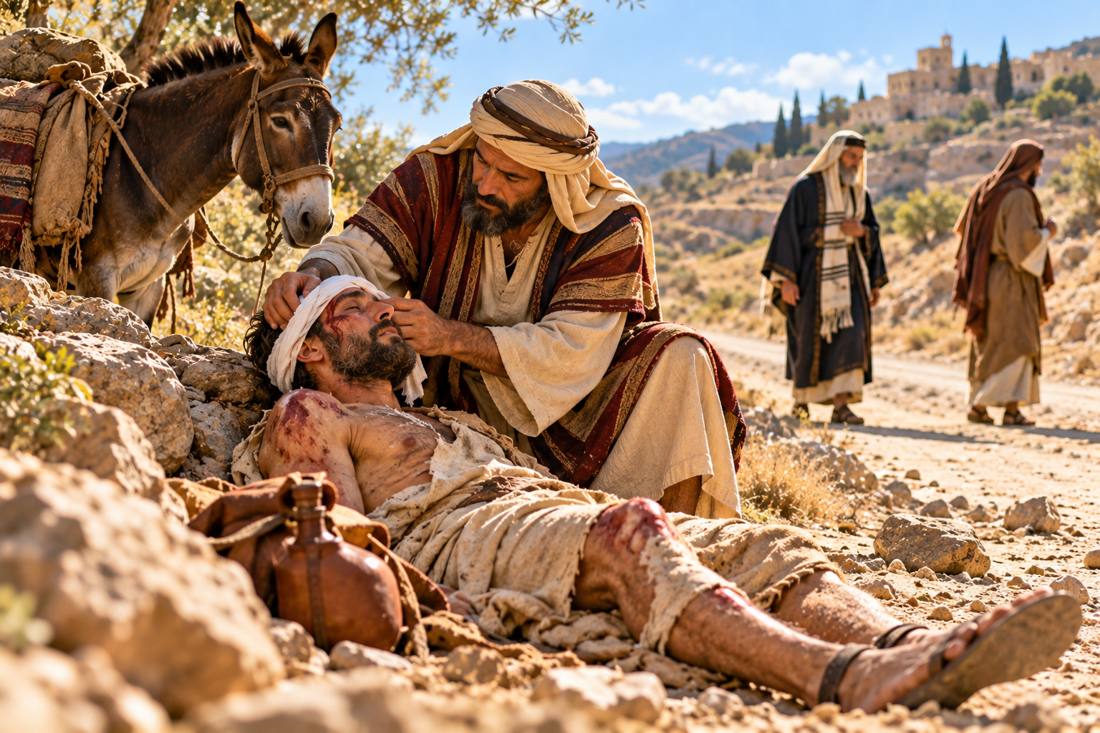
"A certain man went down from Jerusalem to Jericho, and fell among thieves, who stripped him of his clothing, wounded him, and departed, leaving him half dead" (10:30). The road from Jerusalem to Jericho runs about seventeen miles and drops some 3,300 feet through barren, rocky hills full of sharp turns and narrow passes where bandits could hide. Early Christian writers called part of it the "bloody way." The robbers took even the man's clothes and beat him almost to death.
The robbers represent a philosophy of life: "What's yours is mine, and I will take it." They saw the traveler not as a person but as an opportunity. That attitude is still with us. The eighth commandment says, "You shall not steal," and we can steal by not paying our debts, by not giving an honest day's work, and even, as Malachi 3:8 warns, by robbing God in tithes and offerings.
For years my wife Andi and I worked in prison ministry in Louisiana. An inmate named Scott later wrote about the prison where he had been living "like a king from a penitentiary perspective," smuggling phones and fighting. On Christmas of 2009 a gang member tried to steal his cell phone and stabbed him, and Scott believes guards friendly to that man tried to put him in the same cell. A few hours later, at two in the morning, Scott's name was called for a transfer that his grandfather and our ministry had already requested. He wrote that God had orchestrated it and saved his life, and that at the new prison he found peace and opportunities he would never have pursued on the streets. The robbers' philosophy nearly killed him. Grace rescued him.
III. The Religious: "What's Mine Is Mine, and I Will Keep It"
"Now by chance a certain priest came down that road. And when he saw him, he passed by on the other side. Likewise a Levite, when he arrived at the place, came and looked, and passed by on the other side" (10:31–32). There were so many priests in Israel that each one served in the temple for only two weeks a year, and many of them lived in Jericho. Jesus' hearers would have expected a man of God to rush to help. The Levite, a temple assistant, went a little further: he came and looked, and then hurried on.
They may have had their reasons. The law forbade priests to touch a dead body (Leviticus 21:1–4), and the man lay "half dead"; he might not have been moving. The Levite may have known that bandits sometimes used a "wounded" decoy to ambush travelers who stopped to help. Maybe you have passed someone broken down on the highway because you were afraid or in a hurry. But the law was just as clear about helping those in need, even an enemy: "If you meet your enemy's ox or his donkey going astray, you shall surely bring it back to him again" (Exodus 23:4). The priest was perfectly orthodox, and he left a man to die in a ditch. The religious philosophy says, "What's mine is mine, and I will keep it": my time, my safety, my purity, my schedule.
James asks, "If a brother or sister is naked and destitute of daily food, and one of you says to them, 'Depart in peace, be warmed and filled,' but you do not give them the things which are needed for the body, what does it profit?" (James 2:15–16). A Christian woman named Diane Dew wrote about the months she and her young son were homeless. At a prayer meeting she asked for prayer for a place to live, and the very next request came from a church member asking God to send a tenant for his empty apartment. When she asked to rent it, he turned her down and told her she needed to trust God more. A church refused her a box of food from its pantry because "we haven't seen you here lately," though the week before no one would give her a ride to the service. Pastors gave her verses and advice but no help. In the end, strangers who read her story in a newspaper offered housing and work. Jesus said, "Inasmuch as you did it to one of the least of these My brethren, you did it to Me" (Matthew 25:40). There is an old legend about Martin of Tours, a Roman soldier who cut his cloak in half to give to a freezing beggar at the city gate. That night he dreamed he saw Jesus in heaven wearing half a soldier's cloak. When an angel asked why, Jesus answered, "My servant Martin gave it to Me."
IV. The Redeemer: "What's Mine Is Yours, and I Will Share It"
"But a certain Samaritan, as he journeyed, came where he was. And when he saw him, he had compassion" (10:33). Up to this point everyone liked the story. After a priest and a Levite, the crowd expected the hero to be an ordinary Jewish man. Instead Jesus named the last person they wanted to hear. After Assyria conquered the northern kingdom in 722 BC, foreigners were settled in the land and intermarried with the Israelites who remained. The Jews of Jerusalem despised their descendants, the Samaritans, as half-breeds and heretics who worshiped on Mount Gerizim instead of in Jerusalem (John 4:20). The last person anyone expected to help a wounded Jew was a Samaritan.
Look at what he did. "He went to him and bandaged his wounds, pouring on oil and wine; and he set him on his own animal, brought him to an inn, and took care of him" (10:34). Oil soothed and wine cleaned the wounds. He walked so the wounded man could ride. He stayed the night. The next day he gave the innkeeper two denarii, two days' wages, and said, "Take care of him; and whatever more you spend, when I come again, I will repay you" (10:35). He handed the innkeeper a blank check for a stranger. His philosophy was, "What's mine is yours, and I will share it."
Alan Chalmers told of a famous engineer named Peter Holme who built bridges and railroads but lost everything and returned in poverty to his home village. His neighbor kept a vicious dog, and when Holme warned him, the old man cursed him. One day Holme came home to find the dog at his little daughter's throat, and she died. The whole village turned against the dog's owner; at planting time no one would sell him seed, and his plowed fields lay bare. Very early one morning, Holme took his own last half bushel of barley, climbed the fence, and sowed his neighbor's field. When the grain came up, the fields told the story: part of Holme's field lay bare, and his enemy's field was green. That is what the Samaritan did.
Compassion is still practical. In West Virginia a man named Stan Allman read in the newspaper about a forty-year-old father of three, on welfare, who was hitchhiking thirty miles each day to finish his engineering degree. Allman bagged groceries part-time, and his wife worked at a fast-food restaurant, but they had three vehicles and only two drivers. So they gave the student their old pickup truck. "Thank you, Jesus!" his wife cried when she heard.
V. The Question Turned Around (Luke 10:36–37)
Then Jesus gave the lawyer a test of his own: "Which of these three do you think was neighbor to him who fell among the thieves?" (10:36). Notice that Jesus changed the question. The lawyer had asked, "Who is my neighbor?" meaning, "Whom am I required to love?" Jesus asked, "Who proved to be a neighbor?" The real question is not "Who qualifies for my love?" but "To whom can I be a neighbor?" The lawyer could not even bring himself to say the word "Samaritan." He answered, "He who showed mercy on him." And Jesus said, "Go and do likewise" (10:37).
A pastor in Gary, Indiana, told of a woman in her Bible study who was hiding from an abusive husband who had tried to have her killed. She lived in a wretched apartment above a drug house. When someone broke down her back door one night, the police did not come, and social services had not been able to help her, but the drug dealers downstairs sat on the stairs all night to protect her. In her story the police were the priest, the social services were the Levite, and the drug dealers were the Samaritan. The parable still shocks us when we see who proves to be a neighbor, and who does not.
How can we know whether we love God? The old steam engines had great boilers, and it was impossible to see how much water was inside. So a small glass tube ran along the outside as a gauge. John gives us the gauge for our love for God: "Whoever has this world's goods, and sees his brother in need, and shuts up his heart from him, how does the love of God abide in him?" (1 John 3:17). Our love for others shows how much love for God is really inside.
VI. The Samaritan and the Savior
In Unit 1 we saw how Augustine turned every detail of this parable into a symbol: the inn became the church and the innkeeper became Paul. We should not do that. The inn is an inn. But we should not miss the larger truth either. The lawyer asked what he must do to inherit eternal life, and the parable shows that no one loves his neighbor perfectly. It exposes the lawyer's attempt to justify himself, and ours. We cannot earn eternal life by keeping this commandment; we have all passed by on the other side.
And we cannot help seeing Jesus in the Samaritan. Jesus was Himself despised and called a Samaritan by His enemies (John 8:48). We were the ones lying helpless by the road, wounded by sin, unable to pick ourselves up. Christ did not pass by on the other side. At the cost of His own life He came to where we were, bound up our wounds, and paid whatever it cost to make us whole. The tragedy is that many people today, like the lawyer, have seen Christ but have not recognized Him as their Savior. Only those who have received the Samaritan's mercy can truly "go and do likewise."
VII. Preaching the Good Samaritan
This parable preaches clearly with three philosophies of life: the robbers, "What's yours is mine, and I will take it"; the religious, "What's mine is mine, and I will keep it"; and the Redeemer, "What's mine is yours, and I will share it." Ask the congregation which philosophy rules their lives. Be sure to include the gospel: the parable shows our need of a Savior before it sends us out to serve. Close with practical application. Many of us need to relax our schedules so that we have energy to care; Jesus never seemed rushed, and the priest and Levite probably had important places to be. Mother Teresa, according to a well-known story, once answered a young man who asked how to make his life count with a card that said, "Find your own Calcutta."
Haddon Robinson told of asking his young son what he had learned in Sunday school. The boy described the Good Samaritan in detail. "Son, what is the spiritual lesson of the story?" his father asked. The boy thought and said, "That whenever I'm in trouble, you've got to help me." It is not the whole answer, but from the ditch beside the road, it is one way of looking at a neighbor.
Closing
All the world lies between Jerusalem and Jericho, and it is full of wounded people. The robbers still say, "What's yours is mine." The religious still say, "What's mine is mine." But the Redeemer came down that road and said, "What's mine is yours." A prayer traditionally attributed to Teresa of Ávila puts it this way: Christ has no body now on earth but yours, no hands but yours, no feet but yours. Having received His mercy, we hear His command: "Go and do likewise."
— Dr. Wayne Cook
Chapala Theological Seminary
Unit 12 Exam
Certificate track: the 20 multiple-choice questions. Associate: multiple choice and the 10 fill-in-the-blank questions. M.Div. and Th.M.: multiple choice, fill-ins and the 10 short-answer questions. 90% of each part is required to pass. If you do not pass, the exam waits a short time before you can try again.
M.Div. and Th.M.: all five assigned readings are part of the course. Their separate exam is required after activation; see its page for the current rule. Honors remains optional and does not replace the exam.
Open Course Readings →